Traditional home design with connected rooms, layered rugs, and warm natural materials.

Traditional Home Design: Five Foundational Elements That Last

The highest compliments I have gotten as an interior designer were when my grown kids asked me for advice when decorating their own homes. Even when they were very small, I took them with me to go sourcing antiques for our home and my retail spaces.

Over the years they absorbed the importance of quality construction and materials. They know that if you buy a quality piece of furniture or decor, that you may not ever have to replace it in your lifetime.

People often confuse traditional home design with being old-fashioned. On the contrary, timeless home design is created by using classic elements that never go out of style.

The homes that stay relatable throughout the decades often have less to do with trends and more to do with the decisions that shape them over time.

What Defines Traditional Home Design

Labels are used frequently when talking about interior design. Contemporary, minimalist, and traditional are all terms you’ve likely seen online and in magazines. So, what exactly is traditional home design?

The word traditional is used to describe decor that often has a European influence. Traditional home decor often emphasizes symmetry.

Other elements that are trademarks of traditional interior design are layering of fabrics and patterns, curved and ornate wood carvings, and pieces that have been collected over time.

Spaces with traditional home design are a reflection of who lives there. At the heart of traditional home design is an understanding that rooms should feel visually balanced before they are ever fully decorated.

Proportion and Scale in Traditional Interior Design

If you’ve ever walked into a room and felt something about the decor was amiss, but you couldn’t put your finger on what it was, it was probably because something was off with the proportions or scale in the room.

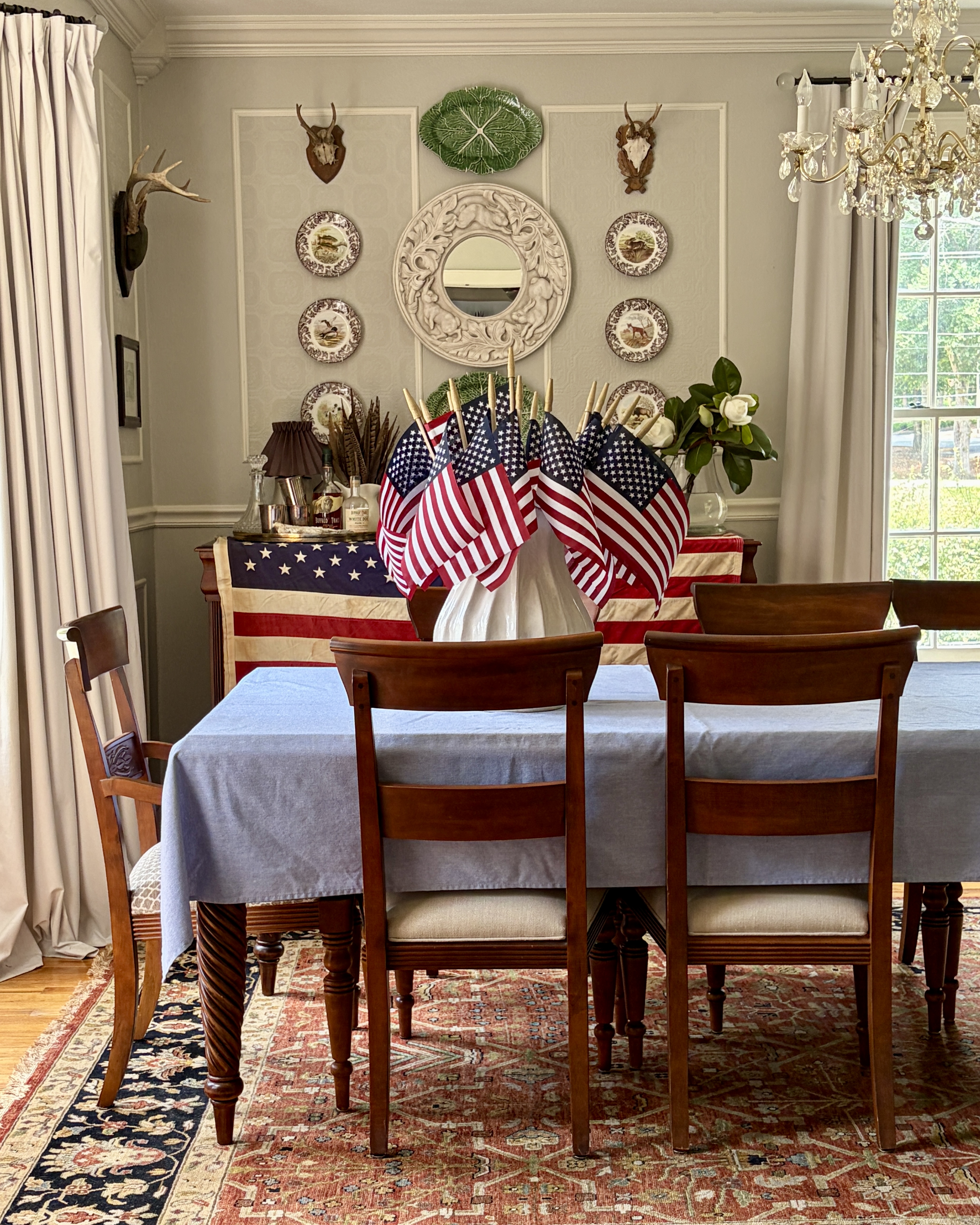
Traditional dining room with carved wood table, patterned rug, and collected wall decor.
Traditional interiors often rely on proportion, natural materials, and collected details that feel layered over time rather than purchased all at once.

After moving into a new house, a friend told me, “I love this sofa so much, but no matter where I put it in the new living room, it just doesn’t look right.”

The problem wasn’t finding the right space for it, and there was nothing wrong with the sofa itself. The issue was that the sofa was purchased to fit in her last house, and it was entirely too big for her new space.

In traditional decor, designers often use the 2/3 rule of scale and proportion. This rule gives a pleasing sense to the eye as you take in the space as a whole. Large rooms can handle larger pieces of furniture, and in turn, smaller spaces need furniture on a smaller scale.

When scale is handled well, a room feels comfortable almost immediately, even if the viewer can’t explain exactly why.

Materials that Shape Timeless Home Design

The most successful traditional designs use materials that could have either been installed yesterday or one hundred years ago, and it’s difficult to know which it is.

Many of the materials associated with traditional homes share two qualities. First, they’re made of something found in nature, like wood, stone, linen, or leather. Second, they’re crafted from something man-made that can stand the test of time, like brass, copper, bronze, or nickel.

Choosing materials that are often found in traditional home decor will result in a timeless home design. As a bonus, these are often superior materials that not only withstand trends, but also physical wear and tear.

Over time, these materials also help create continuity throughout a home, allowing rooms to feel connected rather than separate from one another.

Creating Continuity in Traditional Home Decor

I remember watching the television show Trading Spaces, where neighbors would swap houses to redecorate one room with the help of a designer. As seasons went on, the designs became wild and unrealistic for everyday living.

The room reveals on the show often featured an outlandish space that the designer used to showcase their own creativity, instead of the tastes of the homeowner. As a result, these new rooms never blended with the rest of the house.

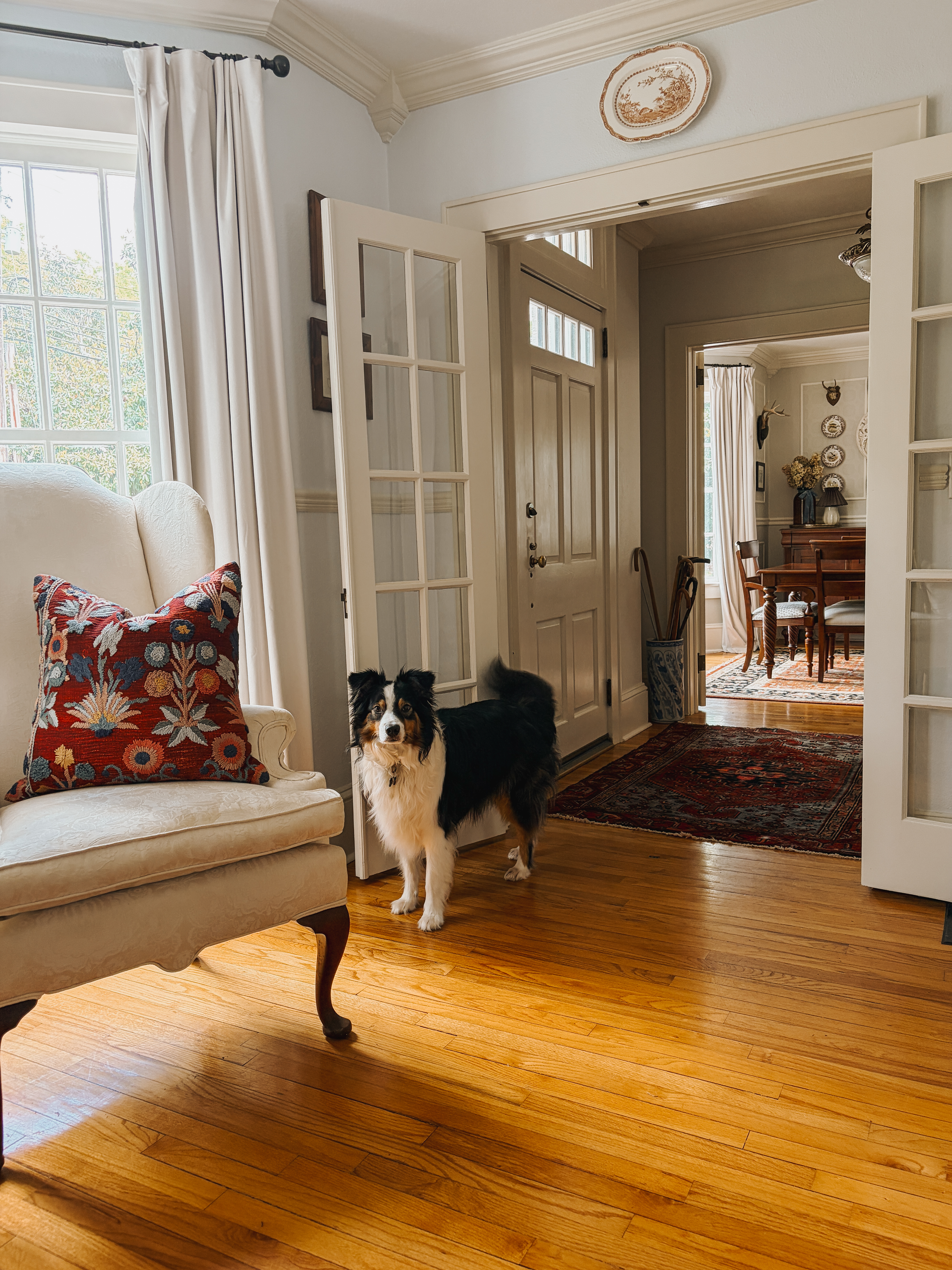
Traditional home design showing continuity between adjoining rooms with layered artwork and warm wood tones.
One of the defining characteristics of traditional homes is the sense of continuity between rooms rather than dramatic shifts in style or color.

In traditional homes, rooms are rarely treated as isolated spaces. Whole house color palettes create a smooth flow without disruptive color changes.

Using uninterrupted flooring finishes and repeating decor elements throughout homes also  creates continuity in traditional home decor. Traditional homes are often memorable not because of a single room, but because the entire house feels connected in both design and purpose.

Functional Layouts in Traditional Homes

In traditional interior design, floorplans have dedicated spaces for each living function. Rooms are designed to fulfill a purpose in the home, and the purposes of adjoining spaces are considered for how they relate to each other.

A kitchen will be designed for optimal workflow, but the kitchen design will also consider the placement and decor of the dining room, since the two often function in tandem.

In a classic home design, a living room layout will function to encourage conversation, and a bedroom layout will be designed to be peaceful and relaxing.

While decorating styles may shift over time, the ways people gather, cook, rest, and converse remain remarkably consistent.

A Collected Sense of Time in Traditional Homes

I love watching renovation shows on TV that surprise the homeowners with a brand new, completely styled room that they always fall in love with at the end. But the truth is that’s not always reality.

Traditional bedroom with antique wood bedside table, patterned textiles, layered artwork, and soft lamp lighting.
Traditional homes often feel collected rather than perfectly coordinated, with furnishings, artwork, and personal objects accumulated gradually over time.

Some people hire an interior designer to redo an entire room in their home. But there are far more people who call designers for help with one thing: draperies for a bedroom, a new sofa and loveseat with custom fabric, or flooring.

As you are making changes to your home, you’re also picking up a piece of art here and there, a basket to hold throw blankets in the living room, or a secretary desk to organize books and stationery in the corner of a study.

Classic home elements aren’t just beautiful; they tell a story that’s been written over time. Perhaps this is why traditional homes rarely feel finished all at once; they are shaped gradually through years of living.

Vintage books and blue-and-white ceramics styled on built-in shelving in a traditional home.
Collected interiors rarely feel overly matched; instead, they reflect years of retained books, furnishings, and meaningful objects.

How to Apply Traditional Home Design in a Real Home

Traditional homes tend to resist short-lived trends in favor of choices that remain appealing over time. In recent years there was an explosion of popularity in barn doors and vinyl plank flooring. These were new and exciting ways to decorate a home, but they weren’t enduring. Classic home decor is beautiful in any era, regardless of what is trending on the internet.

Traditional homes rarely feel assembled all at once, which is one reason perfectly matched furniture suites can feel overly uniform. Unmatched pieces can beautifully complement each other for a more collected look.

The most important thing to remember when creating a home with classic pieces is to go slowly. It’s okay if rooms are incomplete while you search for the right pieces to tell your home’s story.

Why Traditional Home Design Endures

As trends move faster online, interiors have also become more vulnerable to cycles of rapid consumption and replacement.

With instant access and saturation of influence on the internet, home furnishings and décor have become disposable. Composite materials and cheap construction mean that many things purchased today won’t be around in ten years.

Timeless home design endures because of quality craftsmanship and materials that last a lifetime. Traditional interior design considers functionality and cycles of everyday living, not what savvy influencers tell you is trending. Homes built slowly and thoughtfully often remain relevant far longer than those shaped by rapid cycles of consumption.


Check out these other reader favorites:

Traditional home design with connected rooms, layered rugs, and warm natural materials.
Traditional homes are often memorable not because of a single room, but because the entire house feels connected in both design and daily living.

Living room end table styled with a painted tole tray, stacked books, and a large vintage silver trophy bowl

Decorating with Silver: Bringing Vintage Pieces Back Into Everyday Living

A shift toward more casual living gradually reshaped the American home; walls came down, dining rooms disappeared, and somewhere along the way, we stopped decorating with silver.

Silver has been considered elegant and formal. We often think of it as being reserved for special occasions, but in older homes, silver was simply used.

I don’t think silver ever stopped belonging in our homes; we simply forgot how to live with it. It’s time to reconsider how silver lives in our everyday lives.

Decorating with Silver in the Everyday Home

With the shift towards a more casual culture, silver pieces were discarded as people asked themselves, “When would I ever use this?” I think a better question is, “How are you going to use it?” The solution for how to decorate with silver is to find an everyday use.

Living room end table styled with a painted tole tray, stacked books, and a large vintage silver trophy bowl
Layering a silver trophy bowl over books and a painted tray creates depth, blending traditional elements with a relaxed living space.

Silver shouldn’t be kept at a distance up on a shelf or behind china cabinet doors. It should be touched, appreciated, and used as interactive pieces in your daily life.

When we stop looking at silver pieces as objects to be perfectly preserved, and we embrace their natural patina, the possibilities become endless for using silver in home décor.

The Working Kitchen: Where Silver Feels Most Natural

Decorating with silver starts in the kitchen. You’re probably not having guests over for a formal tea service, but you can still use those pieces in new ways to fit your lifestyle.

Decorating with silver in a coffee station using a vintage silver tray, white china cups, and a wooden plate rack display
A silver tray brings structure to an everyday coffee station, layered with white china for a collected, timeless look.

Sugar bowls can be repurposed to hold loose tea or kitchen twine. A petite creamer makes the perfect vase for small flowers picked in the garden.

Silver bowls that were once reserved for main dishes function perfectly for holding fruit, herbs, or other frequently used kitchen items.

Silver should be embraced in everyday spaces. It’s not a thing of the past.

Beyond the Dining Table: Unexpected Ways to Use Silver

The dining room was where we would’ve found the most abundant displays of silver. Today, those same pieces are used in new, creative ways when we incorporate vintage silver décor in our homes.

Decorating with silver using a vintage trophy tray styled with a Christmas cactus in a blue and white ceramic pot
A silver trophy tray grounds a simple plant display, elevating everyday greenery with contrast and character.

Trays that once held entrees become layering pieces on counters or islands. They’re designated places to organize everyday items like your coffee accoutrements or spice jars.

Silver doesn’t need its original purpose to be useful. A footed bowl becomes a beautiful vessel for holding fruit or a seasonal collection, like ornaments.

On the other hand, we can reinvent a silver piece that was never meant for the dining room, such as a trophy, and fill it with beautiful flowers for a centerpiece.

Antique silver teapot repurposed as a pencil holder on a secretary desk with a brass lamp and blue willow details
A small silver teapot takes on new life as a pencil holder, proving that even the most traditional pieces can be used in everyday ways.

Decorating with Silver in Living Spaces

Decorating with silver in living spaces is successful when it is blended with other objects, rather than being used as a featured object.

Vintage silver tray styled with a crystal decanter, cocktail shaker, lowball glasses, and a silver sugar bowl with pheasant feathers
A vintage silver tray anchors a layered bar arrangement, blending glass, metal, and natural elements for a relaxed but intentional display.

A coffee table is undoubtedly beautiful when layered with a silver tray topped with candles, books, and matches. Your side table is perfect for a silver bowl that acts as a catch-all for everyday items.

Silver is easily incorporated into home décor by mixing materials. The formality of the metal is toned down by mixing it with other materials like wood, linen, glass, or even paper objects like books.

Decorating with silver using a small vintage bowl placed on books on a white nightstand in soft evening light
A simple silver bowl layered over books adds a quiet, reflective detail to a softly lit bedside space.

Mixing Old and New: How Vintage Silver Works in Modern Homes

A more modern and relaxed aesthetic is achieved by avoiding the tendency to match each piece with another. Silver pieces can be mismatched or stand on their own.

Vintage silver mint julep cup used as a vase for red roses on an antique desk styled as a nightstand
A vintage mint julep cup becomes an unexpected vase, adding a refined touch to a personal, collected bedside vignette.

Vintage silver décor is modernized by intentionally pairing it with modern pieces. Silver candle holders with black taper candles or a silver tray topped with a modern piece of art are examples of how to blend different styles when decorating with silver.  

Find Pieces to Use, Not Just Display

You will find silver pieces in antique stores, thrift stores, and estate sales. Silver pieces, which were unremarkably lurking in the background, will now jump out at you, ready to be found.

Check your silver pieces for damage before purchasing them. If silver plated pieces are polished too harshly, there will be places where the silver has been removed. Check for wobbly candleholders or broken feet. Damages like that are difficult to repair.

Vintage silver pedestal bowl displayed for sale in an antique store, suitable for decorating with silver in the home
A silver pedestal bowl spotted in an antique store; pieces like this are often waiting to be brought back into everyday use.

Once you find pieces to love, let your imagination flow on how to use them in your home.

A collected home comes together when we buy with intention. Choose pieces you’ll use in your home and avoid buying for the sake of buying.

A More Collected Way of Decorating with Silver

At some point, we forgot that beautiful objects weren’t just for guests; they are for us to enjoy in our homes as well. Vintage silver is meant for everyday use.

So, here’s your permission slip: Start with one silver piece that you love and incorporate it into your daily life. You deserve to have a bit of elegance in your own home.


There’s more to explore, try these articles next:

Patterns & Patina: How to Layer Like a Southerner

How to Style Vintage Blue and White China for Summer Entertaining

cherry blossom tree in bloom against blue sky for spring floral arrangements inspiration

Spring Branches in Bloom: Easy Spring Floral Arrangements from the Garden

Bringing Spring Indoors with Simple Branch Arrangements

When spring arrives, you’re likely to find something unusual in my car. Open the glove box, and you’ll find a pair of bypass pruners tucked between a stack of old church bulletins and a handful of well-used lip glosses.

Don’t mistake these garden tools for personal protection, but as a sign of the season. Across the South, branches are just beginning to bud, and it becomes second nature to keep pruners close at hand.

In this region, flowering trees and woody perennials offer some of the most beautiful materials for spring floral arrangements. When branches are cut just before they bloom and brought indoors, they make a big impact that can rarely be replicated with store-bought flowers.

A row of bright yellow forsythias in the yard may draw attention outdoors, but a few thoughtfully clipped branches can create an even more remarkable display inside your home.

This article may contain affiliate links. If you choose to shop through them, I may earn a small commission at no additional cost to you.

Why Branches Make the Most Beautiful Spring Floral Arrangements

We love a decorative moment created by a dainty vase filled with early spring daffodils, but have you met her flamboyant older sister, the blooming branches? Budding branches cut from the yard to bloom inside make a dramatic statement to take center stage in your spring décor.

Blooming branches are perfect for spring floral arrangements for a variety of reasons. These stems can be displayed on their own as a complete flower arrangement, or used to create structure when paired with additional flowers and greenery.

When cut and cared for properly, branch arrangements can last for weeks in your home. These blooms are longer lasting than many of the cut flowers found in other spring flower arrangements.

We think the top reason to love blooming branches in an arrangement is that they’re cost effective. You can often cut them from your own yard or a friend’s for free.

With just a few branches, you can create an arrangement that feels both effortless and intentional.

The Best Flowering Branches for Spring Arrangements

If you’re deciding which plants will provide you with beautiful flowers, keep an eye out for these showy bloomers in your yard or local nursery.

close up of cherry blossom branches in a spring floral arrangement indoors
A close look at delicate cherry blossoms, one of the easiest branches to bring indoors for spring arrangements.

Eastern Redbud Tree

The Eastern Redbud tree can be found in many areas of the United States. It’s extremely successful in the southeastern region, and it’s one of the first signs of spring in the South.

The Eastern Redbud has showy flowers in various shades of magenta pink. It’s a striking choice when you want an arrangement that feels both seasonal and distinctive.

Forsythia

Forsythia is a woody shrub often seen used in borders, roadways, and city parks. The bright yellow flowers are unmistakable.

Forsythia is one of the earliest bloomers, sometimes called “Easter tree.” If you want to force Forsythia buds to bloom indoors, you’ll need to start looking for buds very early in the season.

Japanese Cherry Tree

Cherry blossoms are synonymous with spring throughout the world. The blooms can vary from pale to saturated pink.

Japanese cherry trees bloom sometime between March and April. In our experience, these are especially long lasting when forced indoors.

Dogwood Tree

These native trees are often found at the edges of wooded areas. You may not even know you have one in your yard until it blooms in spring.

Dogwood blooms can be seen in varying shades from creamy white to bright pink. The stems tend to be more delicate than others on this list, giving arrangements a softer, more relaxed shape.

Magnolia

Magnolia is often associated with summer blooms in the South. However, there are many spring blooming cultivars.

Look for varieties such as ‘Jane,’ ‘Ann,’ and ‘Butterflies’ if you’re selecting a spring-blooming tree for your garden.

A Note from the Garden

Another favorite bloomer that works well to force indoors is Spirea. These delicate and airy blooms are a wonderful addition to your spring floral arrangements.

One to avoid: We advise against using Bradford Pear. While beautiful, the blooms create an offensive fish-like odor. This invasive tree is structurally weak and not one to include in your garden.

How to Force Flowering Branches in Early Spring Arrangements

Once you’ve identified a spring blooming tree or shrub in your yard, there are just a few simple steps before you can enjoy them indoors.

spring branch arrangement in glass vase by window with natural light
A simple vase of flowering branches brings natural light and softness into the room.

Choose branches before they bloom.

Depending on when your buds bloom naturally outdoors, start looking at your branches in late winter to early spring. Once you see buds are fully formed, it’s time to cut your branches.

Cut with intention.

There are a few things to consider when deciding which branches to cut. Look for small, healthy branches with an abundance of buds on them. Avoid cutting branches larger than appropriate for your vessel. Take cuttings from several areas of the plant so that you don’t cause damage or create a noticeable hole.

Using sharp pruners, create a clean, angled cut on your stem. Doing so will prevent damage to the host plant and give your buds a healthy start in the vase.

Bring them into warm water.

To encourage your buds to bloom, place them into slightly warm or room temperature water. Avoid giving them water that is too hot or cold. Give your branches fresh water every few days.

Encourage the branches to open.

A variety of methods can be used to encourage your branches to open. One method is to use your pruners to create a vertical split at the end of each stem. Another method is to use a floral hammer to lightly crush the end of each stem.

This step is optional, but it can help encourage the buds to open more quickly.

Give them time in the right place.

After you’ve cut your stems and placed them in water, find a nice spot away from direct light and heat. It may take anywhere from a couple of days to a couple of weeks, but with proper care and conditions, your buds will bloom indoors.

Once the branches begin to open, the arrangement itself becomes simple.

How to Create Easy Spring Flower Arrangements with Branches

Now that you’ve collected your spring blooming branches, there are a few simple steps to follow for a beautiful floral arrangement.

how to arrange spring branches indoors in a vase by a window with natural light
How to arrange spring branches indoors for a simple, natural arrangement using just a few cut branches and a vase.

What You’ll Need

Step-by-Step Arrangement

Choose a vessel that supports the branches.

Your branches will be taller and heavier than flowers typically used in spring flower arrangements. Be sure to select a vase that will be able to support their height and weight without tipping over.

Trim branches to scale.

Compare the size of your vase to the length of your branches. You’ll want to make sure that buds are above and branching from the top of the vase.

Make a clean cut to shorten your branches to the ideal size for your particular vessel.

Clear the lower stems.

Using sharp pruners, trim away any lower stems, leaves, and buds that will be below the water line. Remove any bulky lower stems that will crowd the vase.

Start with your strongest branches.

Beginning with your biggest branches first, begin to place your strongest stems into the vase. Use several of these to create a structure that will support the smaller stems.

Layer naturally and step back.

After creating structure with your larger branches, begin filling in the arrangement with smaller stems.

Be sure to occasionally turn your vase to add stems at all angles. Step back regularly to look for any areas that need additional branches.

Styling Notes for a Natural Look

Due to the nature of spring blooming branches, your floral arrangement will likely have an organic, asymmetrical form. Look at your arrangement from a distance and determine if the shape is nicely arranged while keeping with the characteristics of the stems.

These types of spring floral arrangements should feel gathered, not arranged. Let the branches be the statement in your design.

styling spring branch arrangement at home with flowering branches in a white vase
Styling a simple spring branch arrangement at home using flowering branches and garden greenery.

Where to Style Spring Floral Arrangements in Your Home

Once your arrangement is complete, placement becomes just as important as the arrangement itself.

I enjoy placing a vase of cherry blossom branches on my kitchen counter. Since I’m in this room several times a day, I’m able to see the natural progression of the buds turning into beautiful flowers.

This year I created a spring flower arrangement for my Easter table. I purchased this extra-large vase recently, and it was the perfect vessel for an arrangement I created with some eastern redbud branches from my backyard.

We also enjoy bringing in some Japanese cherry buds to bloom on our fireplace mantel each year at the start of spring. They would even look beautiful on an entry table to impress your guests as they come in the door.

spring centerpiece with flowering branches and white hydrangeas on dining table
A layered spring centerpiece using flowering branches and seasonal blooms for a full table arrangement.

A Simple Way to Welcome Spring into Your Home

If you can look out your window and see branches beginning to bloom, you already have everything you need.

With a simple pair of pruners and a bit of patience, you can bring that same beauty indoors and enjoy it for weeks to come.

Flower arrangements don’t have to be expensive or difficult to be beautiful. A few carefully chosen branches can transform a room, bringing in a sense of the season that feels both natural and lasting.


If you enjoyed this article on how to create an early spring floral arrangement from your garden, you’re invited to stay awhile and read some of the other spring articles from Belle Antiquarian. Here are a few others we suggest:

A Beautiful Easter Table: How to Set a Class Spring Easter Table

The Southern Easter Menu: Classic Southern Easter Recipes for a Traditional Holiday Meal

How to Create a Thanksgiving Floral Arrangement

Fall Garden Prep: Essential Tasks for a Beautiful Start to Spring

Classic spring easter table setting with layered vintage and new tableware, pink linens, crystal glassware, and floral centerpiece

A Beautiful Easter Table: How to Set a Classic Spring Easter Table

An Easter Table Set with Intention

In the South, there isn’t a great thaw of ice and snow at the end of winter. Our spring thaw is more of a metaphysical one. We are starved for the changing angles of the sun after months of darkness searching for signs of spring: velvety buds, chartreuse sprouts, and fervent birdsong. Winter may keep us indoors, cocooned in thick blankets, but when spring arrives, we are liberated from the imprisonment of cold and darkness.

As a culture, Southerners aren’t solitary people. Warmer temperatures and longer days in spring give us opportunities to show hospitality and connect with others. Naturally, when Easter arrives, it’s an occasion to reunite with our friends and family around the Easter table to share a meal.

Easter is the perfect time to set the table with a mixture of new and collected pieces. Your Easter table setting can be planned beautifully by layering thrifted, collected, and new elements. Here’s how to build a layered, classic Easter table using a mix of things you already own, and perhaps a few new additions.

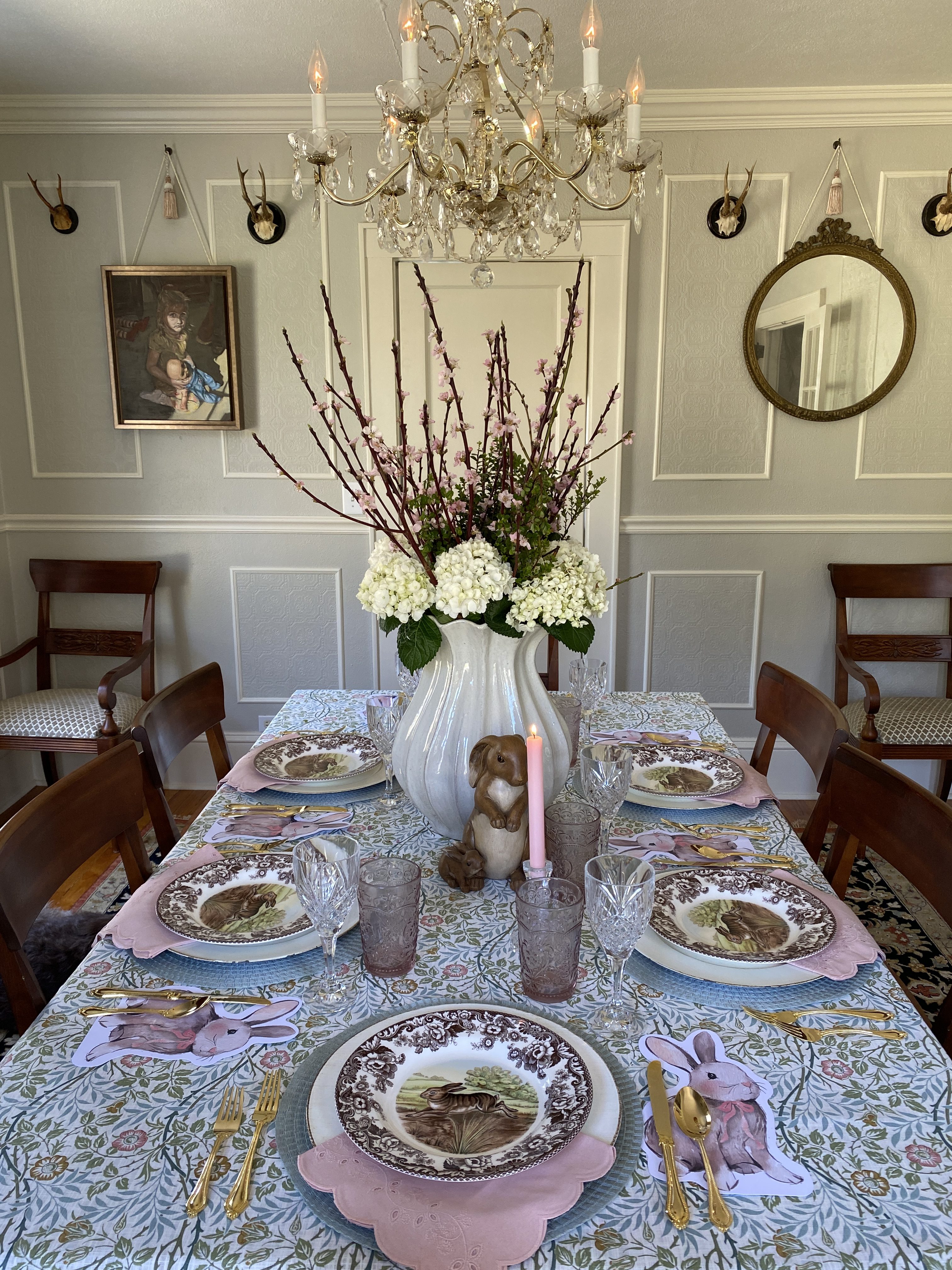
Easter table setting with vintage rabbit dinnerware, pink napkins, gold flatware, and spring floral centerpiece
A classic Easter table layered with vintage rabbit dinnerware, soft spring linens, and a gathered floral centerpiece.

This article may contain affiliate links. If you choose to make a purchase through one of these links, I may earn a small commission at no additional cost to you.

Start with a Foundation You Love

Spring gives us our greatest inspiration with soft pastel colors, new life, and warmer temperatures. The first step in creating a beautiful design is to consider your foundation, the tablecloth. The tablecloth sets the color palette and anchors the rest of the table.

When choosing a tablecloth for Easter, consider one that is neutral or one that brings in soft, seasonal colors. Choose a tablecloth that can be used for multiple occasions, not just one day.

The Easter table setting in this article uses a classic William Morris design, Sweet Briar. This pattern brings in soft pinks and greens on a cream background with occasional brown accents. These colors, reminiscent of spring, will be incorporated throughout the rest of the table setting.

Layering Pieces for a Collected, Timeless Look

After selecting a tablecloth, consider ways to create a layered look on the Easter table. Layering pieces over the tablecloth creates visual interest and depth to the design.

Layered easter table place setting with woven placemat, charger, rabbit dinner plate, pink napkin, and gold flatware
Layering a placemat, charger, and patterned plate creates depth and gives an Easter table setting a collected feel.

Layers can be achieved in many ways. Take inspiration from the colors and textures in the tablecloth and begin to build each place setting with intention.

I’ve selected a woven placemat, which adds texture and pulls in color found in the tablecloth. On top of each placemat, I layered an off-white charger. The off-white color creates a soft contrast to highlight the next layer. Finally, on top of the charger sits the focal point plate. These Spode Woodland Rabbit dinner plates are a classic design. The colors from the plate pick up colors from the previous layers, especially our tablecloth. Creamy white, pink, soft green, and chocolate brown; the color palette is cohesive from our base to the top plate.

Consider using elements for each layer of the place setting that have varying textures and tones. Doing so will create a visually interesting space at the table that makes each guest feel special sitting in front of it.

How to Mix Vintage and New Without It Feeling Disjointed

Often a collected table setting feels much more interesting than one where everything has been purchased all at once. Using pieces collected over time feels polished and approachable.

When shopping, keep in mind colors and materials that work well throughout the year. For this Easter table setting, gold flatware was purchased in an online auction years ago. The gold brings in a warm tone on the table that reflects the temperatures of spring, but it can also be used at Thanksgiving and Christmas.

The off-white chargers were recently found at a thrift store for one dollar each. These were fabulous finds because they can be used in endless scenarios throughout the year.

The woven placemats were purchased many years ago on clearance, and it’s wonderful that they pick up the same color found in the tablecloth, which was purchased new this year.

The soft pink napkins were new this year and selected specifically to bring the pink from the flowers on the tablecloth to another layer of the place setting.

Each of these pieces, new, found and old, tie to each other to create a cohesive design.

Choosing Glassware That Feels Special But Practical

Don’t be afraid to integrate everyday pieces into your Easter table setting. Pink drinking glasses repeat the pink found in the tablecloth and dinner napkins. If your everyday pieces complement your tablescape, by all means, use them.

Glassware is another opportunity to layer pieces that you have found, collected, or purchased new. Clear Godinger crystal wine glasses pair with pink drinking glasses to create a subtle seasonal layer.

Easter table setting with crystal wine glasses, pink water glasses, and a lit taper candle centerpiece
Mixing crystal and colored glassware adds warmth and interest to a classic Easter table.

When mixing glass styles on the table, be sure the styles work well with each other and the other elements being used so that the tone is cohesive. Often glassware styles can be bridged with other pieces. Clear glass candlesticks with pink taper candles unite the pink and clear drinkware on the table.

Adding Simple Easter Touches Without Overdoing It

Nearly everything in this tablescape design is versatile. The tablecloth, napkins, and items in the plate stack could be used anytime in spring or even for Mother’s Day. Adding a few restrained touches to the table can show that it’s Easter without overwhelming the design.

Easter table setting detail with rabbit place card, gold flatware, pink napkin, and vintage-style dinner plate
Simple seasonal details, like a rabbit place setting, add charm without overwhelming the table.

In this case, simple die-cut paper rabbit decorations are placed under each knife and spoon. These simple touches can be discarded after the meal. Understated elements effortlessly communicate the occasion without cluttering the design.

Let the Flowers Be Effortless

Flowers for the Easter table don’t need to be elaborate. Often, something from the yard in a simple vase is enough. For this table, branches from an Eastern Red Bud tree were cut to bloom indoors. The pink flowers reflect the shades of pink used throughout the tablescape.

Spring easter table centerpiece with white hydrangeas, flowering branches, and pink taper candle
A simple spring centerpiece with seasonal branches and soft blooms brings height and movement to the table.

I share more about spring arrangements and using branches in this article.

A Simple Formula for Your Own Easter Table

If you’re not sure where to begin, or you’re overwhelmed with planning a special Easter table setting, here are a few simple steps that you can use to recreate this look in your own home.

  1. Start with a soft base – Select a tablecloth or runner that gives you a strong foundation and inspiration to layer other elements on top.
  2. Layer texture – At each place setting, use pieces like placemats, chargers, and different sizes of plates to create a beautiful scene in front of every guest.
  3. Mix one vintage element – A collected piece that tells a story brings character and depth to your Easter table. Try using a vintage deviled egg plate, candlesticks, or silver tray to bring some character to the table.
  4. Repeat a color – This Easter table setting uses pink, green, cream, and brown in various ways. Let the colors in your tablecloth or feature plate guide the color palette that repeats on your table.
  5. Add one seasonal detail – Keep your Easter table setting enjoyable and classic. Too much holiday décor can visually clutter the table. Choose one seasonal detail to take the focus.
  6. Finish with simple flowers – Flowers are synonymous with spring. Whether you purchase a simple bouquet from the grocery store, or you cut a bunch of daffodils from the yard, simple flowers are the perfect touch for your Easter table.

A Table Meant to Be Lived In

While it is satisfying to see a well-laid Easter table, the goal is to gather with friends and family around the table for a meal. The Easter table is more than a lovely work of art to fill a dining room. It’s meant to be used and lived in. Each person seated at the table should be considered more precious than the items used to decorate it.

When you’re planning your Easter table setting, consider how each guest will feel seated at your table. It’s important to make sure everyone feels comfortable and relaxed enough to want to come back.

If you’re looking for help with your Easter menu while you’re planning your tablescape, check out this article on the Southern Easter menu.

In Closing

The thing about a collected design style is that it takes time. Your table doesn’t need to be perfect to invite others in. While a beautifully set table is a nice thing to have, those gathered around it will remember the food, laughter, and love most of all.

Don’t wait until you have the perfect pieces to create a place for laughter to linger.

Happy Easter!

Simple Valentine’s Day decor in a kitchen using red transferware, fresh flowers, and small seasonal accents.

Simple Valentine’s Day Decor: 4 Ways to Decorate Without Clutter

Just as the Christmas décor is boxed up and put away until next year, I start to see photos and videos reminding me that Valentine’s Day is just around the corner. I’ve been enjoying the clean counters and empty corners after months of seeing all my beloved Christmas treasures in every room. If you’re like me, and you’re ready for a break from visual overload, you will find these tips for simple Valentine’s Day décor helpful.

Today I’m sharing four ways that you can affordably decorate for Valentine’s Day without cluttering your space or overwhelming your senses.

This article may include affiliate links, which help support Belle Antiquarian at no additional cost to you.

Simple Valentine’s Day decor in a kitchen using red transferware, fresh flowers, and small seasonal accents.
A collected kitchen makes seasonal decorating feel effortless and unfussy.

Color

The easiest way to decorate for Valentine’s Day without spending a lot of money on décor is to introduce everyday items in typical Valentine’s colors. I like to “shop” my house for anything red, pink, or white.

Simple Valentine’s Day decor on a mantel using framed family photos, red books, and a vintage Valentine garland.
Gathered red books paired with a wedding photo create a simple Valentine’s Day scene.

Once you’ve gathered items you already own in Valentine’s colors, you can create little vignettes throughout your home that subtly nod to Valentine’s Day without being over the top or spending a lot of money. Here are a few examples of creating simple Valentine’s Day décor by shopping your house for color:

  • A stack of red books with a pink candle
  • A pink photo frame next to your child’s red baby shoes
  • A stack of red and white transferware plates tied with pink velvet or lace ribbon

Using items you already own and love in Valentine’s Day colors is an easy way to decorate without a big shopping trip for junk you’ll only use once.

Pattern

Often patterns in table linens, decorative pillows, and bed linens can be used for multiple seasons and holidays. If you are shopping for Valentine’s Day décor items, and you want to be able to use them in various ways, here are a few patterns worth looking for:

  • Red and white gingham
  • Red ticking stripe
  • Pink or red florals
Simple Valentine’s Day decor using red transferware plates tied with ribbon and styled with candles on a tabletop.
Everyday red and white fabrics evoke a Valentine’s Day feeling when paired with red and white transferware dishes.

A red and white gingham tablecloth can be reused for 4th of July or a game-day tailgate. Red ticking stripe fabric can also be used in Christmas vignettes. Keep in mind which fabrics and patterns can be used in a variety of ways throughout the year.

Pro Tip: If you’re looking for fabric that can be used in a variety of ways, steer clear  of anything with hearts on it.

Easy Swaps

One of the easiest ways to update your décor for different holidays and seasons is to have a few things that get swapped out seasonally.

In my living room, I invested in some nice down pillows. Instead of buying new throw pillows each season, I simply swap out the pillow covers in a seasonally festive color.

In the fall I used pillow covers in a rusted pumpkin color. During Christmas I used a pine green color. I recently swapped out my pillow covers for a light pink color that will work well for both Valentine’s Day and Easter. Pillow covers are much easier to store than full sized pillows, and they cost a lot less.

Simple Valentine’s Day decor in a living room using soft pink pillows layered with a vintage quilt.
Soft color swaps are one of the easiest ways to decorate for a holiday.

Another idea to easily swap out décor is to use a coordinating set of small picture frames. I found a beautiful set of four gold gallery frames for my mantel. For Valentine’s Day, I can either use images from a vintage children’s book or vintage Valentine’s Day cards in each frame. For Easter, I will easily swap these out for little rabbit or egg pictures.

Pro Tip: If the images are thin enough, they can be stored behind each other in frame. Otherwise, just keep an envelope of images in a drawer to easily reuse and swap out.

Use Fresh Flowers or Fruit

If you’re overwhelmed by how many bins for holiday decorations you have, and you truly want to decorate with something that won’t take up any storage space, then I recommend using fresh flowers and fruit.

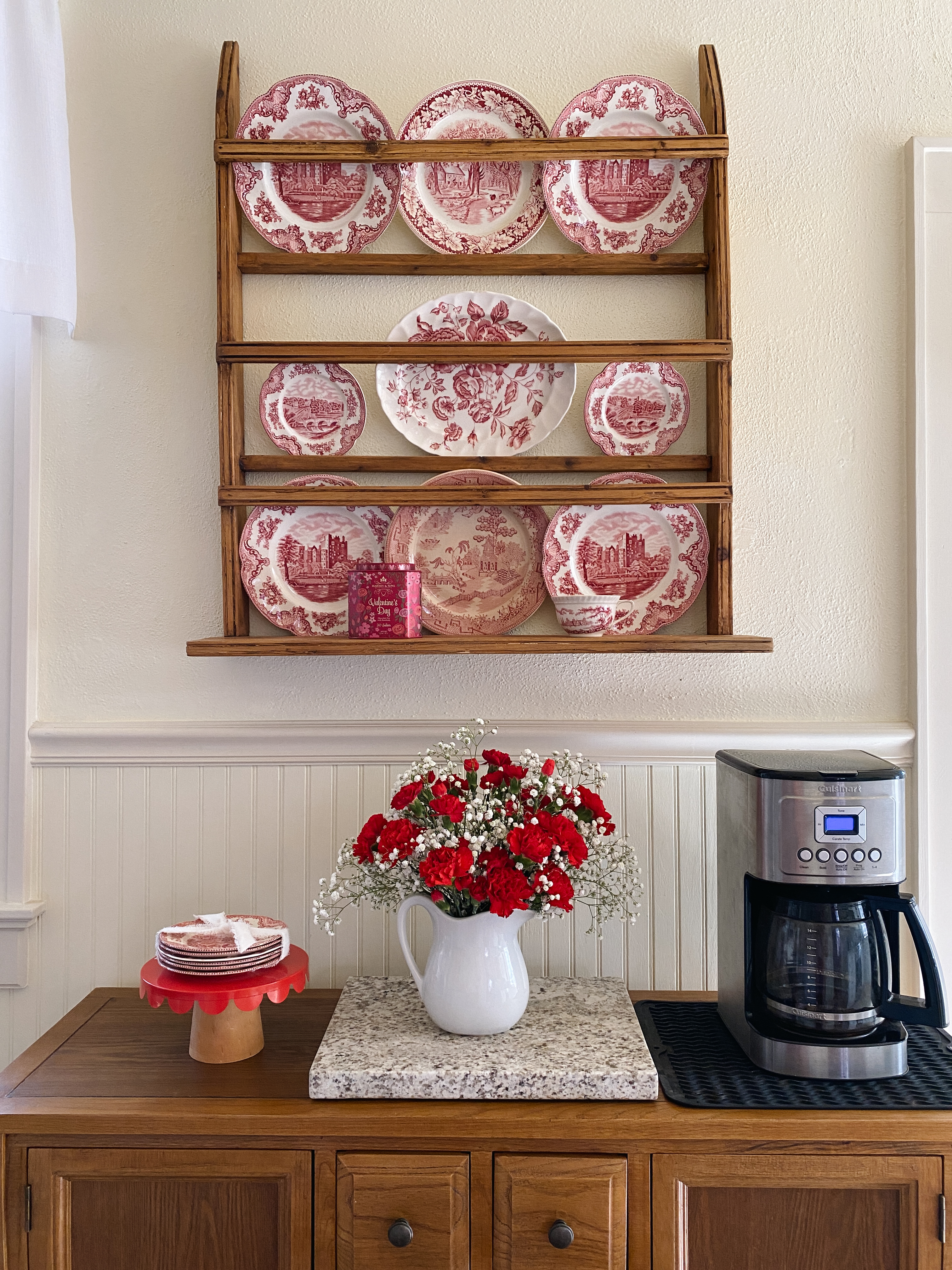
Pink and red carnations, along with some baby’s breath, clearly signal that you’re decorating for Valentine’s Day. Dragon fruit and strawberries also look lovely on a counter near Valentine’s Day.

Don’t be afraid to browse your local produce section to see what you can use in your home this year.

Pro Tip: A vintage berry bowl or red transferware filled with red produce is beautiful at this time of year. Elevate it even further as décor by placing the bowl on top of a vintage silver tray.

Simple Valentine’s Day decor using red carnations in a white pitcher styled beneath vintage red transferware plates.
Fresh flowers and everyday pieces are often all it takes to decorate for the season.

Seasonal Decorating, Simplified

It’s easy to feel burned out when every season calls for a full overhaul. Allowing your home to rest, with less clutter and décor, often makes it easier to imagine what comes next.

Whether your reason is to save money or storage space, live more sustainably, or give your home a rest, I hope you find these ideas for Valentine’s Day décor helpful.

Simple Valentine’s Day decor featuring a pink candle in a vintage teacup styled with red transferware plates.
A pink candle in a red transferware teacup is an easy way to decorate for Valentine’s Day without spending money on new decor.

This year Belle Antiquarian has plans to bring you new, creative ideas for home décor, gardening, Southern recipes, and travel. Be sure to use the box below to subscribe to our latest articles. You can also find us on Facebook, Instagram, Pinterest, and LTK.


More Valentine’s Articles from Belle Antiquarian

Finished customized Costco Christmas wreath decorated with magnolia, cedar, pinecones, berries, and a plaid bow on a black door

How to Beautifully Customize a Costco Christmas Wreath

Customize a Costco Christmas Wreath

There’s a day I look forward to every holiday season – the day that the fresh Costco Christmas wreaths arrive in the store. We’ve used artificial Christmas trees in our home for years, but I’ve held onto the tradition of buying fresh Christmas wreaths.

The smell of fresh evergreen branches instantly transports me back to my childhood. My family enjoys the charm of fresh greenery at Christmas as well, and the Costco Christmas wreath is an easy way to bring a bit of holiday joy into our home.

The only thing I don’t love about the Costco Christmas wreath is that because they’re so popular, every house on the street has an identical wreath on the door. Years ago, I decided to “hack” the wreaths and customize them. I wanted a unique wreath that reflected my style. Since the wreaths are so affordable (just $19.99), I began to create a unique wreath unlike anyone else’s.

I have shared a version of this idea in past years, but I wanted to create a more detailed guide for those of you who love simple holiday projects. If you would like to look back at my earlier wreath tutorial, you can find it HERE.

This article contains affiliate links. As an affiliate, I may earn a small commission if you purchase items through my links, at no cost to you. Thank you for supporting Belle Antiquarian.

Costco Christmas wreath before customization with pinecones, berries, and evergreen branches
The wreath straight from Costco before any customization.

Tools and Supplies

There are a few basic tools and supplies that you’ll need to transform your Costco Christmas wreath. When you have the right tools for the job, it will make it easier and more enjoyable.

When I go out onto our property to gather magnolia and holly stems, I always use a pair of strong pruners to make a clean cut. These stems are thick, and using a quality pair of pruners or snips ensures that the plant isn’t damaged when you make the cut.

In order to attach items to your wreath, you’ll need some floral wire, floral tape, and pine wired stems. Along with those things, you’ll need some scissors and wire cutters.

The last items you’ll need are whatever embellishments you decide to include. These can be things like ribbon, premade bows or sashes, bells, or artificial floral picks.

You can find my favorites linked HERE or by clicking on the image below.

Pro tip: Avoid using hot glue to attach items to your wreath. Hot glue doesn’t adhere well over time to fresh greenery. If your wreath will be outdoors, temperature fluctuations make the glue unstable. In addition, hot glue can be more visible than other methods like floral wire and floral tape.

Pinterest graphic titled Customize a Costco Christmas Wreath with all supplies linked, featuring a fresh wreath with pinecones and a red bow.
Click the image to shop my favorite supplies.

Fresh Greenery for Added Texture and Fullness

Sometimes more is more, and that’s my philosophy when customizing my Costco Christmas wreath. The first thing I do whenever I customize a fresh wreath is to see what’s available outdoors. Using natural elements gathered from your yard is not only affordable, but it adds a touch of natural elegance.

During the holiday season, I can find magnolia and holly branches, as well as camellia stems growing on our property. If you don’t have those available to you, chances are that you have pine, spruce, or even Leyland cypress growing nearby. Using different types of greenery to customize a fresh Christmas wreath will layer a variety of textures and shades of green, which creates a luxurious quality.  

When choosing which greenery to add to your Costco wreath, consider things like fragrance and longevity. For example, using olive branches and rosemary adds a layer of scent to the fragrant evergreens already included in the Costco Christmas wreath. In addition to that, be sure to consider selections that won’t wilt in a few days. You’ll want your wreath to appear fresh for weeks throughout the holiday season.

When taking clippings from your yard, be sure to prune small amounts from different areas. You don’t want to misshape the plant or make the yard look untidy. Cutting too much from one area could damage the plant.

Magnolia leaves and holly branches in a basket for customizing a Costco Christmas wreath
Gathered magnolia and holly from the yard add natural charm to a fresh wreath.

Natural Accents That Bring Warmth and Southern Charm

The next step to consider when you customize a fresh wreath are natural wreath decorations. These might be things that you forage from your yard, or they could also be purchased.

If you’ve seen other Costco Christmas wreaths that I’ve customized in the past, you might’ve noticed that each wreath includes pheasant feathers. Here’s a little secret: those are the same pheasant feathers in every one of the wreaths. I purchased a bag of pheasant feathers about fifteen years ago, and I carefully remove them each year to use them again and again.

This year I have included some Magnolia seed pods in my natural wreath decorations. I pruned the seed pods from my Magnolia trees and allowed them to dry. I used them in multiple ways this fall, and now I have wired them into my wreath.

In the past, I used dried orange slices in my wreaths. If you would like to dry your own orange slices at home, I have a simple step-by-step tutorial you can follow. It adds the loveliest touch of old-fashioned charm to your wreath. CLICK HERE for the dried orange tutorial.

Magnolia seed pods, pheasant feathers, and pinecones used to customize a Costco Christmas wreath
Magnolia seed pods, pheasant feathers, and pinecones make beautiful natural accents for a fresh Christmas wreath.

Other items that would look beautiful added to your wreath include:

  • Sweetgum pods
  • Eucalyptus pods
  • Acorns
  • Cedar berries
  • Cotton bolls

Pro tips: Elevate your foraged items with some gold or glitter spray paint. Dried oranges sprayed with glitter or acorns painted gold create festive accents for your wreath. Create a cluster of pheasant feathers by using floral tape around the ends before wiring them into your wreath.

Close-up of customized Costco Christmas wreath with magnolia leaves, holly, berries, pinecones, and pheasant feathers
A close look at the magnolia, holly, and pheasant feather accents that make this Costco Christmas wreath feel collected and personal.

Affordable Add-Ins From the Craft Store or Online

When I customize a fresh wreath, I tend to use what I can find and forage from the outdoors. But don’t miss out on your chance to get creative with embellishments you can find at your local craft store or online. Using quality artificial embellishments can create a designer look that fits your personality.

If you don’t have natural elements in your outdoor space that can be added to your wreath, you can purchase faux greenery and stems. Look for faux magnolia, berries, and even eucalyptus with realistic qualities.

In addition to natural looking items, you can customize your Costco Christmas wreath with a variety of holiday picks and decorative accents. Using your floral wire, attach things like mini ornaments or floral picks with gift boxes on them to create a holiday look. Faux pomegranates and pears are also lovely holiday-themed items to include.

Other items to consider are metallic stems, small bells, velvet poinsettias.

Finishing Touches That Define Your Style

Finished customized Costco Christmas wreath decorated with magnolia, cedar, pinecones, berries, and a plaid bow on a black door
The finished wreath, created with magnolia, cedar, pinecones, berries, and a classic plaid bow.

The last thing you’ll need before you start to customize a fresh wreath is your finishing touch. It’s important to know whether you’ll be hanging your wreath outdoors or indoors. If your wreath is outdoors, you’ll want to know if it’s covered or uncovered.

Once you know where your wreath will be hanging, it’s time to select your finishing touch. Your finishing touch can be a premade bow or a bow that you make yourself. It could be a bow made of velvet, plaid, or even burlap ribbon.

If a bow isn’t the look you’re going for, you may want to consider a simple ribbon tied with long tails trailing. I also love the look of a wreath sash, which can be customized with your monogram and used year after year.

When considering your bow, ribbon, or sash there are a few things to consider. Select something that is in the same scale as your wreath. You don’t want a tiny bow or sash on a big wreath, because it won’t look right. If you’re making your own bow, select a ribbon width that matches the proportions of your wreath.

If your wreath is going to be outdoors, especially if it’s uncovered, choose a bow or ribbon that can withstand the elements. Wired ribbon tends to be better in this case, as it will hold its shape against the weather.

Simple Steps to Transform Your Costco Wreath

Watch the wreath come to life in this short video.

Now that you’ve gathered all the materials that you’ll need to customize your Costco Christmas wreath, it’s time to get started!

  1. Inspect your wreath. If you notice any broken or loose branches, use your floral wire to reattach or tighten them to the wreath frame.
  2. Lay out your materials. Group the items you’ll be adding to your wreath by natural and artificial materials. Lay all your tools in one area. Precut wire so that you have it ready to use.
  3. Start with the largest greenery. Always insert items into your wreath in the same direction. Look at your original wreath and notice if the greenery has been created going clockwise or counterclockwise. Add your stems (and everything else) in the same direction that the original wreath is going. Wire stems like magnolia and cedar into the wreath. This may require longer pieces of wire that can reach to the back of the wreath frame for stability.
  4. Add medium-sized greenery. Look for spaces in your wreath that you can fill with things like holly, camellia, and rosemary. These stems can often be wired to existing stems in the wreath instead of the wreath frame on the back. Layer these under existing greenery and wire them in a way that hides the wire and the ends.
  5. Insert your character pieces. Always add items in odd numbers. It’s more pleasing to the eye when we see things in groups of 3 or 5. Since these items are closer to the surface of the wreath, I like to use alternate between regular floral wire and pine wired garland ties, depending on whether the wire can be seen or not.
  6. Step back and evaluate your wreath. Make sure that items are evenly distributed around the wreath. One side shouldn’t have more added than the other side. If you need to add or remove things, do so now. You’ll also want to check for any visible floral wire. Either reposition branches to hide wires or use your wire cutters to trim it down.
  7. Add your finishing touch. Once your wreath meets your satisfaction, it’s time to attach your bow, ribbon, or sash. Ribbons and sashes can be tied directly around your wreath. A bow can be attached using your floral wire. The most common placements are top-center and bottom-center, but slightly-off center can be charming as well.

Ideas for Styling Your Customized Costco Wreath

If you’re interested in customizing a Costco Christmas wreath, but you’re overwhelmed with the options, try starting with a theme. Here are a few themes to get you started:

  • Southern Traditional – A Southern Traditional wreath will use elements easily gathered from the Southern outdoors, like Magnolia and cedar. Other elements that would be integrated into this theme include pheasant feathers and velvet ribbon.
  • Classic Christmas – This wreath uses traditional Christmas elements used in many Christmas decorations. Holly, berries, pinecones, and plaid bows will create a wreath that fits this theme.
  • Natural Woodland – For this theme, integrate a mixture of forest gatherings like pine, juniper, and acorns with rustic elements like tiny bells and twine.
  • Minimalist – If you want to customize your wreath but still keep it simple, try using a mixture of olive branches, bay leaves, and linen ribbon.
  • Festive and Bright – This wreath will be colorful and cheerful. Customize your Costco Christmas wreath with faux berries, a satin bow, and glittery ornaments.

Care Tips for a Fresh Christmas Wreath

You’ve taken a lot of care to create a beautiful Christmas wreath, so you’ll want it to last all season long. Wreaths that are outdoors will last longer in a covered area where they’ll be out of direct sun and strong weather conditions.

Give your wreath a light misting every few days to refresh the greenery and prevent it from drying out too quickly. Check for loose pieces after wind or rain and re-secure them using floral wire.

After the season is over, use wire cutters to remove elements like pheasant feathers and artificial stems that can be reused. Once you’re sure they’re dry and free from debris, store them in a bin for next year’s wreath.

In Closing

Costco Christmas wreaths are beautiful just as they come. But there’s something charming about taking a cookie-cutter decoration and making it personal. This is one of the most affordable Christmas crafts that you can find. I’ve researched prices online and in-person, and you won’t find another lush wreath like Costco’s this affordably.

I encourage you to explore nature or even your craft bin with spare bits. Use what you have on hand and express your creativity to customize a Christmas wreath that’s one-of-a-kind. I hope you feel inspired to create our own customized Costco Christmas wreath and enjoy the beauty it brings all season long.

Explore More from This Series

If you enjoyed this article on holiday traditions, we invite you to explore more from the series. Each article in this series celebrates the beauty of Southern living through the seasons. You can find the full collection on the homepage under Home for the Holidays: A Southern Season of Charm.

Pin this for Later

Pinterest graphic showing a customized Costco Christmas wreath with plaid bow and magnolia leaves
Pin this tutorial to save these ideas for later.

Thank you for subscribing!

Please check your email to confirming your subscription.

Elegant banner image reading “How to Create a Thanksgiving Floral Arrangement,” featuring orange pumpkins and green botanical accents on a soft cream background.

How to Create a Thanksgiving Floral Arrangement

As an empty nester, I cherish the moments when my family gathers for the holidays. I love decorating our home in meaningful ways, and today I’m sharing how I create a Thanksgiving floral arrangement to make the table feel special.

Over the years we normally had Thanksgiving at home, just the four of us. My husband worked nights and weekends in law enforcement, and he usually only had a few hours on Thanksgiving to sit down with us for a meal.

We didn’t always have fancy heirloom plates or crystal wine glasses. For many years, the most treasured Thanksgiving decorations on the table were placemats that the kids made and brought home from school. During the early years, Thanksgiving simply meant the parade on TV, the smell of onions and celery softening in butter, and the sound of kids playing a board game together while they waited to eat.

Now that they’re older, I’ve started creating a special Thanksgiving floral arrangement to decorate our table. Last year, I shared an arrangement filled with warm fall tones and garden greenery. This season, I’m changing things up a bit and walking you through each step so you can create one, too.

Flowers have a way of making the table feel special, whether it’s set for two or twelve. When my kids come home for Thanksgiving, they share in the excitement of the season. Not only do they enjoy eating the familiar Thanksgiving food that they love, but they can also tell that I’ve gone out of my way to make the table special, just for them.

If you’d like to share some flowers on your table this Thanksgiving, here are the steps you’ll want to take.

This article contains affiliate links. As an Amazon and LTK affiliate, I may earn a small commission from qualifying purchases at no extra cost to you. All opinions are my own.

Step One: Choose Your Vessel

The first thing I like to do when I’m creating a Thanksgiving floral arrangement is to think about what kind of vase or vessel I’ll be using. If the floral arrangement is going to be in the center of the table while we’re eating our Thanksgiving meal, then I’ll select a container that creates a profile that is low enough to be able to see each other’s faces while talking. On the other hand, if the flowers are going to be on a sideboard or entryway, then I might pick something taller to create more of a vertical look.

In my case, I’m creating a floral arrangement for the center of the Thanksgiving table, so I’m going to select something that looks nice in proportion with the length of the table, but it won’t inhibit the conversations.

Another thing to consider when choosing the vessel for your Thanksgiving floral arrangement is whether it suits the occasion. There are many ways to use ordinary objects and turn them into something beautiful to hold your flowers. Things like ironstone tureens, transferware bowls, or vintage silver pieces can be just the right thing to set a festive tone for a table setting with Southern and heirloom aesthetics. Don’t be afraid to repurpose containers in creative ways; they often make the most charming vases.

Vintage silver bowl used as a vessel for a Thanksgiving floral arrangement, sitting on a marble countertop in soft autumn light.
A vintage silver bowl makes a beautiful vessel for a Thanksgiving floral arrangement.

Vessels to consider: Low compotes, ironstone tureens, transferware bowls, vintage silver pieces, or even dough bowls lined with floral foam

Step Two: Build the Foundation

After you have selected your container, the next step is to build the foundation for your floral arrangement. I want to make sure my flowers stay in the positions I’ve arranged them in. In order for them to do this, I’ll use something inside the vessel to secure them. There are a few options to secure your flowers, and the most common are floral foam, chicken wire, or a flower frog. Some people even make a grid over the container by using clear tape. By using one of these methods, the Thanksgiving floral arrangement will be given structure and stability. This is especially important if the flowers are on a table that’s in a busy area or has a lot of movement around it.

Green floral foam soaking in a clear plastic container of water, preparing the base for a Thanksgiving floral arrangement.
Soak floral foam before arranging to help flowers stay fresh longer.

Before I start adding my greenery and flowers, I also want to think about water. You can make your floral arrangements a few days before your Thanksgiving meal, but you’ll want to make sure to take some steps to keep it looking fresh. Some flowers will prefer the water to be very clean. In that case, you’ll need to gently drain and refill the water every other day. If the water looks cloudy, it’s best to drain and refill it.

Other arrangements will have flowers that are “heavy drinkers.” You can simply use a watering can with a narrow spout like the one I use to refill the water in the container as needed. Be sure to check on the water often to prevent the flowers from dying before Thanksgiving Day.

Here are a few of my favorite things to use when I’m arranging flowers. I’m including everything from my favorite containers to my favorite floral snips. Click the image to shop these exact items in my LTK.

Graphic showing Belle Antiquarian’s favorite floral arranging tools and supplies, including vessels, floral snips, wire frogs, and floral foam, styled on a neutral gingham background.
My go-to floral arranging tools and supplies for creating timeless, garden-inspired arrangements.

Three: Select Seasonal Greenery

A lot of people ask me how to get their flowers to look like the ones created by a florist. One of the secrets to a beautiful Thanksgiving floral arrangement is the greenery. After we select our vessel and consider the foundation, the next step is to start adding greenery. For a truly Southern table, greenery often does the heavy lifting.

In the South we’re lucky to have a lot of greenery in our yards that is suitable for flower arrangements. Magnolia and camellia stems are beautiful and easy to find. I’ve also used boxwood and cedar cuttings in my arrangements. If you’re lucky enough to have autumn ferns in your yard, they make a wonderful addition to Thanksgiving floral arrangements.

When you’re thinking about which greenery to use, don’t be afraid to use more than one kind. Some greenery has matte leaves, and others are glossy. Some have big, wide leaves, and others have feathery tips. Layering more than one kind of greenery can create visual interest.

Your greenery sets the shape and volume of your floral arrangement. It’s the quiet structure beneath every bloom. Once we start adding them, your flowers will generally follow the shape that you created with the greenery.

Camellia branches arranged in a silver bowl with floral foam, forming the greenery base for a Thanksgiving floral arrangement.
Camellia branches form the base of this Thanksgiving arrangement. Their glossy leaves add structure and shine.

Lastly, consider the scale of your greenery in proportion to the scale of the vessel you’re using. If you’re using a small vase, large greenery, like Magnolia, will take up more visual space. You may not want as much Magnolia in that case. In a very large container, tiny leaves may get lost in the floral arrangement, so you may need more of them.

When I cut greenery in my yard, I use floral shears, snips, and a gathering basket to gather what I need before bringing it indoors.

Consider: Shape, color, texture, and size of leaves

Step Four: Add Blooms and Accent Elements

It’s finally time to talk about the stars of the show: the flowers themselves. (Are you surprised that there was so much to consider before even adding the flowers?)

Bundles of fall flowers in shades of rust, amber, and cream resting in a kitchen sink before arranging.
Fresh flowers in warm autumn tones, ready to be arranged for Thanksgiving.

If you’ve been following me on Instagram for a while, you know that my favorite place to buy flowers is Trader Joe’s. Trader Joe’s is very accommodating to me when I come in to buy a lot of flowers for floral arrangements. They know that flowers are a big part of entertaining guests, and they expect their floral section to be busy at this time of year. They’ll even send you home with a bucket of water if you’re buying multiple bundles.

Woman arranging fall flowers in a silver vessel near a kitchen window, creating a Thanksgiving floral arrangement.
Arranging flowers at home is one of my favorite holiday traditions.

Ideally, when I go into Trader Joe’s to look for flowers for a Thanksgiving floral arrangement, I like to look for flowers that come in fall colors and will also last a long time. Flowers like this will be Chrysanthemums, roses, marigolds, sedum, and eucalyptus. I’ll look for colors like russet, amber, burnt orange, cream, and blush. I generally stay away from bright whites and bold reds for my Thanksgiving floral arrangements.

Pro Tip: A Florist’s Formula for Balance
When arranging flowers, think in categories:
air (delicate stems that add lightness), filler (connective greens), disks (rounded blooms), spikes (height and rhythm), and focals (your statement flowers).
This simple formula helps every arrangement feel natural and balanced.

Illustrated chart showing five elements of a floral arrangement: Air Stems, Filler, Disks, Spikes, and Focals, on a gingham background with botanical sketches.
The five key elements of a balanced floral arrangement — Air Stems, Filler, Disks, Spikes, and Focals.

Step Five: Arrange for Entertaining

Now that you’ve created your Thanksgiving floral arrangement, there are a few things to keep in mind before you serve the turkey. If you made your floral arrangement ahead of time (and I hope you did), it’s best to keep it away from heat sources. The flowers will stay fresher if they aren’t in a hot kitchen or close to a HVAC vent.

We talked above about keeping the floral arrangement lower on the table so that conversations aren’t inhibited. But sometimes the arrangements turn out bigger than we expected. (This happens to me a lot, actually!) In that case, be sure to move your flowers off to another spot when it’s time to eat. The most important thing is to entertain your guests gracefully, not make your flowers the star of the show. After all, a welcoming table is more about warmth than perfection.

Finally, take some direction from the colors and textures in your flowers when deciding on the table décor. Colors in your napkins and tablecloth should complement or repeat the colors that you selected for flowers. Your Thanksgiving floral arrangement is just part of the table setting that you create for your guests, and it should blend seamlessly with the rest of the design.

Step Six: Finishing Touches

Once your flowers are in place, it’s time for a few finishing touches. Don’t be afraid to get creative and add unique touches to your floral arrangement. There’s artistic expression in how we position each stem, in the quiet rhythm of arranging. Even if we are all given the same exact flowers and tools to use, our arrangements will turn out looking quite different from each other.

Finished Thanksgiving floral arrangement in vintage silver bowl on dining table with vintage brown transferware plates.
The finished Thanksgiving arrangement, filled with autumn blooms and Southern charm.

One way to add your own touch is to think outside the box for items that aren’t commonly used when arranging flowers. I’ve wired some dried Magnolia seed pods to long bamboo skewers and added them into my arrangement as unique accents. Brown velvet ribbon or pheasant feathers would be wonderful additions to a Thanksgiving floral arrangement as well.

Close-up of a Thanksgiving floral arrangement featuring a wired magnolia seed pod, orange alstroemeria, and autumn chrysanthemums.
A dried magnolia seed pod, wired to a bamboo skewer, adds natural texture and Southern charm to the arrangement.

Tip: When the meal is over and your guests have gone, be sure to move your flowers to a spot where you’ll see them. Flowers bring joy and life to our rooms, and you can get the most out of them when you see them.

In Closing

This Thanksgiving, remember that who is gathered around the table is more important than what is on it. Flowers are a wonderful way to celebrate the season, but our friends and family will really remember the ways we embrace them this season through small, meaningful gestures.

Soft petals, inherited bowls, and laughter around the table make a house feel like a home. More importantly, loved ones who gather to share a meal make any place feel like home when they’re together. Be sure to let them know you’re thankful for them.


Explore More from This Series

Each article in this series celebrates the beauty of Southern living through the seasons. You can find the full collection on the homepage under Home for the Holidays: A Southern Season of Charm.

Natural Fall Decor: Simple Ways to Bring the Outdoors In

Welcome to the first installment of my newest series, Home for the Holidays: A Southern Season of Charm. Today we begin by sharing ways to bring the outdoors inside to decorate your home with natural décor for fall.

The holiday season in the South is rich in tradition. It’s a graceful time of the year where we extend hospitality and celebrate the season by adding seasonal touches in gathering spaces. Each week of the Home for the Holidays series will be a celebration of meaningful traditions, nostalgic décor, and cozy inspiration for the heart of the home.

Whether you plan to host a large holiday gathering or your goal is to simply add traditional touches around your home, I hope you’ll come back each week for inspiration and a sense of community.

Autumn charm tucked into a secretary desk — goldenrod in a stoneware crock, bowls of acorns, beeswax candles, and heirloom blue-and-white china.

Why Choose Natural Fall Decor?

Albert Camus is credited with saying, “Autumn is a second spring when every leaf is a flower,” and I can’t hear this quote without thinking of the mighty Southern magnolia.

Truly a Magnolia grandiflora, in the spring she entices us with massive, fragrant flowers in a milky white hue that contrast with her green leaves. Yet, the Magnolia doesn’t stop in spring! In the fall, we are presented with brilliant and strange cones that push out bright red seeds as they ripen. The vivid green leaves of spring have developed their velvety brown undersides, softening as the heat of summer eases into the first chilled autumn evenings of the Deep South.

During the spring and summer, we bring nature’s bounty indoors to eat. When autumn arrives, the growing season has come to an end. But that doesn’t mean we turn our backs on what nature has to offer. For generations Southerners have brought nature inside during autumn to decorate with and enjoy. By taking advantage of what nature has to offer us from the land, garden, and forests, we can decorate our homes in the traditional Southern fashion for little to no cost.

Southern autumn in hand — a magnolia seed pod bursting with brilliant red seeds.

The Three Categories of Natural Fall Decor

To make gathering from nature more approachable, I like to think of natural fall décor in three categories.

The Harvest: Abundance for the table and sideboard

The food we harvest to eat in the fall can also be used to decorate our homes. Apples of all shades from yellow to red to bright green mimic the colors of the leaves. A basket full of apples in the center of a breakfast table becomes edible artwork.

Pumpkins are sometimes overlooked as indoor décor. Most houses will be seen with one next to the front door, waiting for a face to be carved. But pumpkins can be used as indoor décor as well. A large pumpkin can be turned into a centerpiece, and small pumpkins can line a windowsill.

Layered textures of hydrangeas and grapevine wreath frame an heirloom pumpkin for an inviting fall accent.

In the fall we also harvest other growing plants like cotton, wheat, and many types of flowers. Bundles of cotton and wheat can be used in vases or wreaths. Dried hydrangeas and goldenrod are also traditional Southern fall decor.

The Gathered: Treasures from the forest floor

A walk through our natural surroundings will reveal all sorts of treasures if we observe the world around us. These items aren’t necessarily grown to harvest at the end of the season. They’re little gifts that we can find while looking on the forest floor or in the trees. Sometimes a stroll along the shore of an ocean or lake will reveal a prize to bring inside.

A hand-carved wooden dough bowl brimming with acorns adds warmth to a fall mantel styled with grapevine pumpkins.

In my own yard I collected magnolia and pine cones, acorns, and pecans. I filled all kinds of bowls and vessels to use them as natural fall décor. I also cut branches of magnolia to use in floral arrangements.

Other gathered finds are items like feathers, antler sheds, ethically sourced turtle shells, and oyster shells. All of these can be thoughtfully integrated into your fall décor.

Rustic fall touches — pinecones, twine, dried grasses, and terracotta pots flank a vintage dog portrait for cozy seasonal charm.

The Handcrafted: Artisan-made with natural materials

The final category of natural fall décor is the handcrafted. Artisans use natural items to create things that we use on a daily basis. We can thoughtfully incorporate those items in our fall décor to highlight their natural materials and craftsmanship.

Pheasant feathers in ironstone, vintage books tied with velvet ribbon, and a grapevine pumpkin create timeless autumn layers.

Candles made of beeswax perfume the room and add a warm yellow tone to the space even when they’re not burning. Baskets made of local grass and willows are useful all year round, and in the fall they can be used to showcase things like a bunch of gourds.

Other handcrafted items to consider using in your natural fall décor are quilts, pottery, and sculptures made from wood or local rock.

How to Incorporate Natural Decor into Your Home

A common mistake people make when decorating their homes for the holidays is to go overboard with a theme. If every item in your home has a pumpkin motif on it, it will start to look more like a gift shop than a home with decorative touches. The same thing can happen if you go overboard with natural fall décor.

I recommend finding ways to integrate natural fall décor into your existing vignettes. Take one or two natural elements and treat them as “hero pieces” in combination with other groupings of existing décor. Consider things like textures, colors, and size when you’re styling or arranging your spaces.

A cozy fall corner — heirloom pumpkin centerpiece beside a wingback chair and brass lamp, framed by autumn light.

Four Places to Add Natural Fall Decor

A brown transferware bowl filled with moss, seed pods, and a candle rests on a stack of well-loved books for simple fall charm.

Shop the Look

If you like the idea of decorating for fall using natural décor, but you don’t live in an area where you can find it on your own, I’m sharing some links for items that I recommend. I’ve curated a list of items you can use throughout the year, as well as some resources for natural items like shells and dried flowers.

You can find this list by clicking the image below or going directly to my curated LTK shop for fall.

Shop the look: timeless natural finds I recommend for autumn decorating. These pieces can be styled throughout your home and carried into other seasons with ease.

Looking Ahead: A Season of Charm

Throughout this eight-week Home for the Holidays series we’ll explore a few Southern holiday recipes, decorate our tables for special holiday meals, and explore easy ways to show hospitality and care to those around us this season.

I invite you to come back each Saturday for the next installment of Home for the Holidays: A Southern Season of Charm. Be sure to bookmark this website in your browser and follow along on Instagram for updates. Links to the other segments in this series will be added to the bottom of this article as we make our way through the holidays season together.

Closing Thought

When we choose to use natural décor in our homes it honors the environment around us. We’re at a time in history when home décor is being treated as though it is disposable. Walk into any craft store, and you’ll find shelves up to the ceiling that are lined with hundreds of identical decorations that will likely only be used for one season before ending up in the trash.

I want to encourage you to consider buying quality items that can be used in different ways every season, instead of something that can only be used for a couple of weeks. For example: A dough bowl can be filled with eggs in the spring, shells in the summer, acorns in the fall, and ornaments at Christmas.

Investing in quality décor saves money in the long run and decreases mental and physical clutter in our homes. Dante Alighieri said, “Nature is the art of God,” and I hope you have been inspired to bring nature into your décor this fall.  

Autumn elegance in the dining room — antler mounts, brown transferware, cabbage plates, and hydrangeas with velvet ribbon.
Autumn natural decor ideas illustration featuring seasonal elements such as magnolia stems, oak leaves, dried wheat, pumpkins, grapevine, dried hydrangeas, pheasant feathers, cotton stems, acorns, pinecones, dried seed pods, antler sheds, and oyster shells. Styled for fall decorating inspiration with a Southern touch.
Bring the outdoors in this autumn with simple, natural decor. From magnolia stems and acorns to antler sheds and oyster shells, these timeless touches add warmth, charm, and Southern character to any home.

Explore More from This Series

Each article in this series celebrates the beauty of Southern living through the seasons. You can find the full collection on the homepage under Home for the Holidays: A Southern Season of Charm.

Fall porch with pumpkins, lanterns, cornstalks, and a wreath — an inviting seasonal entryway idea.

Front Doors & First Impressions

There’s an old English proverb that says, “First impressions are the most lasting.” We usually think of first impressions when we meet someone face-to-face. However, when a visitor arrives at your home for the first time, they come “face-to-face” with your house. We also create a lasting first impression of where we live.

Although we’ve been discussing fall for several weeks now, this week marked the official first day of fall. Today I’m sharing very affordable tips that anyone can use to freshen up their front door area as we transition into the next season.

Welcome back to the final installment of our fall series, Falling for Home: A Weekly Autumn Journal. If you’re just joining us from Google, Pinterest, or Instagram, I invite you to browse through the other articles in this series, which are all linked at the bottom of this article.

Front porch decorated for fall with pumpkins, lanterns, and a festive wreath for simple and affordable curb appeal.
A welcoming front entry styled with a fall wreath, layered doormats, pumpkins, and lanterns — affordable seasonal touches with big impact.

Begin with a Clean Slate

If there is nothing else you can do to change the entrance to your home, cleaning and tidying will still make a big difference. Take time to sweep away fallen leaves or other yard debris. If you live in an area with a lot of foot traffic, you may need to pick up some litter. If you have a glass storm door or window at your entrance, be sure to clean off dirt and smudges.

Once your entryway is clean and tidy, we’re ready to layer in some pieces to add warmth and personality.

Start with a Welcoming Wreath

One of the easiest ways to create a warm welcome into your home is by adding a wreath. Since it’s fall, I found a wreath with seasonal colors, like orange and beige. It also has small faux pumpkins, which leaves no question that this is to celebrate the fall season.

Faux flowers have come leaps and bounds in the last ten years. Retailers are now creating wreaths with realistic outdoor faux flowers for fall that are weather resistant. I found my wreath HERE.

Pro Tip: If you’re renting and you can’t install a hook to hang your wreath, there are some quality, affordable options to add a temporary hook. See my favorite temporary wreath hooks on Amazon.

Layer Your Doormats

In last week’s article, Patterns & Patina, we talked about how mixing patterns thoughtfully takes a basic look and turns it into a sophisticated, polished one. We can see an example of this by layering doormats.

I found two affordable doormats (HERE and HERE) for my entryway and layered them to create a layered fall look. If you want to use this technique, make sure the doormat that will be on the bottom is slightly larger than the mat that will go on top.

Pro Tip: Make sure the mats are tied into each other by either being complementary colors or patterns. Mix different textures to create visual interest.

Add Lanterns & Lighting

One of the easiest ways to add a little magical ambiance to your front porch this fall is by adding some lanterns. Don’t be afraid to opt for tall lanterns, rather than shorter ones. This will bring in some height to your design, creating balance and visual interest.

Black lantern with flameless candle and pumpkins — a simple fall front porch decor idea for instant warmth.
A black lantern with flameless candle adds cozy light alongside pumpkins for simple, affordable porch decor.

For my lanterns, I found these waterproof flameless candles that come with a remote. They can be operated on a timer, or I can easily turn them off and on by pointing the remote out of the nearby window.

Pro Tip: Add a lantern on each side of the entryway to create symmetry. Our subconscious prefers balance in home décor.

Evening porch decor with glowing lanterns, pumpkins, and fall accents for a warm, welcoming entryway.
Lanterns with flameless candles create a cozy glow, while pumpkins line the steps for a charming fall porch look.

Greenery or Planters

The big-box stores have us trained to buy mums every fall. While they do evoke the fall season, the problem is that they are not low-maintenance additions to your front porch décor. Many of us struggle to keep them alive for the whole season, and we’re left with pots full of dead flowers.

Try swapping fall mums for more low-maintenance plants like fall ornamental grasses and sedums. These are more drought tolerant and won’t require daily watering and regular fertilizer like mums do.

Another option is to go with faux mums in your planters. Like we discussed earlier, faux florals have come a long way. There are some outdoor faux mums that would fool anyone until they closely inspected them.

Pro Tip: When buying plants for your pots this fall, use this formula to create a polished look: 1 thriller (tall or spike plant), 3-5 fillers (bushier, compact plants), 3-5 spillers (trailing, vining plants). Remember: Thriller/Filler/Spiller

Side view of a fall porch decorated with pumpkins, cornstalks, and lanterns for classic autumn curb appeal.
A side view of the porch shows layered doormats, pumpkins, lanterns, and cornstalks — timeless fall styling.

Little Details that Count

Don’t underestimate the impact of a small change. One of the easiest and most affordable changes you can make to your front porch is to upgrade your house numbers. This simple change will affect the first impressions of your front door year-round.

Hardware like doorknobs, knockers, and handles can easily be modernized by switching them out with a couple of screws. Say goodbye to peeling polished brass from the 1990s and hello to something more modern like matte black hardware.

Lastly, pick up a few fall-themed outdoor pillows for your front porch. Create an inviting spot for guests to sit on your chairs and benches.


I hope you’ll take the time to check out the things I used to refresh my own front patio. You’ll be pleasantly surprised at how affordable they are. Easy swaps like this make refreshing your front door seasonally, the perfect way to make a good first impression.

You can find the exact products I used linked throughout this article, or you can find them all in one place in my LTK storefront. Click the image below to navigate there.

Shop my curated picks for a quick and affordable fall front porch refresh. These Amazon and Walmart finds (wreaths, lanterns, doormats, pillows, and more) arrive fast and make it simple to welcome the season in style.

Next week we begin a new series, Home for the Holidays: A Southern Season of Charm. This series will be a weekly celebration of meaningful traditions, nostalgic décor, and cozy inspiration for the heart of the home.

Explore More from Falling for Home: A Weekly Autumn Journal

This article is part of my series called Falling for Home: A Weekly Autumn Journal. Be sure to check out these reader favorites:

You can subscribe here to receive new articles, seasonal inspiration, and vintage-style favorites delivered right to your inbox.

Full view of a fall front porch decorated with pumpkins, lanterns, and a wreath for simple seasonal curb appeal.
A symmetrical fall front porch styled with pumpkins, lanterns, and a seasonal wreath for instant curb appeal.
Fall porch with pumpkins, lanterns, cornstalks, and a wreath — an inviting seasonal entryway idea.
Classic fall porch styling with pumpkins on every step, lanterns for a warm glow, and cornstalks tied with ribbon for a festive finish.
Evening porch decor with glowing lanterns, pumpkins, and fall accents for a warm, welcoming entryway.
Lanterns with flameless candles create a cozy glow, while pumpkins line the steps for a charming fall porch look.

Patterns & Patina: How to Layer Like a Southerner

Have you ever found yourself admiring someone’s personal style, whether in their home or wardrobe, and wondered why it feels so sophisticated? Perhaps you were inspired to create a similar outfit or room in your home and ended up feeling like yours just wasn’t on the same level of style. Today we’re discussing how mixing patterns and patina creates a personal style in your wardrobe and home that tells a story, adds character, and creates a timeless collected look.

Welcome back to our fall series Falling for Home: A Weekly Autumn Journal. If you’re just joining us from Google, Pinterest, or Instagram, I invite you to browse through the other articles in the series, which can be found linked at the end of this article.

Patterns: Mixing with Confidence

In the South we never miss an opportunity to dress something up. Whether it is a specially wrapped gift, a room in our home, or ourselves, we find opportunities to express our personality and present it to the world on a visual platter.

It’s often true that the most charming aesthetics are created when patterns are thoughtfully combined and layered to create depth and interest throughout your home and wardrobe. Interior and fashion designers use this technique in both clothing and home decor selections to create a visual conversation and unique story.

Our subconscious minds are attuned to visual interest. In last week’s article, Home as a Haven, we briefly discussed how too much visual interest can prevent you from getting rest in your bedroom. Similarly, too much visual interest in your outfit or home décor can cause unpleasant clashing.

With some practice and a few guiding principles, mixing patterns to create a polished and collected look can be done by anyone. Here are some tips I’ve learned along the way.

What to Pay Attention To

If you’re just getting started with pattern mixing, there are four things to be mindful of to achieve your desired effect.

  1. Color Family – Be mindful to keep color tones in the same palette. Too many different colors, or colors that don’t blend well, will end up clashing with each other. Colors that are next to each other on a color wheel or opposite from each other are usually successful choices.
  2. Scale – When mixing patterns, be aware of size and scale. For example, if you’re selecting a large floral pattern, consider a smaller stripe or plaid to complement it.
  3. Texture – Remember to consider the fabrics and materials of the patterns you’re choosing. Compare how different a velvet paisley is from a crisp cotton plaid.
  4. Balance – An important factor when mixing patterns is balance. Let one pattern be the star of the show, and the other patterns play a supporting role. For example, two different stripes can be successfully combined when one is a large bold stripe, and the other is a small, subtle stripe. Avoid being so over-the-top that you get lost in your aesthetic from trying to do “too much.”

Example Combinations

Have you ever heard people say, “Never mix plaids with stripes”? That’s not necessarily a good piece of advice. There aren’t many hard-and-fast rules for which patterns to mix, and if you follow the 4 design rules that I mentioned above, you can create endless combinations.

If you’re having trouble getting started, here are a few of my favorite patterns to combine for a polished look in both fashion and home décor:

  • Leopard + Plaid – This combination is classic and bold. It works in interiors with combinations like a leopard pillow and a plaid footstool. In fashion, a plaid blazer can be combined with a leopard belt for a touch of playfulness.
  • Paisley + Herringbone – These two traditional patterns can be combined for a refined and classic statement. Select paisley drapery panels with a herringbone chair for a timeless duo. You can’t miss when you combine a paisley scarf with a tweed herringbone jacket.
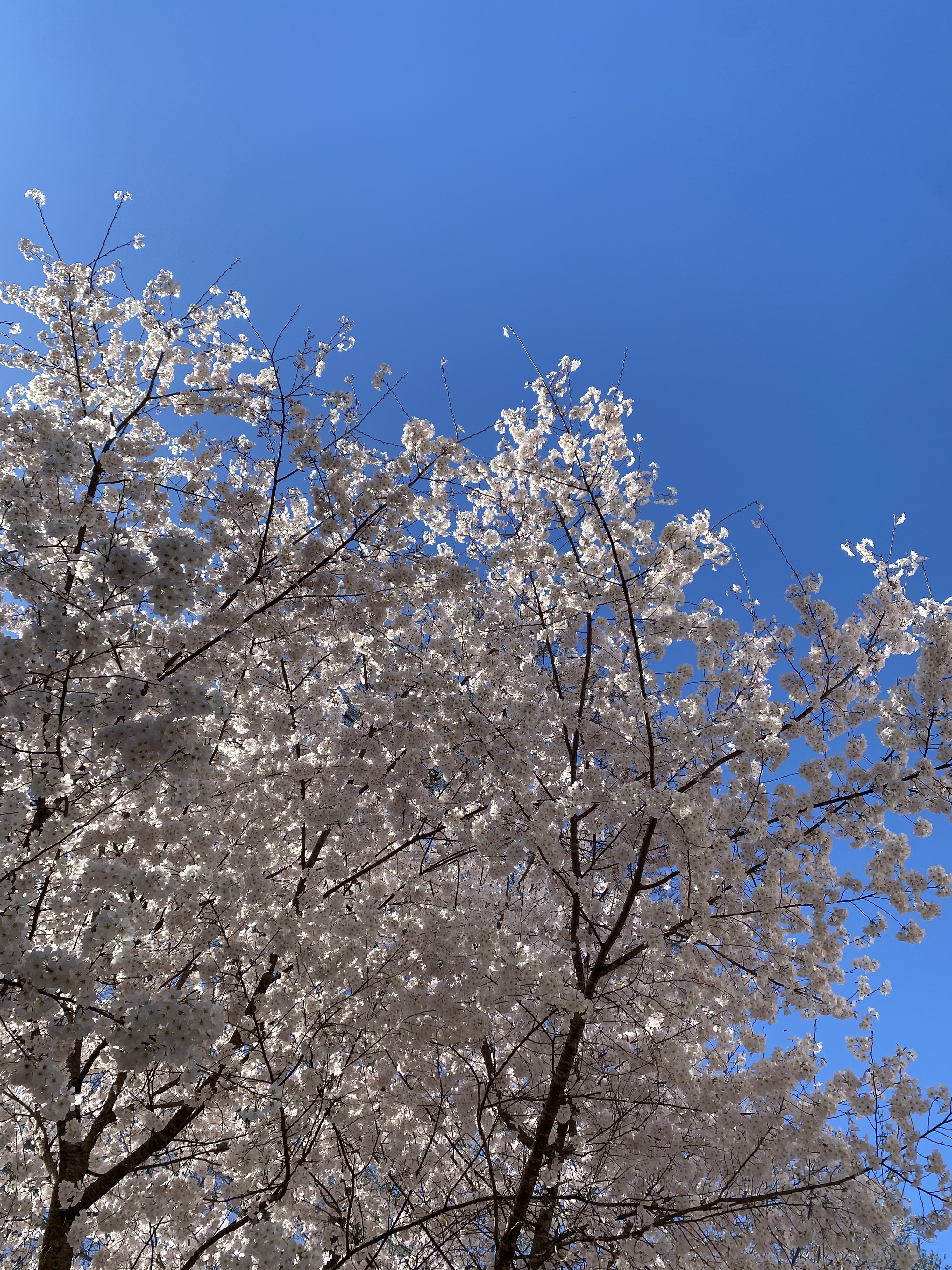
  • Floral + Buffalo Check – Florals balance the bold, graphic nature of buffalo check to create a charming and approachable look. In your home, combine a floral sofa with buffalo check throw pillows. In your closet, a delicate floral scarf pairs well with a buffalo check skirt or shirt.
  • Stripe + Plaid – These linear patterns can be combined to create an energetic, tailored look. In décor, a striped rug can be successful under plaid armchairs. In fashion, a crisp white shirt layered under a subtle striped sweater and paired with a plaid blazer will be seen as polished and sophisticated.

Patina: The Beauty of Time

Patterns catch the eye, but patina holds attention. It’s what makes a room or outfit feel lived in. Patina adds authenticity, character, and a sense of permanence. Patina is the way a lived-in surface changes appearance, and it can only be achieved with use, age, or weathering. Patina is what gives items soul. Antique appraisers look for signs of patina when determining authenticity of an item in question. Furniture will see patina around drawer pulls and surfaces with heavy use. Jewelry and other accessories show patina in the gentle softening of shine and wear on the surface,

When we’re aiming to achieve an aesthetic that includes items with patina, it’s necessary to consider whether new items we purchase will age with time and use. Items made of acrylic, vinyl, “vegan” leather, and laminated finishes do not age well or achieve the desired patina effect. For this reason, items made of those materials should not be treated as investment pieces.

Wondering how to incorporate patina into your home or closet? Here are a few examples of what to be on the lookout for:

Interiors

  • Leather armchairs darkening with use.
  • Unpolished silver trays, candlesticks, or cutlery.
  • Natural wood: farm tables, cutting boards, frames with softened edges.
  • Stoneware or pottery with subtle crazing.
  • Seasonal touches: a patinaed copper bucket for firewood, a weathered wicker basket for blankets.

Wardrobe & Accessories

  • Leather belts, handbags, boots that soften and show character.
  • Jewelry that develops a mellow sheen rather than a perfect shine.
  • Brass buckles, buttons, or clasps with gentle wear.
An antique silver bowl, painted tray, and well-loved books bring pattern & patina to life.

Bringing it Together

Many of us understand that having a solid foundation is essential to décor and fashion. However, a well-honed personal sense of style goes behind finding colors that match. Don’t be afraid to create a style that feels layered and personal.

It’s easy to settle for beige walls and a plain sofa, but your signature look is developed when you begin to layer coordinating patterns to showcase your unique personality. When we add touches of patina to our home and closet, we can explore opportunities to add soul to otherwise lackluster choices. After patterns and patina are combined, they seem to effortlessly create spaces and wardrobes that feel collected rather than staged.

I invite you to embrace layering styles at home and in your daily style. In addition to all the timeless Southern style recommendations that I’ve given in this article, the ultimate test is how your space and outfit make you feel. If it doesn’t feel right, it’s probably not. If it makes you happy and comfortable, then it’s probably a good choice. That’s the beauty of a personal style – it should matter most of all to you.

Discover how to style ticking stripes, gingham, and folk-inspired prints with vintage accents for a cozy and timeless bedroom look.
Stripes, gingham, and folk prints mingle with vintage accents for a collected bedroom.

Join me next week for the final article in this series, Falling for Home: A Weekly Autumn Journal. Next week’s article, Front Doors & First Impressions, is all about the importance of first impressions and how your entryway sets the tone.

Explore More from Falling for Home: A Weekly Autumn Journal

This article is part of my series called Falling for Home: A Weekly Autumn Journal. Be sure to check out these reader favorites:

You can subscribe here to receive new articles, seasonal inspiration, and vintage-style favorites delivered right to your inbox.