B2S Clip-Pin’s for Teacher


Here in the South school starts early, usually the first week of August. While the rest of the country is still enjoying the lazy, hazy days of summer, our little belles and beaus are hitting the books and getting their brains filled with knowledge.

We are very blessed and extremely thankful to have had some amazing individuals come into our lives and teach our kids. During the 9 months of the school year our kids will often spend more waking hours of their day with these teachers than with us. It’s important for us to let our kids’ teachers know from the get-go that we intend to partner with them and work together to teach our children. Because of this, and also because I am a southern lady that likes to show our hospitality and graciousness, I like to start the school year off with a small gift to the teachers. It’s never anything big, just a small gesture of “Here’s my baby. I hold them dear to my heart. Please keep them safe while they are away from me.”

This year I’ve been so busy and I’m trying to be more frugal with my crafting dollars, so I challenged myself to make Back to School teacher gifts using only materials that I already own. I decided to make some clip-pins from a previous post. Have you ever noticed that thin strip of cork that runs across the top of the chalk/white/smart board? These are perfect for that!

First up: A half-empty can of chalkboard paint from my advent calendar tutorial and leftover clothespins from my push-pin tutorial.

Spray paint some clothes pins. I used chalkboard paint because that’s what I had, but you could also use flat black. The chalkboard aspect of it doesn’t make a difference.


Next, I had a pack of school themed scrapbook paper leftover from teacher appreciation last year. This is a pack of 5×7 paper that I got from Michael’s. I used these thumbtacks, which originally came from Walmart.


After the paint is dry, cut paper to fit the front and back of the clips. I used some spray Elmer’s adhesive that I had, but ended up having to use hot glue in some spots. I also used some matte spray poly on top of the paper once the glue had dried. Once everything is dry, hot glue the tack to the back at the top.
 
 
I didn’t want the pins to poke anyone through the bags (Michael’s), so I cut a piece of foam core board that would fit inside the bag. Cut the foam core board at least 1/2″ smaller than the width of the bag so that everything will fit nicely.
 
 I covered the piece of foam core board in some paper to give it a finished look. I cut a small piece of paper and clipped all of the pins to it at the bottom to keep them from moving around in the bags.
 

Finally, I used my tag punch, some black card stock, and a white colored pencil to make the tags.


The only thing I would’ve done differently is to write the teachers’ names on the solid black clip with a white paint pen. But since I was restricting myself to materials I already had, I didn’t do it.
 
By the way, middle schoolers are too cool to hand their teachers gifts on the first day of school. So I will be giving these to his teachers at Open House. 😉 I have his permission. LOL. He just can’t be seen doing the deed himself. My 3rd grader on the other hand was happy to play Back to School Santa.
 
Enjoy! Please, please “pin” and share.
XOXO,
Abby


//assets.pinterest.com/js/pinit.js

The {Final} Nitty-Gritty on Sanding. When You’re Done?


I’ve noticed that a lot of times tutorials that go over how to use “furniture” (aka “chalk”) paint don’t go over what to do once the paint has dried. I personally have several more steps to go once the paint is dry on my furniture. I sand it, seal it, and often glaze it.

Sand it when the paint is dry? For latex or spray paint, not usually. For “furniture,” chalk, or milk paint, yes. There is an incredible difference in the finish of “furniture” paint when you sand it after it dries and when you don’t. It becomes incredibly smooth and “finished” looking. The paint should dry 8 hours, or overnight, before you sand it.

Depending on the look I am going for, I will either use 220 grit sandpaper or “00” steel wool. Usually using 220 grit sandpaper with my Black & Decker Mouse sander will give more of a distressed look. That means whatever the surface color was before you sanded it (wood or a different color) will show through on the edges and raised details. If I just want to “finish” the piece and I don’t want to distress it I will use “00” (double fine) steel wool. Even when using the “00” steel wool, be careful on the edges and details.

DON’T freak out when you sand your painted piece. Paint dust will come off. Trust me when I say, do not sand indoors, even a garage. You will cover everything in a fine coating of chalk dust. The great thing about “furniture” paint is, if you sand off too much, just touch it up with some more paint. Also, don’t freak out if your paint color “lightens” up a bit. This is just the effect of the “chalk” or plaster of Paris in the paint. When you apply your wax the color will deepen again.

Before you continue the process of finishing your painted piece after you have sanded it, wipe it down completely with a DRY cloth. Actually, most of the time I vacuum the piece with my shop vac when I’m done sanding. You can even use the final sanding process as a way to be creative with your paint. Once you have done a final sanding, you are ready to finish your piece with wax, polyurethane, or glaze. (or all of the above) 😉

I will go over more info on using “furniture” paint in a future blog post.
XOXO,
Abby

//assets.pinterest.com/js/pinit.js

The Nitty-Gritty on Sanding {Part Two}

In my previous post I went over the reasons why I would or wouldn’t sand a piece before refinishing it. In this post I’m going to go over how exactly to go about sanding.

Three things that will make your life easier while sanding:
#1 An electric hand held sander.
#2 Know your grit, Sherlock.

#3 Always sand in the direction of the grain. (the direction that the lines in the wood are going)

An electric hand held sander is going to cut your time by at least 75%. I have an old Black & Decker “Mouse” sander and I love it. I want a new sander, but just because I love tools. This one works great. Sandpaper is made especially to fit it and is easily put on and off. I like this because I can switch in between sandpapers when I’m working on something. Yes, it is possible to sand using a sanding block, but it is going to take you a lot of time.
 
Know your grit. Grit refers to the roughness of the sandpaper. The lower the number, the rougher the grit. You always, ALWAYS start with a lower number and work your way up to the higher number. For example, when I am refinishing a table top I will start with 60 grit. The 60 grit will grind down through any varnish and stain to the bare wood. If you use 60 grit too long, it will eventually start to grind away at your wood. 60 grit will leave your surface rough. There will be visible sanding marks and your piece will not be ready to paint or stain.

After removing the paint, varnish, or stain you were aiming to remove, next you will be ready to start creating a smooth surface ready for your finish. I like to move from 60 grit to 120 to 220. Going in this order will leave you with a quality surface that looks professional and neat. Be sure to check the surfaces that you’re sanding from different angles. If you are able to see sanding marks, you will need to re-sand that area to get rid of them, which is why I like the mouse. If I am working with the 220 grit sandpaper and I see marks left from the 60 grit, I can take the 220 off and put some 120 back on, remove the 60 grit marks, and then move back to the 220.

Finally, always sand with the grain of the wood. “Grain of the wood” refers to the direction that the lines in the wood are going. Don’t argue; just do it.

If you’ve sanded properly, when you apply your stain you will be rewarded with a thing of beauty. If you apply your stain and you suddenly see marks from sanding, wait for the stain to dry and begin again.

Sanding is one of those things that when you do it right, it is completely rewarding. You can literally see your hard work pay off. I’ll go over how to stain furniture sometime in the future.
This is my 12 year old sanding a bookshelf for his room. Don’t be afraid to get started. You can do this.
 
Next up will be: Sanding when you’re…done?

XOXO,
Abby


//assets.pinterest.com/js/pinit.js

The Nitty-Gritty on Sanding {Part One}

I’ve had some questions about sanding furniture, so I thought I would do a series of posts about it. Sanding isn’t my favorite thing to do. However, it can be very rewarding when it is done correctly. Since this is such a big topic, in this post I will cover information about sanding prior to painting or refinishing.

Before you start on a piece it is important to decide whether or not you need to sand at all. Let tell you when I don’t sand.
  • When I start with a piece that is unpainted, painted, or stained and I am planning to completely cover it in “furniture” (chalk) paint.
  • When I start with a piece that is painted or stained and I am planning to use a crackle finish, and I want the existing paint or stain to show through when it crackles.
  • Even if I am making repairs to the piece with wood putty or rebuilding a foot, for example, I only sand to make the repair even with the rest of the piece. I don’t sand the entire piece.

I make my own “furniture” paint. Some people may call it “chalk paint.” My furniture paint does not require prepping the surface before you use it. It will stick, and stick well, without sanding. That’s the whole point of using this kind of paint — to save time and prep.  So if you’re painting the whole piece and you’re using “furniture” paint, don’t waste your time by spending hours sanding.

Now here is when I DO sand prior to painting and refinishing:
  • I’m painting the piece, except for maybe the top of a dresser or a table top. In that case I will only sand the surface that isn’tgetting painted.
  • I’m using spray paint. Spray paint will show even tiny imperfections.
  • The piece is already painted, and I am planning to do a crackle finish that doesn’t include the current color.
  • The piece is painted and I want to remove the paint and stain it instead.
  • The piece is stained and needs to be re-stained.

I get a lot of questions about furniture and most people assume that everything needs to be sanded. This is not the case. Remember, chances are if you are painting the entire piece you do not need to sand before you paint with “furniture” (chalk) paint.

 
Come back in a few days for my post on how to sand.
Hope this helps!
XOXO,
Abby

//assets.pinterest.com/js/pinit.js

Keep Calm & Share Ideas

A friend overheard me sharing my “chalk” paint recipe and couldn’t believe it. Why not share? I’m not trying to sell paint.


I don’t mind sharing my paint recipe. If you bother to ask me, I’ll bother to tell you. The paint is super easy to make. What comes after that is the hard part. I believe in helping people get started. I’m not trying to sell paint. If you take that recipe and figure out how to use it, well, good for you! I want you to know that you can do this. There’s nothing special about me that you don’t have.

Here’s the thing though: Don’t make the mistake of thinking that because the paint itself is easy to make that the process and finished product isn’t valuable. The process of using this paint is lengthy with multiple steps involved. While it doesn’t require that you spend a lot of time prepping the surface to be painted, that doesn’t mean that the piece didn’t need repairs first. The paint needs to cure in between coats. Once the final coat is dry there are at least two more steps.


I was recently participating in an antique fair and I listened as one woman oooh and ahhhed over one of my pieces and her friend proceeded to talk her out of buying it. “Oh, that would be so easy to make. You could make that. You could have your husband do that. Don’t pay for that.” I’m absolutely sure that she could make it. I’m positive that her husband could, too. But I’m am 99.99% certain that they wouldn’t. She left that day without buying the piece that she admired and stood in front of for 15 minutes. Do you think she went home and made it? I’d be surprised if she did.

These pieces aren’t found on a whim. I research and drive, and drive, and drive some more before I find anything decent to buy. Yes, buy, as in purchase. I buy the materials: paint, brushes, rollers, LOADS of sandpaper, plaster, repair materials, and many times new hardware. That doesn’t include the cost of gasoline and my time. And just imagine, I actually want to make a profit on top of that.

I’ve decided that every time I blog about a piece I’m going to list at the bottom the amount of time it took and the amount I spent on basic supplies, not including the price of the piece. You can do this. And I hope you do. I want to inspire you to paint your own furniture and create your own decorations. But, please, please do not belittle the time, knowledge, and money that I have invested. And please, for pete’s sake, don’t come up to me at a fair while I’m trying to sell something and ask me how I made it. Not the time, folks.

P.S. Y’all rock!
XOXO,
Abby//assets.pinterest.com/js/pinit.js

Easter Mantle Ideas


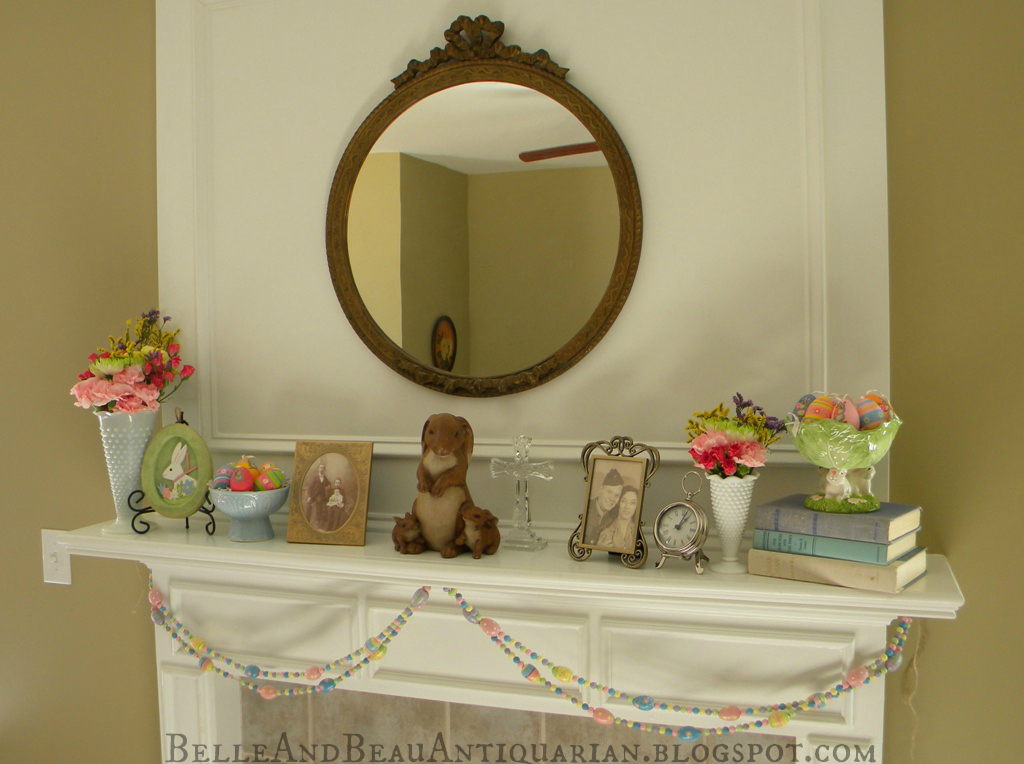
 I’ve decorated our mantle for Easter. And, as always, I’ve used a mixture of new and old. That’s the best way, don’t you think? If everything was vintage or antique, we’d be missing out on some of the great new decorative items out there. And I love shopping way too much to do that. 😉


I like how effortless it looks. A lot of it was pulled from “shopping” in other rooms in the house. The only things that are always on the mantle are the antique mirror and the clock, everything else was borrowed from other places in the house.


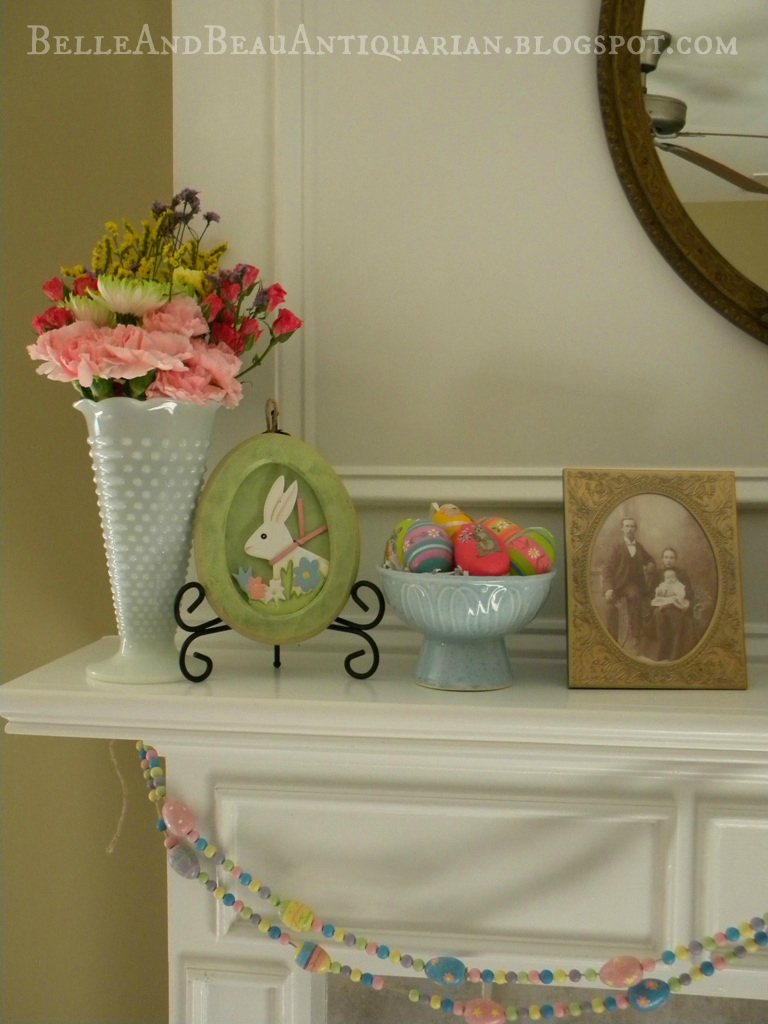
Here you can see how I combined new and old.
What’s “old?” The Fire King hobnail milk glass vase, the Brush-McCoy robin’s egg blue egg & dart dish, the picture of my great-grandparents.
What’s “new?” The garland, the eggs, the rabbit plaque, and the picture frame.


Sometimes when I am putting together a vignette or mantle, I simply walk around the house looking for certain colors. These old books were the perfect spring time color for the mantle.

Here are some other mantles that I found on Pinterest. I think they’re lovely, don’t you?

This one is from marthastewart.com. I like that it uses different shades of just pink and blue. 

This one is from Tattered & Inked. I love the mix of natural wood and burlap with the bright colors of the eggs.


Here is another one from Emerald Interior Design. It’s fresh, simple, not too busy, and it will definitely carry past Easter and through Spring.


Finally, this was was too bright and cheerful to leave out. It’s from Positively Splendid, and it is. Positively Splendid.


I hope you’ve been inspired to create a beautiful Easter mantle of your own. I found all of these lovely ideas on Pinterest. Join me there!

XOXO,
Abby


//assets.pinterest.com/js/pinit.js

Drop Leaf {Table} Like It’s Hot


I love marking things off of my “list.” And this table has been on my to-do list for wayyyyyy too long. I have procrastinated doing this table like nobody’s (I’ll get to it) tomorrow.

I paid more than I thought I should have. (We left it in the garage.)

I thought it was going to be very difficult and time consuming to fix. (We dumped stuff on top of it.)

I thought the existing finish was going to be stubborn. (We never even completely unwrapped it.)

But you’ll never guess what happened. It’s the first piece that I have been able to refinish 100% on my own. As in, no one had to move it for me. No one had to hold it up while I did anything to it. I did it all. On. my. own. Oh, how glorious it is to say that. I hate asking for help. For anything. (Do you know that about me yet?)

I sanded the top just to rough it up a little bit for some “tooth.” “Tooth” means something for the paint to grab onto. Chalk paint isn’t supposed to need priming or sanding, but like I mentioned, I was worried about the existing finish being stubborn and difficult. I didn’t sand anything other than the top.

I make my own chalk paint. I used Martha Stewart Living in “Duck’s Egg” as my base.
After that I used Valspar Glaze in “Mocha.” 
Lastly, I used Krylon UV-Resistant Matte spray finish. I didn’t use a wax as I normally do because I didn’t want any sheen (shine), however I did want some protection on the table top. The trick to using this spray and having it be truly matte, with no spray marks, is to hold it at least 12 inches away from your surface. If  you hold it much closer than that you won’t have an even finish. As the directions on the can say, wait at least 2 minutes in between coats to avoid “white-ish” spots.

It’s more green than in this pictures. Don’t know why this came out so much lighter.

This table is perfect for our house. We like to have big family meals with the whole family, which is 15 and counting. If we open this up with the two leaves and combine it with our other dining table which seats 8. there will be plenty of room for everyone.

I hope you love it as much as I do.

XOXO,
Abby

Functional Push Pins.

I like it. I don’t like it. 

I want it up. I want it down. 

It motivates me. It irritates me.

The sun is shining. The sun is not shining.

Life changes. I change my mind. Sometimes. A lot. Every day something new inspires me. Colors, People, Quotes, Photos. I needed a way to be able to actually use my bulletin board that I made in yesterday’s post.

Typically I put the bulletin board up, and then I pin some things onto it. And then those same things stay pinned up onto the bulletin board for 3 (or 11) years, while the little things that I use every day stay on the surface of my desk.

What if there was a way to avoid looking lazy improve the functionailty of my bulletin board? When I really thought about it, the reason that I wasn’t using my bulletin board as an organizational piece on a day to day basis was that I was constantly needing to pin up, remove, and repin what I was using.

For example, a paint chip. Found one I love: pin it up. Want to hold it next to something: take it down. Lose the pin. Leave paint chip on the desk. Need to take the paint chip to the fabric store. Can’t find the paint chip.

Example No. 2: Put up a fancy-schmancy quote to inspire me throughout the day or week. Get used to the quote being there. Stop looking at the quote. Stop being inspired. But leave the quote up because if I take it down, it’s going to get lost on my desk and wrinkled. Then I’ll have to throw it away and that will hurt a tree.

Solution: Pins for my bulletin board that are also…CLIPS. I’ll let that sink in for a minute.

Pin once. Clip over and over and over again. Clip several things together. Switch them around.

The best part? NO. PIN. HOLES. *gasp*  So simple to do:

Both from Walmart in the Office Supply aisle. Next to all the cute Post-It Notes. You could use flatter push pins, but I like these.

Glue Gun. You’ll need one. Also found at Walmart. Craft section.


Life changer.

Functionality.

And don’t forget. You’re a Peach.
XOXO,
Abby

Fabric Covered Bulletin Board

So, here’s the thing:

To a creative person originality is very important. When a creative person comes up with an idea and then suddenly discovers that it wasn’t their own individual idea that they can take credit for entirely, it’s not a good moment. It’s like a HISSY FIT inside the head. “No, Ma’am. I do not think so, Missy! That idea was mine, mine, mine!”

That is exactly what happened to me. At any given time I have several blog posts in progress at the same time. Sometimes there are even snippets of other projects in the background of other projects that I’m posting about. I’ve had this project done entirely (and up on my wall) for weeks now. I’ve even used it as a background for other posts and for some Etsy listings.

That being said, the other night I was browsing Pinterest before bed. I don’t know what it is about scrolling Pinterest on the iPad, but it always lulls me right to sleep. Anywho, suddenly, there it was. My project (this project) done entirely, exactly like mine. Same exact fabric and everything. So ahead of time, if you happen to see a similar exactly the same project on Pinterest, it was not intentional. I did however get inspiration from a Pinterest project, and I want to give that project credit for inspiration here. 

~~
I’ve mentioned (either here or on our Facebook page) that I’m revamping my office space. Step one for me is organization. I want it to be organized so that it’s not only functional, but also enjoyable.  One of the small things I’ve done is to take a bulletin board that I was already using and make it beautiful and even more useful. Today I’m going to show you the more beautiful part, and tomorrow I’m going to show you the more useful part.

I started with my bulletin board, some spray adhesive, my fabric of choice, my handy-dandy staple gun, and some upholstery tacks.

Next, I cut my fabric to size so that I could wrap it around the edges. I rolled it up, so that after I sprayed the adhesive it would be easier to apply.

Once the fabric was wrapped around to the back, I trimmed off the excess and used my staple gun to attach it to the wood trim in the back.

The last step was to use the upholstery tacks as a finishing touch around the edges. Since they are sharp, they simply push into the cork board. To make this project a super easy snap, below are links to the supplies that I used.

Time to get to work!
XOXO,
Abby
 

Cosmetic Sugery: A Furniture Facelift

I have a big birthday coming up in a few weeks. Okay, no I don’t. It’s not a big one! It may or may not be a mid-life number. Okay, it’s not. I refuse to believe that half of my life is over. It’s not. I’m calm over-reacting.

*sigh* At what number did I stop wanting to get older? One minute I’m wishing that everyone would take my super-young, over-achieving, bossy-pants self seriously. The next minute I’m wishing that everyone would just chill out, relax, and get over themselves. How did I get from having two small kids, to having one that is bigger than me? Today is the day. It’s the day that I start my savings account for cosmetic surgery when everything is sagging and dragging on the floor mid-life crisis therapy.

Speaking of “cosmetic surgery.” Check out what got a facelift! Within a couple of weeks, we found two, almost identical chifferobes. This one, I’m embarrassed to say,  has been sitting in our foyer hallway for nearly 6 months. If you aren’t familiar with chifferobes, basically it is a closet, outside of a closet. Houses never used to have the enormous walk-in closets that are standard in today’s new construction. Closets were tiny, and if you needed more closet space, a chifferobe is what you got.

On one side (the left in this case), are drawers and a small cupboard. On the other side is a door that opens to a bar for hanging clothes. In this particular chifferobe, when you open the door, there is space under the drawers for a pair of shoes.

This piece definitely needed a face lift. It’s wrinkles cracks were spackled. It had a limp (one missing wheel). Surgery was successful.


I made my own chalk paint using Martha Stewart’s “silhouette” from Home Depot. Afterwards I used Valspar glaze in “mocha.” I finished it off with Minwax Paste Finishing Wax.

We had originally planned on keeping the mirrors, but while adjusting the hinges I dropped one of the doors. The mirrors were out and the chicken wire and burlap were in. I’m actually kind of glad it happened, because I love how it turned out.
I am having a hard time saying “goodbye” to this one. I would love to keep it in my foyer to hang guests’ coats in. Or perhaps it would be good for hanging the kids’ backpacks in. I can also imagine this being used in a kitchen for aprons, kitchen towels, and other linens. 
I will most likely have this for sale at my next antique festival in April.
I hope you love it!
XOXO,
Abby