A History of Country Easter Egg Decorating: a Pennsylvania Dutch Tradition

//assets.pinterest.com/js/pinit.js

An introduction:

Today most families decorate their Easter eggs with store bought kits. I know we certainly do! The more advantageous egg decorators may even use natural dyes they discovered on Pinterest. I would like to share with you the history of how my grandparents and great-grandparents decorated Easter eggs with their kids, my dad included, while they lived in Shenandoah Valley, Virginia. Their ancestors were Pennsylvania Dutch and these methods for Easter egg dying most likely came with them from Pennsylvania to Virginia over a century ago. I post this here in the hope that this history will not be lost. Thank you to my aunts Gail and Martha who humored me a couple of years ago with my questions, and my apologies for taking so long to publish it here.

“Easter was an important part of growing up in the country — not only did we see Easter Sunday as the most important Sunday in the life of the church, it was a time when we kids could take part in coloring Easter Eggs, and at the same time we heard stories of an even older time!  Here is the sequence of how we did our eggs:

First, on Good Friday Mama (Grandmother Polly Will Lytton) would boil several dozen eggs — sometimes 3 or 4 dozen depending on how many were at hand.  Once the eggs were boiled they were placed in colanders or pans — nestled into old cotton of some sort (old dish towels, clean rags of every kind) and ALWAYS with very clean hands — Mama did not want any oil or grease to spoil what would be the final product.  The pans of eggs were then put on the back screened porch to cool overnight — never into the icebox (or later the refrigerator) where if cooling too fast they would “sweat”.

On the Saturday before Easter, after supper, Mama would gather all the things needed to “spot eggs” — vinegar, suet, dyes, old woolen shirts or sweaters — she would have everything ready before she brought the eggs in from the porch.

//assets.pinterest.com/js/pinit.js

 With all us kids hovering around and Grandma Edna and Granddad Carson near by we would start (I can’t remember your Granddad Ty Cobb Lytton being involved at all — maybe he was doing final outside chores …or taking time to just sit aside and read the paper!)

This is how it would go:   Grandma had boiled some onion skins to make brown dye; Granddaddy would be standing by to mix the toxic black dye (kids not allowed to touch – it was cloth dye and it was toxic!); Mama would set old cups or those stained from previous Easter dye sessions around the table and carefully put the dye tablet, some vinegar, some hot water in each cup and each of us would take up a space around the table and try to stir and melt the tablet without spilling a drop (not always successful at that).  With that accomplished Mama would carefully put an egg in each cup and we would try to made sure that each egg was evenly colored.  Each colored egg was laid again in clean cotton cloth to completely dry and wait for “spotting.”  We kids of course would try to outdo each other in whose eggs came most perfectly out of the dye — not a quiet discussion.
When we were very young we would be sent off to bed to wait for Easter morning where we would find baskets of the decorated eggs — as we grew older and stopped believing in the Easter Bunny WE were allowed to help and this is how it went:

Once the eggs were cool and colored, Mama would melt the suet in a pan on the stove — this really was beef tallow that she saved from year to year —  from Easter to Easter — with very clean hands we would each take an egg and using our fingers — or for more intricate designs a straw from a REAL broom — and dip into the tallow and make spots of tallow all over the egg — or dip each end of the egg in tallow and put a design in tallow around the middle –or use a straw to make a design;  Mama ALWAYS took the green eggs and made a  wheat design [shafts of wheat, little tadpoles, crosses, bunny tracks, spiders] up and down the egg w/tallow using a broom straw   — Granddaddy used the black dye to make “baldies” by dipping each end of the egg in the tallow — then he would take a black egg and with a straw draw spiders all over the egg — somehow I cannot remember if we decorated Grandma’s onion skin dyed eggs –maybe we just admired them as brown — I’ll have to ask one of the “Lytton girls” about that …anyway  we could make any design we could manage — as you can imagine some of us had much more artistic talent then others!!

After the tallow hardened on the egg — and it hardened quickly on the porch-cooled eggs — and the older the tallow the more quickly it hardened — Mama would place the eggs in a bowl of water and apple vinegar where they would sit for a few minutes — then out she would take them and rub with the woolens she also kept from year to year — all the color would come off EXCEPT for that under the tallow — can you picture that?  Of course the tallow came off too but the color underneath did not and formed the design.

Preparing/decorating Easter Eggs in this way was always attributed to our Pennsylvania Dutch/German ancestors — I like to think of them as folk art — while those of the Ukraine are/were much more complex and sophisticated — I do not know of anyone who decorates eggs “our” way now — Some of us have tried  over the years — but the eggs are treated/coated when they come from the store – so you need straight from the hen — the dyes are much too harmless nowadays so the color won’t stick – and the tallow must be heated again and again to render it to the point when it will harden quickly –“
The eggs were a simpler version of traditional Dutch decorated eggs such as these.

//assets.pinterest.com/js/pinit.js

This process must’ve produced the most beautiful and unique eggs. I don’t think that I will ever actually be able to take these steps. The tallow and fresh eggs aren’t realistic ingredients for me to come by. But I do think it is important for this history to be written down and remembered. There is a lot of art lost in convenience, don’t you agree?

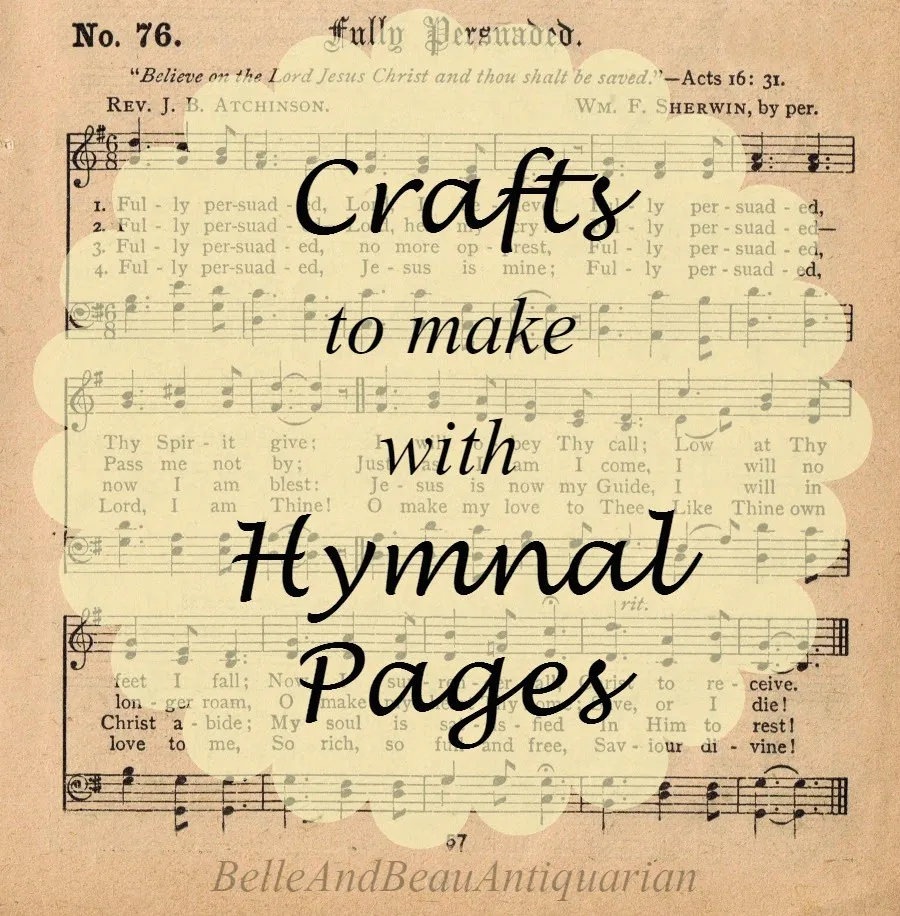
header image crafts to make with hymnal pages

Crafts to Make with Hymnal Pages

Years ago, a friend asked me a simple question: “What would someone do with an old hymnal?”

An old hymnal can be lovely simply sitting on a piano or tucked into a shelf of antique books. Open one, and you may find familiar songs associated with Sunday mornings, weddings, funerals, or someone you once heard singing from the pew beside you.

However, not every old hymnal remains in a condition that allows it to be used as a songbook. When the binding has failed or pages are already missing, the remaining hymns can be given a new purpose through framed art, Christmas ornaments, wreaths, handmade gifts, and other paper crafts.

If you have an old hymnal that has reached the end of its original life, here are several meaningful ways to preserve a few of its pages.

This article contains affiliate links. If you purchase through these links, Belle Antiquarian may earn a small commission at no additional cost to you. As an Amazon Associate I earn from qualifying purchases.

a stack of vintage and antique hymnals ready to be used for crafts
Using damaged hymnals is a great way to save precious hymns from the trash.

Before You Take Apart an Old Hymnal

Before removing any pages, take a few minutes to look through the entire book.

A hymnal with a family inscription, handwritten notes, a church dedication, or another meaningful connection may be better kept intact. The same is true for an unusual or particularly old edition that you have not researched.

I own several intact hymnals that I would not use for crafts. Their value to me comes from the books as a whole, including their worn covers, familiar songs, and evidence of the people who once used them.

For a project, look instead for a common hymnal that is incomplete, damaged, or no longer sturdy enough for regular use. If you want to create something from a meaningful family hymnal without cutting it, make a copy of the page and return the original to the book.

This is also a good time to choose the hymn carefully. A song connected to a wedding, a loved one, or a family tradition will make the finished piece more meaningful than a page selected only for its appearance.

Where to Find Hymnals for Crafts

Old hymnals can often be found anywhere secondhand books are sold. Look in thrift stores, antique shops, estate sales, library sales, church rummage sales, and online resale marketplaces.

When shopping in person, check the condition of the binding and look through the pages for inscriptions or missing sections. A book that is too damaged for a collector may be exactly right for a paper project.

Online listings can also be useful when you are searching for a particular hymn, denomination, or publication date. Because the contents vary from one edition to another, ask the seller to confirm that a specific hymn is included before purchasing the book for that purpose.

a stack of open hymnals showing favorite hymn songs

Useful Supplies for Hymnal Page Crafts

Many crafts using hymnal pages require only a few basic paper supplies. The materials you need will depend on the project, but these are useful items to have available:

A hymnal page is usually thinner than cardstock and may have become fragile with age. Work slowly, particularly around worn edges, and avoid applying more moisture or adhesive than the project requires.

See all of my recommended hymnal page craft supplies.

Frame a Favorite Hymn

The simplest way to use a hymnal page is also one of the most meaningful: place it in a frame.

Years ago, I framed a hymn and displayed it on the bedside table in our guest bedroom. The project required very little alteration to the page, but it allowed the words and music to become part of the room.

A framed hymn can commemorate a wedding, honor someone’s favorite song, or preserve music associated with a particular church or season. It can stand alone or be layered with a mat, photograph, handwritten note, pressed flower, or another small keepsake.

If the page is old or especially meaningful, use acid-free mounting materials rather than applying ordinary glue directly to the paper. A simple wood or brass frame complements the warm color of aged paper without distracting from the music.

a rustic picture frame holds a vintage hymnal page
A simple way to repurpose old hymnal pages is to place them in a frame.

One of the simplest projects is to place a meaningful hymn in a frame, allowing the words and music to become part of the room.

Incorporate Hymnal Pages into Original Artwork

Hymnal pages can also become part of a larger piece of artwork.

In an earlier project, I used cut pieces from hymn pages in a painting. The printed notes and lyrics added another layer to the image, both visually and in meaning.

Pages can be used as a background for a silhouette, arranged beneath a painted or printed image, or cut into shapes to become part of a collage. If the words will remain visible, consider how the hymn relates to the subject of the artwork rather than choosing a page at random.

A precision craft knife and cutting mat are helpful when the design includes smaller shapes. For a layered collage, choose an adhesive intended for paper and test it on an unused page before applying it to the final piece.

Pieces of hymnal pages can add texture and meaning to paintings, silhouettes, and other mixed-media artwork.

Make Christmas Ornaments from Hymnal Pages

Christmas crafts are a natural use for old hymnal pages, especially when the book contains familiar carols.

Pages can be folded into simple shapes, cut into stars or trees, rolled into cones, or applied to the surface of an ornament. Thin hymnal paper may need to be attached to cardstock before cutting, particularly if the ornament needs to hold its shape.

Finish the ornament with a narrow velvet ribbon, satin ribbon, or natural twine. The materials can be chosen to suit the rest of your Christmas decorations without covering the music that makes the ornament special.

When selecting a page, look for a recognizable title or lyric that will remain visible after the design is cut or folded.

IDEA:  Hang on dining room window latches    in love with these diy cloth ornaments and color scheme for sun-room - all year

Create a Hymnal Page Wreath

A wreath made from rolled or folded hymn pages can preserve a large portion of a damaged book in one project.

Some wreaths are made by rolling individual pages into cones and attaching them around a circular base. Others use folded pages to create a softer, ruffled effect. A flat wreath form provides a base for arranging the paper while keeping the finished wreath light enough to hang.

Before attaching anything permanently, arrange the first layer around the form to determine the spacing. The finished wreath can be left simple or completed with a restrained ribbon at the top.

Because old paper can fade and become brittle, display a hymnal page wreath away from moisture and prolonged direct sunlight.

A Hymnal Page Wreath :: Hometalk

Turn a Hymnal Page into a Meaningful Gift

A handmade gift does not need to be complicated to feel personal.

A favorite hymn can be used to create:

  • A framed wedding or anniversary keepsake
  • A bookmark
  • A handmade card
  • A gift tag
  • Paper flowers
  • A small Christmas ornament
  • A background for a family photograph
  • A memorial piece honoring a loved one

One reader shared that she used hymnal pages throughout her son’s church wedding, making paper roses, bows, vases, hearts, and table runners. Her comment is a wonderful example of how a simple material can carry meaning throughout an important family occasion.

When making a gift, begin with the person rather than the project. Think about which hymn, occasion, or memory connects the page to its recipient. That small decision is what changes an attractive paper craft into something worth keeping.

Use Hymnal Pages for Decoupage Projects

Hymnal pages can be applied to boxes, trays, drawer fronts, furniture, and other decorative surfaces.

The size of the project should determine the role the paper plays. On a small box or tray, the music can cover the entire surface. On a larger piece of furniture, it may be more effective to limit the pages to drawer fronts, panels, or another defined area.

Before beginning, consider whether the surface is clean, smooth, and appropriate for decoupage medium. Older paper may darken or become more translucent when wet, so test a spare page first.

One of the original sources included in this article showed old book pages applied to furniture, storage boxes, and a lampshade. You can see the paper-decoupage examples at AJ’s Trash to Treasure.

Paper-covered lampshades require additional care because paper and heat are not a good combination. Treat them as inspiration unless you are certain that the shade materials, adhesive, fixture, and bulb can be used together safely.

Give an Old Hymnal a Thoughtful New Purpose

An old hymnal does not need to be dismantled simply because it is old. Many deserve to remain just as they are, particularly when they carry a family or church history.

Others have already been loved nearly to pieces. Their bindings are broken, pages are missing, and they can no longer serve the purpose for which they were made. Those are the hymnals that can be thoughtfully transformed.

Whether one page is placed in a frame or many are gathered into a wreath, the most successful hymnal page crafts begin by choosing something meaningful. The familiar words and music are what make these projects more than decorations.

They allow part of an old book to be seen, remembered, and appreciated again.

Do you enjoy finding thoughtful ways to use old things, preserve meaningful traditions, and create a home that feels collected over time? Join the Belle Antiquarian mailing list to receive new stories and seasonal inspiration for the traditional home and the life surrounding it.

You may also enjoy:

Dressing with Southern Class (& a little bit of sass!)

//assets.pinterest.com/js/pinit.js

1. Pearls go with everything. A nice, quality set of pearls is basic piece in every southern wardrobe. Pearls can be worn everywhere from work or a wedding to a baby shower, church, or picnic. Pearls never go out of style and can be passed down through generations. Pair your necklace or earrings with a dress or jeans. You’ll look and feel fabulous with them on.
Sterling Silver and White A-Quality Freshwater Cultured Pearl Necklace (7.5-8mm), 18″

2. Monogram it.
If you liked it, then you should’ve put a monogram on it! Southern ladies like to add a monogram to shirts, workout shorts, handbags, and sheets. You can even add a monogram to your wall! I love this timeless monogram necklace.
Sterling Silver Fancy Monogram Necklace (18 Inches)

3. Timeless pieces mixed with modern and trendy accessories. The basis of any great southern wardrobe are timeless pieces that you can mix and match. Find ways to bring colorful, modern, and trendy patterns into your wardrobe with accessories!

4. Fun with classic lines. Think Lilly Pulitzer fabrics . Think Seersucker suit. We do like to have fun with a playful pattern! Southern gents have been known to wear shorts in all sorts of tongue-in-cheek patterns. The important thing to remember is that pieces should always have classic, modest lines. Have fun, but command respect!
Lilly Pulitzer Women’s Janice Shift

5. Modest and tasteful.
Let’s face it. Modern jeans that make your figure look fantastic while standing up, don’t always step up to the job while you are sitting down or bending over. The same can be said for semi-sheer to sheer tops or tops with lower cut necklines. A southern lady leaves certain areas to the imagination. I personally own several of these tank tops and wear one almost every day. They help cover areas that jeans and tops can leave exposed. As an added bonus, these tanks make all of your curves feel fantastic. (i.e. Not jiggly!)
Sugar Lips Seamless Rib Tank Top, Black, One-Size

6. Dress for the occasion.
Knowing exactly what to wear for each occasion can leave you feeling panicked and unsure of yourself. Black tie, white tie. Formal, business casual. Company picnic, baseball game. It’s important to know what is appropriate and how to make a good impression at all times. Check out this fantastic guide:
A Guide to Elegance: For Every Woman Who Wants to Be Well and Properly Dressed on All Occasions

7. Always support your team, your sorority, and your school.
Southerners are known to support their colleges, sororities, and fraternities for life! A SEC football game is an opportunity for every southerner to bring out the preppiest of fashions in their school colors. I personally love this shirt. Because, well, it *is* home…til the day I die, y’all!
Homeland Tees Women’s Georgia Home State T-Shirt

Keep it classy, y’all!
XOXO,
Abby

This post contains links to amazon affiliate ads.