
Creating a heritage home with antique furniture, collected artwork, traditional furnishings, and pieces chosen to last

Creating a Heritage Home That Lasts for Generations

In 1880, British designer William Morris said, “Have nothing in your houses that you do not know to be useful or believe to be beautiful.” I think this statement could be taken one step further by adding, “or could last a lifetime.”

My favorite new podcast, The Sentimental Twist, has two ladies who talk a lot about things they’ve learned or inherited from their mothers and grandmothers. One of the hosts has a dining table that was her grandmother’s. The other host talks a lot about recipes that her mother used to make.

Creating a heritage home with antique furniture, collected artwork, traditional furnishings, and pieces chosen to last
Our living room has been collected slowly over time. With the exception of one piece, every piece of furniture in the room was purchased secondhand.

These are practices that truly resonate with me, and you’ll find them repeated throughout the Belle Antiquarian website. I believe in creating a heritage home that is centered around things that are useful, beautiful, and could last a lifetime, as well as traditions that bind us to the ones we love.

A Heritage Home Doesn’t Have to Be Inherited

My own story, however, doesn’t begin with inherited heirlooms and traditions. I don’t own my grandmother’s pearls; mine were a gift from my husband. My family’s traditional meals are ones that I have made every year since my husband and I were married, but I never ate them as a child. The antiques in my home were originally purchased by someone else.

A heritage home does not have to be inherited; it can be created by intentionally choosing what is worth keeping, establishing traditions worth continuing, and building a legacy that can be passed on to the generations that follow.

Traditional living room with antique china cabinet, blue and white china, upholstered sofa, patterned rug, and brass lamp
Our treasured collection has slowly come together over the years. A sofa from an estate sale, china cabinet from a thrift store, rug from an auction, and various other things we’ve collected over the years.

Creating a Heritage Home in an Age of Fast Decor

With the rapid onset of “fast fashion” in recent years, we’ve also seen an increase in fast decor. There has been a shift from purchasing items because of quality construction and durability to things that can be cheaply purchased, and then discarded, with each new trend.

Something that I have encouraged on Belle Antiquarian over the years is to decorate your home for the seasons by gathering items from your home and garden that reflect the seasons as they change, rather than purchasing something new for each one.

For example, a chinoiserie bowl can hold glass ornaments at Christmas, floating camelia flowers at a dinner party, or dyed eggs at Easter.

It is beautiful, useful, and can last a lifetime. It could have been a gift from your grandmother, or a Saturday morning antique store find. It’s the tradition of using it and passing it on that changes it from an ordinary object in your home into a treasured piece in a heritage home.

Blue and white chinoiserie bowl displayed on a silver tray beside a ginger jar and brass lamp
This chinoiserie bowl changes with the seasons, holding everything from Christmas ornaments to camellias and Easter eggs.

Choosing Furniture and Décor That Will Last

Some advertisers and influencers would have you believe that your seasonal décor must be on-trend. Unfortunately, some trends only last for a short time. In a heritage home, not only will pieces work in the same season each year, but they’ll be worth passing on to the next generation as well.

It becomes important to evaluate each item beyond its aesthetics. Many beautiful things are not made to last. Materials like solid wood, marble, and many metals have been used for centuries. Looking for these materials when you purchase a piece for your home will give it the best chance for longevity.

Open drawer showing Knapp joint construction on an antique wood table
The distinctive Knapp joints on this antique table are evidence of the craftsmanship that has allowed well-made furniture to remain useful for generations.

We recently painted the living room in our 1939 Colonial Revival home. As my husband and I were putting all the furniture and décor back into the room, we realized that there was only one piece of furniture in the room that we bought new. Everything else was purchased secondhand.

One piece that we’re still lacking is a coffee table. My husband has offered to take me to a variety of furniture stores to buy one, but I’ve noticed a change in the quality of some furniture in recent years. As I’m looking for a table, I’m keeping quality construction, durable materials, and timeless style in mind.

When we finally buy our coffee table, I don’t ever want to buy another one. Timeless pieces are less likely to be replaced due to changing trends, so it’s important to me to find a coffee table that is worth keeping.

Slow Decorating: Build a Home Over Time, Rather Than Buying a Look

Since I haven’t found the right coffee table for our home yet, that space will remain empty. I’m not interested in filling the void with something until I find one that I want to keep forever.

Your home is a work in progress. The story of your furnishings can be one that takes years to evolve. Whether it’s a piece of art to hang over the fireplace, a lamp for an end table, or a rug for a guest room, there is no reason to rush simply to fill an empty space.

Antique wood secretary desk with open writing surface, family photographs, books, blue and white cups, and brass desk lamp
This corner of the living room is sentimental and functional. This secretary that we found on Facebook Marketplace is filled with antique books, photos of my grandparents, and found objects like feathers and shells.

Be the Beginning

When I think about The Sentimental Twist podcaster talking about her grandmother’s table, I feel a longing for family heirlooms in my own home. Inheriting an attic full of furniture is a gift. But to be honest, the reality is that very few people have that experience.

A family’s heirloom dining room table is certainly one to be treasured; however, the true beauty is that it was made to last through years of Thanksgiving meals where hands were held during the blessing.

Mounted pheasant above an antique china cabinet styled with vintage books, copper bowl, and blue and white china
This pheasant is one of our newest additions. After years of searching for just the right one (at just the right price), my husband found this one in an antique store.

If you’re like me, and you don’t have a box full of your mom’s recipes or a piece of furniture from your ancestors, you can be the one to create a heritage home. As you build your home around you, consider what William Morris (and I) said, “Have nothing in your houses that you do not know to be useful or believe to be beautiful [or could last a lifetime].”

Maybe one day your family’s traditions and treasures will all be traced back to you.

Check out these other reader favorites:
Traditional home design with connected rooms, layered rugs, and warm natural materials.

Traditional Home Design: Five Foundational Elements That Last

The highest compliments I have gotten as an interior designer were when my grown kids asked me for advice when decorating their own homes. Even when they were very small, I took them with me to go sourcing antiques for our home and my retail spaces.

Over the years they absorbed the importance of quality construction and materials. They know that if you buy a quality piece of furniture or decor, that you may not ever have to replace it in your lifetime.

People often confuse traditional home design with being old-fashioned. On the contrary, timeless home design is created by using classic elements that never go out of style.

The homes that stay relatable throughout the decades often have less to do with trends and more to do with the decisions that shape them over time.

What Defines Traditional Home Design

Labels are used frequently when talking about interior design. Contemporary, minimalist, and traditional are all terms you’ve likely seen online and in magazines. So, what exactly is traditional home design?

The word traditional is used to describe decor that often has a European influence. Traditional home decor often emphasizes symmetry.

Other elements that are trademarks of traditional interior design are layering of fabrics and patterns, curved and ornate wood carvings, and pieces that have been collected over time.

Spaces with traditional home design are a reflection of who lives there. At the heart of traditional home design is an understanding that rooms should feel visually balanced before they are ever fully decorated.

Proportion and Scale in Traditional Interior Design

If you’ve ever walked into a room and felt something about the decor was amiss, but you couldn’t put your finger on what it was, it was probably because something was off with the proportions or scale in the room.

Traditional dining room with carved wood table, patterned rug, and collected wall decor.
Traditional interiors often rely on proportion, natural materials, and collected details that feel layered over time rather than purchased all at once.

After moving into a new house, a friend told me, “I love this sofa so much, but no matter where I put it in the new living room, it just doesn’t look right.”

The problem wasn’t finding the right space for it, and there was nothing wrong with the sofa itself. The issue was that the sofa was purchased to fit in her last house, and it was entirely too big for her new space.

In traditional decor, designers often use the 2/3 rule of scale and proportion. This rule gives a pleasing sense to the eye as you take in the space as a whole. Large rooms can handle larger pieces of furniture, and in turn, smaller spaces need furniture on a smaller scale.

When scale is handled well, a room feels comfortable almost immediately, even if the viewer can’t explain exactly why.

Materials that Shape Timeless Home Design

The most successful traditional designs use materials that could have either been installed yesterday or one hundred years ago, and it’s difficult to know which it is.

Many of the materials associated with traditional homes share two qualities. First, they’re made of something found in nature, like wood, stone, linen, or leather. Second, they’re crafted from something man-made that can stand the test of time, like brass, copper, bronze, or nickel.

Choosing materials that are often found in traditional home decor will result in a timeless home design. As a bonus, these are often superior materials that not only withstand trends, but also physical wear and tear.

Over time, these materials also help create continuity throughout a home, allowing rooms to feel connected rather than separate from one another.

Creating Continuity in Traditional Home Decor

I remember watching the television show Trading Spaces, where neighbors would swap houses to redecorate one room with the help of a designer. As seasons went on, the designs became wild and unrealistic for everyday living.

The room reveals on the show often featured an outlandish space that the designer used to showcase their own creativity, instead of the tastes of the homeowner. As a result, these new rooms never blended with the rest of the house.

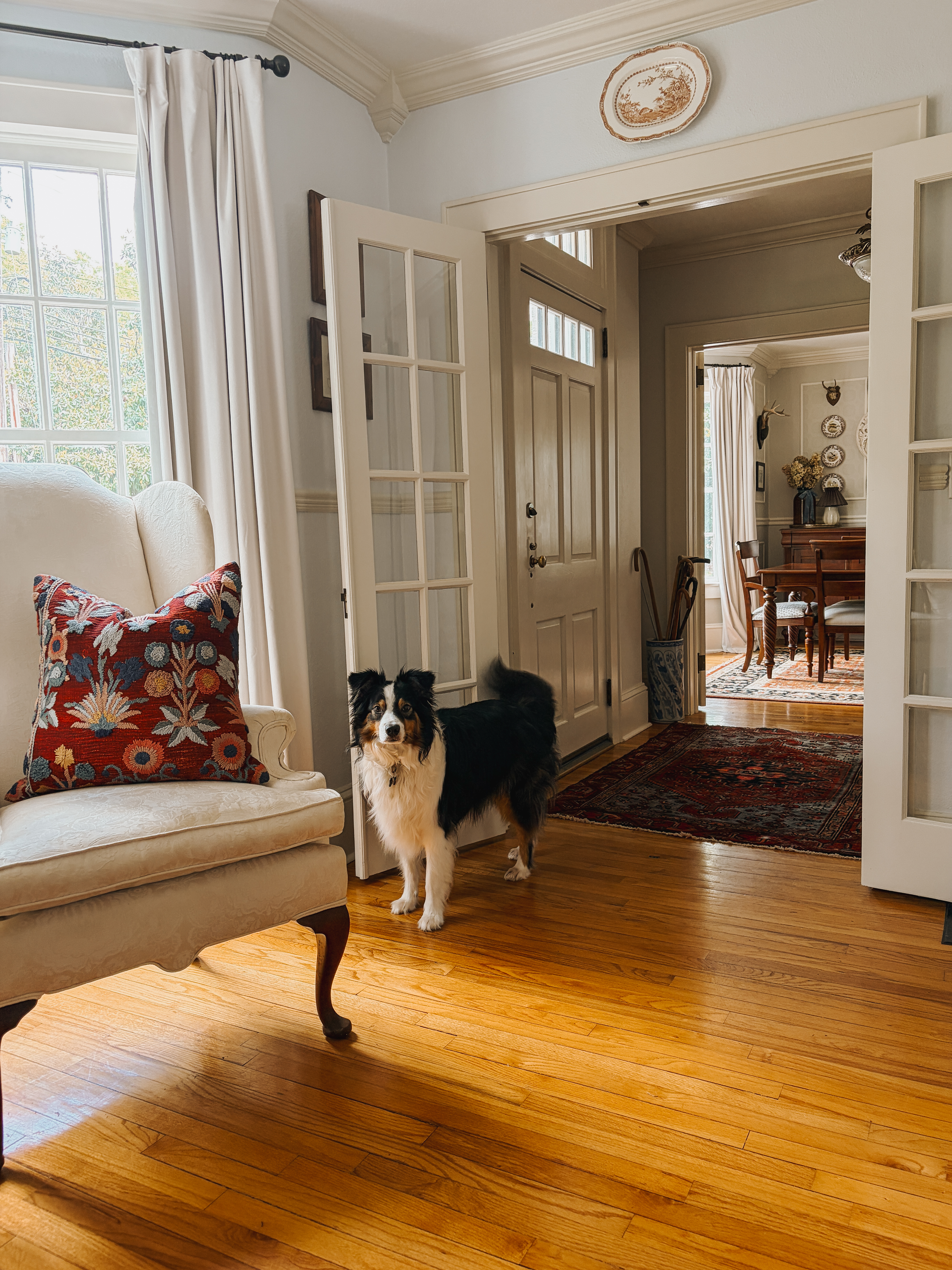
Traditional home design showing continuity between adjoining rooms with layered artwork and warm wood tones.
One of the defining characteristics of traditional homes is the sense of continuity between rooms rather than dramatic shifts in style or color.

In traditional homes, rooms are rarely treated as isolated spaces. Whole house color palettes create a smooth flow without disruptive color changes.

Using uninterrupted flooring finishes and repeating decor elements throughout homes also  creates continuity in traditional home decor. Traditional homes are often memorable not because of a single room, but because the entire house feels connected in both design and purpose.

Functional Layouts in Traditional Homes

In traditional interior design, floorplans have dedicated spaces for each living function. Rooms are designed to fulfill a purpose in the home, and the purposes of adjoining spaces are considered for how they relate to each other.

A kitchen will be designed for optimal workflow, but the kitchen design will also consider the placement and decor of the dining room, since the two often function in tandem.

In a classic home design, a living room layout will function to encourage conversation, and a bedroom layout will be designed to be peaceful and relaxing.

While decorating styles may shift over time, the ways people gather, cook, rest, and converse remain remarkably consistent.

A Collected Sense of Time in Traditional Homes

I love watching renovation shows on TV that surprise the homeowners with a brand new, completely styled room that they always fall in love with at the end. But the truth is that’s not always reality.

Traditional bedroom with antique wood bedside table, patterned textiles, layered artwork, and soft lamp lighting.
Traditional homes often feel collected rather than perfectly coordinated, with furnishings, artwork, and personal objects accumulated gradually over time.

Some people hire an interior designer to redo an entire room in their home. But there are far more people who call designers for help with one thing: draperies for a bedroom, a new sofa and loveseat with custom fabric, or flooring.

As you are making changes to your home, you’re also picking up a piece of art here and there, a basket to hold throw blankets in the living room, or a secretary desk to organize books and stationery in the corner of a study.

Classic home elements aren’t just beautiful; they tell a story that’s been written over time. Perhaps this is why traditional homes rarely feel finished all at once; they are shaped gradually through years of living.

Vintage books and blue-and-white ceramics styled on built-in shelving in a traditional home.
Collected interiors rarely feel overly matched; instead, they reflect years of retained books, furnishings, and meaningful objects.

How to Apply Traditional Home Design in a Real Home

Traditional homes tend to resist short-lived trends in favor of choices that remain appealing over time. In recent years there was an explosion of popularity in barn doors and vinyl plank flooring. These were new and exciting ways to decorate a home, but they weren’t enduring. Classic home decor is beautiful in any era, regardless of what is trending on the internet.

Traditional homes rarely feel assembled all at once, which is one reason perfectly matched furniture suites can feel overly uniform. Unmatched pieces can beautifully complement each other for a more collected look.

The most important thing to remember when creating a home with classic pieces is to go slowly. It’s okay if rooms are incomplete while you search for the right pieces to tell your home’s story.

Why Traditional Home Design Endures

As trends move faster online, interiors have also become more vulnerable to cycles of rapid consumption and replacement.

With instant access and saturation of influence on the internet, home furnishings and décor have become disposable. Composite materials and cheap construction mean that many things purchased today won’t be around in ten years.

Timeless home design endures because of quality craftsmanship and materials that last a lifetime. Traditional interior design considers functionality and cycles of everyday living, not what savvy influencers tell you is trending. Homes built slowly and thoughtfully often remain relevant far longer than those shaped by rapid cycles of consumption.


Check out these other reader favorites:

Traditional home design with connected rooms, layered rugs, and warm natural materials.
Traditional homes are often memorable not because of a single room, but because the entire house feels connected in both design and daily living.