
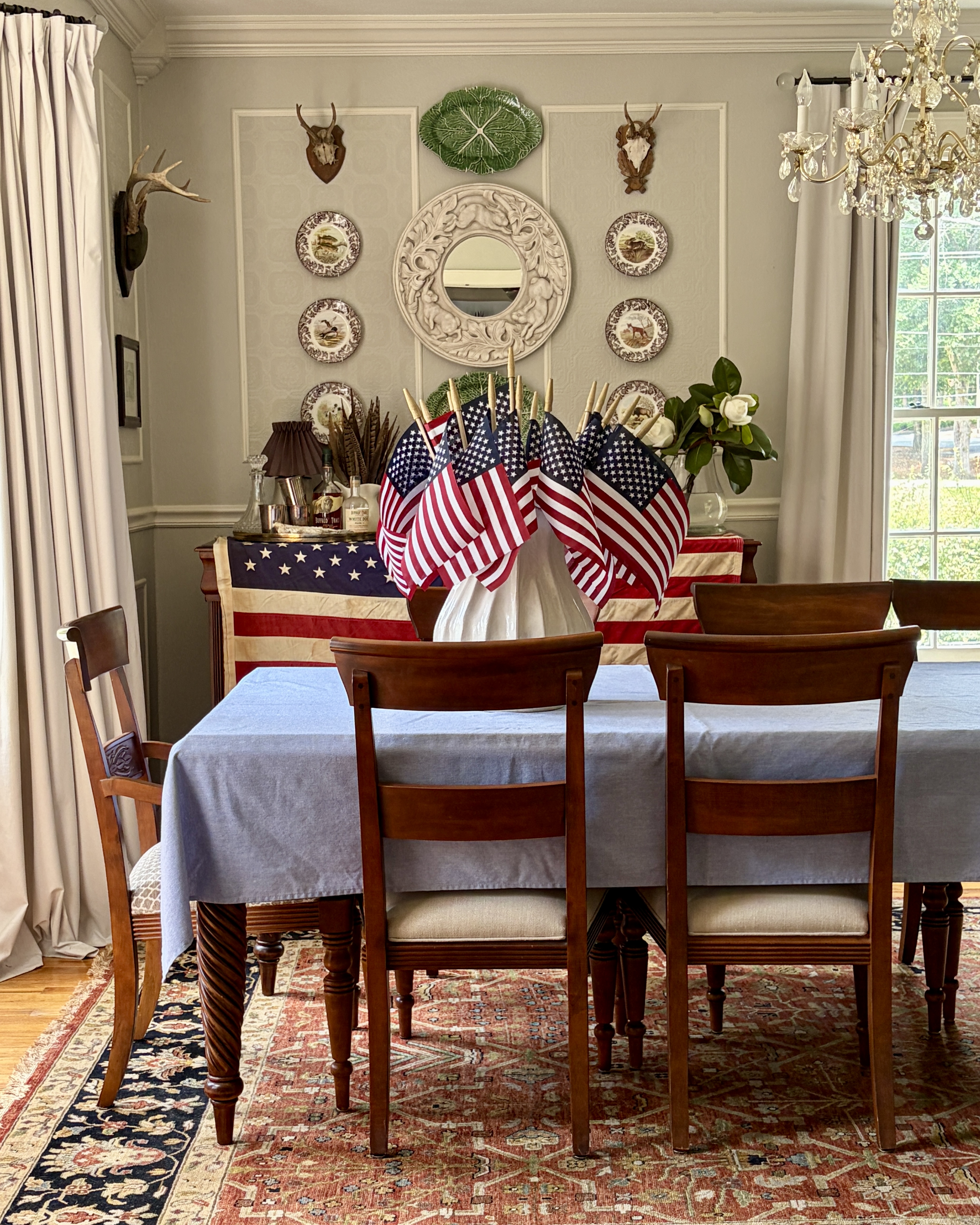
Southern dining room decorated in Americana style with traditional furnishings, layered textiles, vintage flags, and collected antiques

Americana Style in the Southern Home: Decorating with Tradition, Comfort, and Character

As America approaches its 250th anniversary, patriotic decorating is appearing everywhere from retail displays to magazine covers. Yet some of the most enduring expressions of Americana are not seasonal at all. They are the everyday objects that tell the story of a place, a family, and a nation.

The latest edition of my favorite magazine is telling me that Americana style is back. There is a resurgence of patriotic themes and symbols in retail spaces this year.

But true Americana style is not found on an aisle of Hobby Lobby. It’s an enduring design perspective that doesn’t need to be changed out with the seasons. At its core, Americana style reflects a distinctly American approach to home, one rooted in comfort, tradition, individuality, and a connection to place.

Traditional Southern living room with Americana-inspired summer decorating, blue and white porcelain, patriotic bunting, and layered textiles
Americana style often blends traditional furnishings, family collections, and seasonal patriotic touches into spaces designed for everyday living.

More Than Flags and Fireworks

Our little town is having a decorating contest to celebrate America’s semiquincentennial anniversary this summer. Participants are encouraged to decorate their homes or businesses with red, white, and blue for the 4th of July. Throughout town, buntings and flags are being used in various ways to celebrate the season.

As I sat outside one evening after decorating our own home for the contest, I heard a lady walking by remark to her friend that she loved anything Americana. People often associate patriotic symbols with Americana, but those are only one expression of the design style.

Americana style isn’t limited to the era or architectural style that a home was built in. Homes ranging from historical to newly built traditional homes can be decorated through the lens of Americana style characteristics.

The Characteristics of Americana Style

At the heart of Americana style is a reflection of the people who live there. It’s a design perspective that is built around characteristics shaped by the lifestyle of American people.

Americana style adapts traditional lines in furnishings to more softened edges with comfort in mind. Formal floor plans in Americana homes become more approachable because the function of these spaces has been adapted for everyday modern living rather than special occasions.

It’s common in Americana style for both soft and hard furnishings to be made from durable materials. Hardwood construction, combined with elements such as leather, brass, or canvas, are characteristics of Americana style furniture. Linen, wool, and various types of cotton weaves in fabrics reflect the materials sourced from American lands.

Classic patterns and textiles are layered in a manner that welcomes everyday living. Instead of holding beautiful finishes at arms-length, Americana style homes are hospitable and inviting.

As each space reflects the family within, Americana style homes characteristically feature personal collections that are often shaped by the specific place the home is found in.

Traditional bedroom featuring blue and white textiles, antique furnishings, layered rugs, and Southern Americana decorating
Americana style is often expressed through traditional furnishings, heirloom pieces, and layered textiles collected over time.

A Style Shaped by Place

Americana style encompasses a group of styles that are specific to the regions they represent. America has never had one singular decorating style. Each region reflects local influences, climates, and cultures of the people living there.

Southwestern Americana style is largely influenced by the climate of the region with color palettes that are inspired by desert sunsets. Soft furnishings and art are heavily influenced by Native American patterns, the landscape, and Colonial Spanish equestrian themes.

Coastal Americana designs are heavily influenced by maritime life. Artwork, color schemes, and soft furnishings mirror the colors of water and the ecosystems dependent upon it.

Furnishings for Mountain Americana homes are usually in natural wood tones, and it’s common for them to have roughly hewn edges and visible construction.

Here in the South, homes are traditionally designed with hospitality in mind. Homes feature both formal and casual gathering spaces, and additional entertaining spaces are created by using the garden or front porch as an extension of the home.

In Southern Americana homes, rooms are often designed around heirloom pieces of furniture because these homes place a significant emphasis on heritage and tradition.

Regardless of which regional style of Americana design is found in a home, the strongest designs reflect the traditions of the people who live in them.

Southern Americana decorating featuring a vintage American flag, sporting art, game plates, and collected decorative objects
Regional expressions of Americana often draw inspiration from local traditions, landscapes, and cultural influences.

The Role of Tradition in the American Home

When I travel, I like to tour historic homes that have been opened to the public. In Savannah, the Green-Meldrim House is a wonderful example of historic Southern Americana Style. In Santa Fe, the Palace of the Governors features classic Southwest Americana style.

I enjoy integrating vintage and antique pieces into my home, but Americana style doesn’t require us to cling to outdated traditions or live in the past. The modern role of tradition in American homes is to reflect on the history of the region, while moving forward with traditions of people currently living there.

Rather than focusing on strictly using pieces in our homes that fall under a specific design label, use the characteristics of Americana as a jumping point to create character in your home over time.

The most successful Americana designs combine treasures discovered over time and new pieces that will stand the test of time.

Implementing an Americana style in your home may begin with a collection of books on your coffee table, a china cabinet passed down from a grandmother, or a favorite recipe you share with your friends every year on the 4th of July.

Patriotic mantel display with family artwork, American flags, blue and white porcelain, and collected heirloom accents
Collections gathered over time often become some of the most meaningful expressions of Americana style.

Seasonal Americana Décor for Summer

Shortly before Memorial Day, I begin to decorate our home for summer. Since I’ll leave these “decorations” out until mid-July, I tend to steer clear of decorative pieces that feel trendy.

I don’t want to feel like I’m putting a patriotic costume on my house for the summer, so I usually begin by choosing items from each room that will have a summer aesthetic when they’re gathered together.

Baskets of seashells that my children have collected over the years are placed next to a stack of vintage books about American government and history. A small white ironstone pitcher holds blue hydrangeas from my garden with a little flag tucked inside as a nod to the season.

Southern dining room decorated in Americana style with traditional furnishings, layered textiles, vintage flags, and collected antiques
A Southern Americana interior combines traditional furnishings, collected objects, and seasonal patriotic accents without losing its timeless character.

Outside we have hung red, white, and blue buntings from the railings on the top floor. Flowerpots have been filled with red, white, and blue annual flowers.

The way we have decorated the outside of our house could have been from 1980 or 2026; it is timeless and restrained. Americana style has endured through the ages.

Why Americana Style Endures

As America prepares to mark 250 years, the enduring appeal of Americana style may lie in its ability to honor the past while continuing to adapt to the present.

Today, Americana style reflects the people living inside each home. Because America is a melting pot of people, Americana designs allow room for individuality and collections from personal life experiences.

Implementing this design style into a modern home is an act of layering unique perspectives and experiences in home décor, while combining it with a sense of place that echoes the culture and the landscape of the region.


Other Belle Antiquarian reader favorites:


This section contains affiliate links. I may earn a small commission at no additional cost to you.

To read more about Americana style, check out these recommended books:
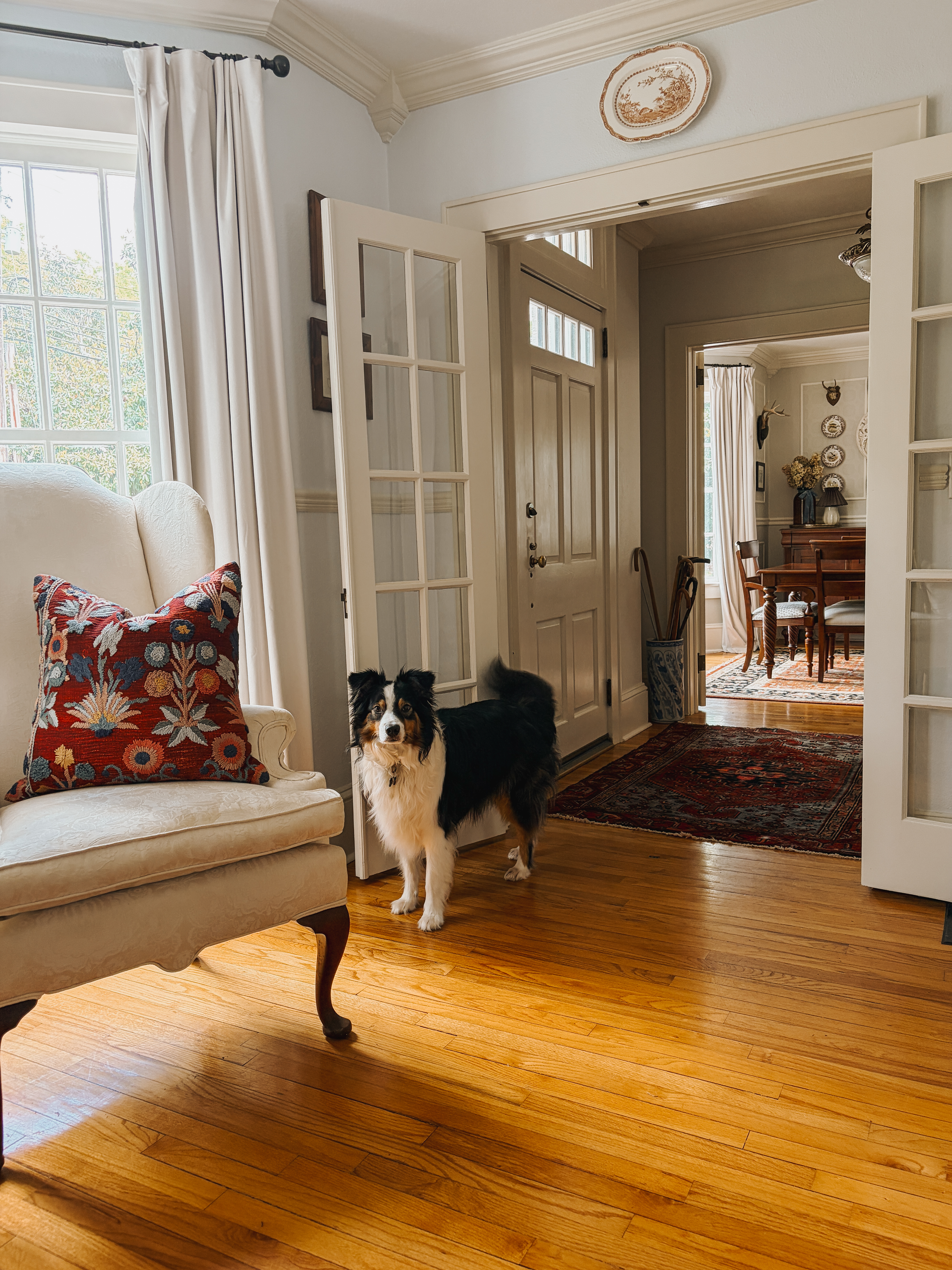
Traditional home design with connected rooms, layered rugs, and warm natural materials.

Traditional Home Design: Five Foundational Elements That Last

The highest compliments I have gotten as an interior designer were when my grown kids asked me for advice when decorating their own homes. Even when they were very small, I took them with me to go sourcing antiques for our home and my retail spaces.

Over the years they absorbed the importance of quality construction and materials. They know that if you buy a quality piece of furniture or decor, that you may not ever have to replace it in your lifetime.

People often confuse traditional home design with being old-fashioned. On the contrary, timeless home design is created by using classic elements that never go out of style.

The homes that stay relatable throughout the decades often have less to do with trends and more to do with the decisions that shape them over time.

What Defines Traditional Home Design

Labels are used frequently when talking about interior design. Contemporary, minimalist, and traditional are all terms you’ve likely seen online and in magazines. So, what exactly is traditional home design?

The word traditional is used to describe decor that often has a European influence. Traditional home decor often emphasizes symmetry.

Other elements that are trademarks of traditional interior design are layering of fabrics and patterns, curved and ornate wood carvings, and pieces that have been collected over time.

Spaces with traditional home design are a reflection of who lives there. At the heart of traditional home design is an understanding that rooms should feel visually balanced before they are ever fully decorated.

Proportion and Scale in Traditional Interior Design

If you’ve ever walked into a room and felt something about the decor was amiss, but you couldn’t put your finger on what it was, it was probably because something was off with the proportions or scale in the room.

Traditional dining room with carved wood table, patterned rug, and collected wall decor.
Traditional interiors often rely on proportion, natural materials, and collected details that feel layered over time rather than purchased all at once.

After moving into a new house, a friend told me, “I love this sofa so much, but no matter where I put it in the new living room, it just doesn’t look right.”

The problem wasn’t finding the right space for it, and there was nothing wrong with the sofa itself. The issue was that the sofa was purchased to fit in her last house, and it was entirely too big for her new space.

In traditional decor, designers often use the 2/3 rule of scale and proportion. This rule gives a pleasing sense to the eye as you take in the space as a whole. Large rooms can handle larger pieces of furniture, and in turn, smaller spaces need furniture on a smaller scale.

When scale is handled well, a room feels comfortable almost immediately, even if the viewer can’t explain exactly why.

Materials that Shape Timeless Home Design

The most successful traditional designs use materials that could have either been installed yesterday or one hundred years ago, and it’s difficult to know which it is.

Many of the materials associated with traditional homes share two qualities. First, they’re made of something found in nature, like wood, stone, linen, or leather. Second, they’re crafted from something man-made that can stand the test of time, like brass, copper, bronze, or nickel.

Choosing materials that are often found in traditional home decor will result in a timeless home design. As a bonus, these are often superior materials that not only withstand trends, but also physical wear and tear.

Over time, these materials also help create continuity throughout a home, allowing rooms to feel connected rather than separate from one another.

Creating Continuity in Traditional Home Decor

I remember watching the television show Trading Spaces, where neighbors would swap houses to redecorate one room with the help of a designer. As seasons went on, the designs became wild and unrealistic for everyday living.

The room reveals on the show often featured an outlandish space that the designer used to showcase their own creativity, instead of the tastes of the homeowner. As a result, these new rooms never blended with the rest of the house.

Traditional home design showing continuity between adjoining rooms with layered artwork and warm wood tones.
One of the defining characteristics of traditional homes is the sense of continuity between rooms rather than dramatic shifts in style or color.

In traditional homes, rooms are rarely treated as isolated spaces. Whole house color palettes create a smooth flow without disruptive color changes.

Using uninterrupted flooring finishes and repeating decor elements throughout homes also  creates continuity in traditional home decor. Traditional homes are often memorable not because of a single room, but because the entire house feels connected in both design and purpose.

Functional Layouts in Traditional Homes

In traditional interior design, floorplans have dedicated spaces for each living function. Rooms are designed to fulfill a purpose in the home, and the purposes of adjoining spaces are considered for how they relate to each other.

A kitchen will be designed for optimal workflow, but the kitchen design will also consider the placement and decor of the dining room, since the two often function in tandem.

In a classic home design, a living room layout will function to encourage conversation, and a bedroom layout will be designed to be peaceful and relaxing.

While decorating styles may shift over time, the ways people gather, cook, rest, and converse remain remarkably consistent.

A Collected Sense of Time in Traditional Homes

I love watching renovation shows on TV that surprise the homeowners with a brand new, completely styled room that they always fall in love with at the end. But the truth is that’s not always reality.

Traditional bedroom with antique wood bedside table, patterned textiles, layered artwork, and soft lamp lighting.
Traditional homes often feel collected rather than perfectly coordinated, with furnishings, artwork, and personal objects accumulated gradually over time.

Some people hire an interior designer to redo an entire room in their home. But there are far more people who call designers for help with one thing: draperies for a bedroom, a new sofa and loveseat with custom fabric, or flooring.

As you are making changes to your home, you’re also picking up a piece of art here and there, a basket to hold throw blankets in the living room, or a secretary desk to organize books and stationery in the corner of a study.

Classic home elements aren’t just beautiful; they tell a story that’s been written over time. Perhaps this is why traditional homes rarely feel finished all at once; they are shaped gradually through years of living.

Vintage books and blue-and-white ceramics styled on built-in shelving in a traditional home.
Collected interiors rarely feel overly matched; instead, they reflect years of retained books, furnishings, and meaningful objects.

How to Apply Traditional Home Design in a Real Home

Traditional homes tend to resist short-lived trends in favor of choices that remain appealing over time. In recent years there was an explosion of popularity in barn doors and vinyl plank flooring. These were new and exciting ways to decorate a home, but they weren’t enduring. Classic home decor is beautiful in any era, regardless of what is trending on the internet.

Traditional homes rarely feel assembled all at once, which is one reason perfectly matched furniture suites can feel overly uniform. Unmatched pieces can beautifully complement each other for a more collected look.

The most important thing to remember when creating a home with classic pieces is to go slowly. It’s okay if rooms are incomplete while you search for the right pieces to tell your home’s story.

Why Traditional Home Design Endures

As trends move faster online, interiors have also become more vulnerable to cycles of rapid consumption and replacement.

With instant access and saturation of influence on the internet, home furnishings and décor have become disposable. Composite materials and cheap construction mean that many things purchased today won’t be around in ten years.

Timeless home design endures because of quality craftsmanship and materials that last a lifetime. Traditional interior design considers functionality and cycles of everyday living, not what savvy influencers tell you is trending. Homes built slowly and thoughtfully often remain relevant far longer than those shaped by rapid cycles of consumption.


Check out these other reader favorites:

Traditional home design with connected rooms, layered rugs, and warm natural materials.
Traditional homes are often memorable not because of a single room, but because the entire house feels connected in both design and daily living.