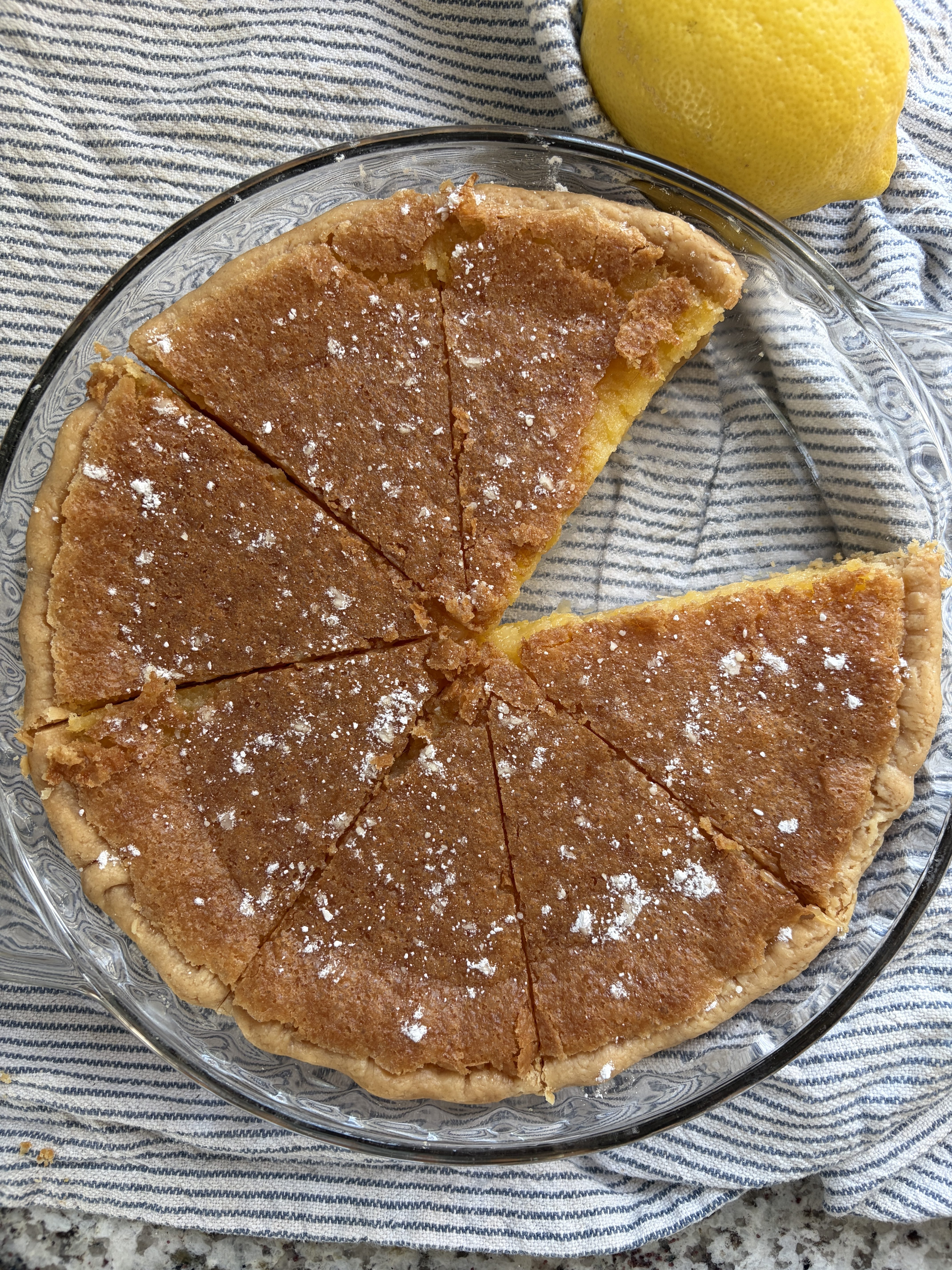

Lemon chess pie with slice removed

Lemon Chess Pie: A Classic Southern Recipe That Still Belongs on Today’s Table

In the decades that I’ve been collecting antiques, I’ve never forgotten the first piece of antique furniture that I fell in love with. It was a primitive pie safe with wood worn so soft from daily use that it felt like butter when I ran my hands across it.

The latch had been opened and closed so many times that the wood around the knob had grown deeper and darker. I’ve always wondered what kind of pies filled its shelves, and I think that surely a lemon chess pie was among the offerings.

Fresh lemons in natural light for lemon chess pie
Fresh lemons are essential for the bright flavor of a classic lemon chess pie.

I recently came across a classic chess pie recipe in a 1941 Southern cookbook I found at a local library sale. The recipe was rich, simple, and written in a way that assumed you already knew your way around a kitchen.

Encountering that recipe in the vintage cookbook brings to mind a Southern lemon chess pie recipe. Bright and satisfying, with a smooth custard filling and the tang of fresh lemon, it’s a pie that feels both simple and enduring on the table.

This article may contain affiliate links. If you choose to purchase through these links, I may earn a small commission at no additional cost to you.

What Makes a Chess Pie a Chess Pie

Chess pies are quintessentially Southern. There are varying opinions as to the origin of the name, but one of them says that it derived from “chest pie.” Chest, meaning that it could be kept in a pie safe at room temperature without spoiling.

All chess pies share a few basic ingredients to form a custard-like filling. Eggs, butter, and sugar are used in each version, and flavors like lemon, chocolate, and coconut are common because of how they cut the sweetness in this very decadent dessert.

Although all chess pies have a few basic ingredients in common, they often have many differences. Some use cornmeal, and some use flour. I’ve seen recipes that use neither. Some use buttermilk, cream, or no milk at all.

Why Lemon Chess Pie Feels Like Spring in the South

Chess pies are eaten all year long, but a chess pie made in the spring simply must be lemon. Spring brings brighter days and warmer temperatures, and a Southern lemon chess pie is the perfect dessert for this time of year.

Lemon freshens the taste buds and awakens our senses. Lemon zest and juice cut through the richness of the sugar and decadence of the butter, which bring a brightness to the dessert.

Why This Is the Lemon Pie to Start With

I know there are people out there who don’t like lemon; I just haven’t met them yet. Since most people love lemon desserts, a classic Southern lemon chess pie recipe is a good place to start.

Chess pies aren’t complicated. With a careful hand, you’ll be rewarded with a delicious pie.

Ingredients You Likely Have on Hand

Chess pies are made with ingredients you probably already have on hand.

Ingredients for lemon chess pie including eggs, butter, and lemons
Simple ingredients come together to create a classic Southern lemon chess pie.
  • Eggs – allow them to come to room temperature first
  • Butter
  • Sugar – regular white sugar is best
  • Fresh lemons are crucial to the quality of this recipe
  • Cornmeal is traditionally used in many chess pies and acts as a thickening agent.
  • Pie Crust – I use premade pie crust to keep this recipe simple, but you can use homemade as well.
Mixing lemon chess pie filling
Whisk the filling until smooth before baking.

Lemon Chess Pie Recipe

This lemon chess pie recipe keeps the ingredients simple while relying on fresh lemon, eggs, butter, and careful cooling for the proper texture.

Lemon chess pie with slice removed
Abby Smolarsky

Lemon Chess Pie

A classic Southern lemon chess pie with a smooth custard filling, balanced with fresh lemon and a slightly set, golden top.
Prep Time 15 minutes
Cook Time 1 hour
Rest Time 4 hours
Total Time 5 hours 15 minutes
Servings: 8 slices
Course: Dessert
Cuisine: Southern

Ingredients
  

  • 1 unbaked 9-inch pie crust (store-bought or homemade)
  • 1 ½ cups granulated sugar
  • ½ cup (1 stick) butter, melted and slightly cooled
  • 4 large eggs
  • ¼ cup fresh lemon juice
  • 1 Tbsp lemon zest
  • 1 Tbsp fine cornmeal
  • 1 Tbsp all-purpose flour
  • pinch salt

Equipment

  • 9-inch pie dish
  • Mixing bowl
  • Whisk
  • Measuring cups and spoons
  • Parchment paper
  • Pie weights or dried beans

Method
 

Parbake the crust
  1. Preheat oven to 375 °F
  2. Line the pine crust with parchment paper and fill with pie weights or dried beans
  3. Bake for 10-12 minutes
  4. Remove weights and parchment, then let the crust cool for 10-15 minutes.
Prepare the filling
  1. Reduce oven temperature to 325 °F
  2. In a mixing bowl, whisk together the sugar and melted butter until smooth
  3. Add the eggs one at a time, mixing well after each addition
  4. Stir in the lemon juice, lemon zest, cornmeal, flour, and salt until fully combined
Rest the filling
  1. Let the mixture sit for 10 minutes to allow the cornmeal to hydrate
Bake the pie
  1. Pour the filling into the parbaked crust
  2. Place the pie on the lower-middle rack of the oven
  3. Bake for 60-70 minutes, until the edges are set and the center has a slight jiggle
Cool completely
  1. Remove from the oven and let cool at room temperature for at least 4 hours, or overnight
  2. The filling will continue to set as it cools

Notes

  • Use fresh lemon juice; bottled juice will not give the same flavor
  • The pie is done when the center moves slightly but is not liquid
  • Avoid overbaking; the filling will firm as it cools
  • A parbaked crust helps prevent a soft or soggy bottom
  • Fine cornmeal is recommended for the best texture
This lemon chess pie is simple in ingredients but rewards careful baking and proper cooling for the best texture.
Lemon chess pie with slice removed
A properly set chess pie will slice cleanly once cooled.
Close-up of lemon chess pie filling texture
The filling should be smooth, set, and slightly custard-like.

What Matters Most When Baking a Chess Pie

Classic chess pies have simple ingredients and uncomplicated directions; however, there are a few key steps that simply must not be skipped to have a successful pie.

Parbaking pie crust with weights for chess pie
Parbaking the crust helps prevent a soft or soggy bottom.

Par-bake your crust before adding the filling. This helps prevent a soft or soggy bottom and ensures the center sets properly.

Rest the filling for ten minutes prior to baking. My traditional recipe uses cornmeal. Cornmeal is included as a thickening agent. When the filling rests for ten minutes prior to baking, the cornmeal has time to absorb liquid and begin to thicken properly.

Bake your pie in the lower 1/3 of your oven. Baking your pies in the lower portion of your oven will make sure that the crust and filling are properly cooked in the center of the pie.

For the filling to fully set, the pie must cool on the counter for a minimum of four hours but overnight is best. When you remove the pie from the oven, the center will appear slightly set, but still a little jiggly. As the pie cools, it will fully set.

Chess pies can be made with pre-made crust or a crust you make from scratch. I like chess pies because of the simplicity, so I opt to use pre-made refrigerated pie dough that is rolled. If you like to keep ingredients on hand so that you can prepare something in a pinch, pre-made pie dough can be kept in your refrigerator or freezer.

Only use fresh lemons when you’re making a Southern lemon chess pie. The quality of your pie will be noticeably better, and the lemon zest is an important ingredient that shouldn’t be skipped.

How to Serve Lemon Chess Pie

Chess pies are best served at room temperature, like pumpkin pies and pecan pies.

You can garnish a Southern lemon chess pie with a dusting of powdered sugar and top each slice with homemade whipped cream as you serve them.

Slice of lemon chess pie with whipped cream
Serve with a dollop of whipped cream for a simple finish.

Frequently Asked Questions About Lemon Chess Pie

Lemon chess pie cooling on counter
Allow the pie to cool completely so the filling can fully set.

Why is the top of my pie brown?

Classic chess pie recipes have a high ratio of sugar in them. The top of your pie will caramelize and often crackle, similar to what takes place with a crème brûlée.

Can I make it ahead?

Yes, and you should. Chess pies must be allowed to cool properly before slicing, or you’ll end up with a runny pie. You can make this pie up to two days ahead of time.

Why is my pie runny?

There are a few reasons why a Southern lemon chess pie could turn out runny. Make sure you rest your filling for ten minutes prior to baking, measurements are followed precisely, and you allow it to cool for the proper amount of time.

Does it need refrigeration?

Old-fashioned chess pies can safely be kept on the counter for up to three days. For the safest food conditions, refrigerate your pie after two days.

Can I freeze it?

You can freeze this lemon chess pie by taking a few steps to prevent it from drying out or getting freezer burned. First wrap your pie completely in plastic wrap and then wrap the pie completely in aluminum foil. Freeze for up to one month.

A Pie That Doesn’t Need Reinventing

I’m not a fan of changing things just for the sake of change itself. I take the expression, “If it ain’t broke, don’t fix it,” to heart. I know when I see something that’s been perfected by generations before me, and one such thing is lemon chess pie.

Just like my vintage 1941 cookbook shows, chess pies have been baked by Southerners for many years. There’s no need to reinvent the chess pie, because it’s already been perfected.


I’ve linked useful kitchen items here if you’d like to try this recipe.

If you enjoyed this recipe, be sure to check out these other reader favorites:

A Southern Sweet Potato Pie Recipe from a Vintage Southern Cookbook

Thanksgiving Breakfast Ideas: Easy and Delicious

Zesty Pickled Carrots (Easy Refrigerator Pickle Recipe)

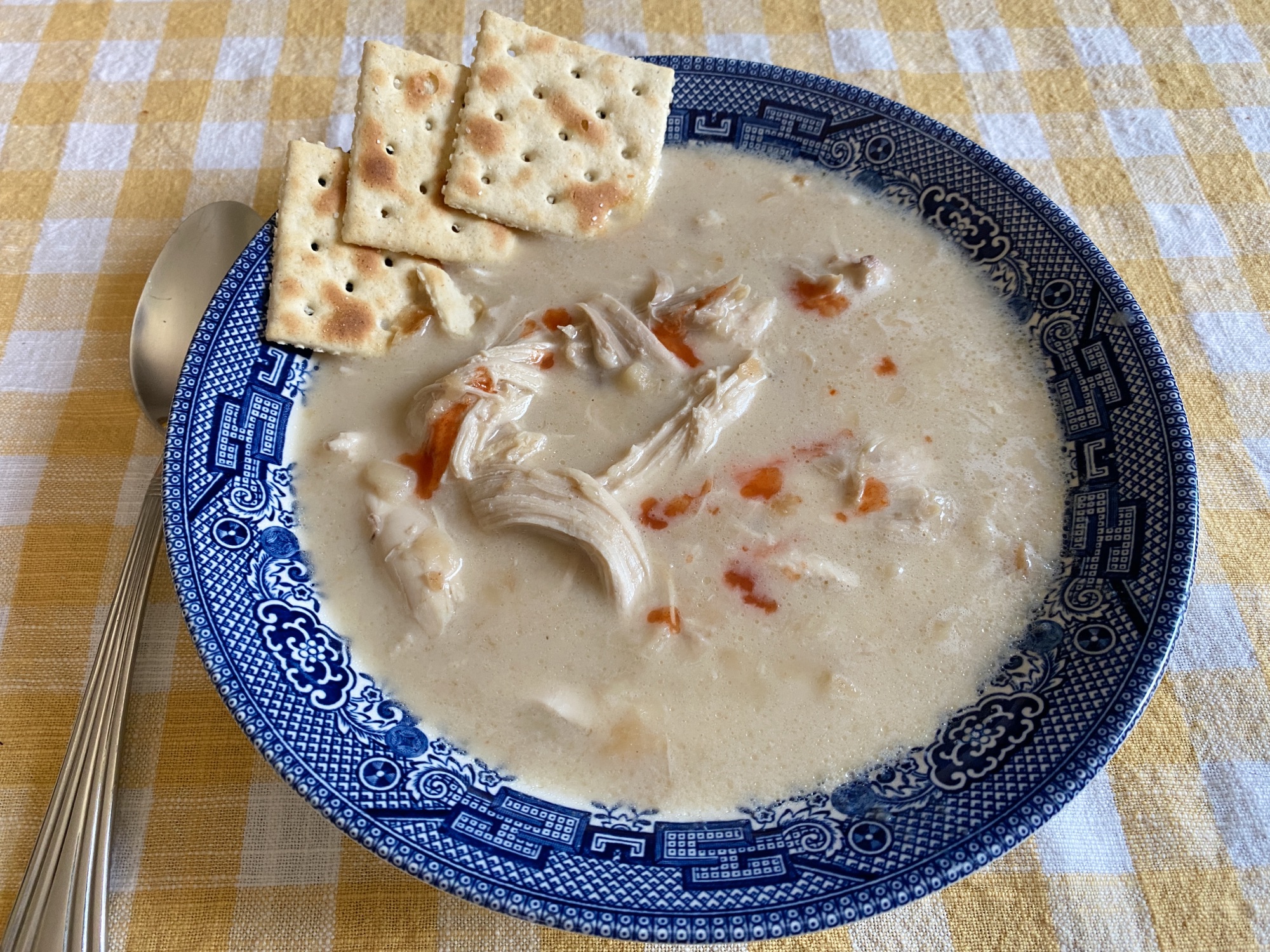
Bowl of creamy Chicken Mull served in white enamelware, garnished with cracked pepper and surrounded by saltine crackers

A Southern Classic for Fall: How to Make Chicken Mull

A Regional Recipe Worth Discovering

Welcome to the fourth installment of my fall series, Falling for Home: A Weekly Autumn Journal. Throughout this weekly Friday series, we’re embracing a slow, intentional rhythm of Southern living rooted in home, heritage, and the kind of traditions that make fall in the South unforgettable.

Today’s article is all about Chicken Mull. I encourage you to use the ingredients that you already have on hand and your favorite pot, as well as to invite friends and neighbors into your home to share it with you this fall.

What Is Chicken Mull? A Brief Southern History

Although I’ve lived in Georgia my whole life, I hadn’t heard of Chicken Mull until moving to the greater Athens, Georgia area. One chilly fall afternoon, someone mentioned that it was Chicken Mull season, and I’ve been intrigued by this creamy, comforting stew ever since.

Chicken Mull is a traditional Southern fall recipe that is usually made with only 3 ingredients: water, chicken, and saltine crackers. The ingredients may be simple, but the flavor is anything but.

Chicken Mull finds its roots in the Carolinas, as well as a very specific region of Northeast Georgia. In fact, Athens, Georgia has often claimed to have invented this Georgia Chicken Mull recipe. (Locals will warn you not to confuse it with Chicken Muddle, which is an entirely different thing.)

Historically, Chicken Mull was more than just a dish. A Chicken Mull was the name of the gathering where the Chicken Mull was eaten. This would have been a church or community event held in the fall, and the Chicken Mull would have fed a large crowd.

Ingredients You’ll Need

While the basic Chicken Mull recipe uses just three ingredients, today I am using the Southern Living version that includes some herbs, heavy whipping cream, and hot sauce. To make my version of Chicken Mull, I’m using cast iron Dutch ovens, a fine-mesh strainer, wooden utensils, and sturdy kitchen tongs. This is a fun dish to serve in vintage enamelware dishes or handled soup bowls…  something that feels as nostalgic as the recipe itself.

Chicken Mull Recipe (Stovetop)

Bowl of creamy Chicken Mull served in white enamelware, garnished with cracked pepper and surrounded by saltine crackers
Abby Smolarsky | Belle Antiquarian

Chicken Mull (A Classic Northeast Georgia Stew)

A creamy, comforting Southern classic, Chicken Mull is a beloved fall tradition in Northeast Georgia. Made with slow-simmered chicken, rich broth, crushed saltines, and a splash of cream, this humble stew is a must-try recipe for chilly evenings. Serve with extra crackers and hot sauce for a taste of Athens heritage in every spoonful.
Prep Time 15 minutes
Cook Time 1 hour 45 minutes
Total Time 2 hours
Servings: 6 people
Course: Main Course
Cuisine: Southern
Calories: 420

Ingredients
  

  • 1 3-4 lb whole chicken
  • 2 large yellow onions unpeeled and quartered
  • 4 celery stalks roughly chopped, about 2 cups
  • 5 cups water
  • 4 cups chicken broth
  • 1 Tbsp kosher salt
  • 1 Tbsp whole black peppercorns
  • 5 fresh thyme sprigs
  • 5 garlic cloves
  • 2 dried bay leaves
  • 1 sleeve saltine crackers crushed, plus more for serving
  • 1 cup heavy whipping cream

Equipment

  • 5.5-quart Dutch oven or large stockpot
  • Fine-mesh strainer
  • Tongs
  • Blender
  • Large wooden spoon
  • Ladle
  • Cutting board

Method
 

  1. In a 5 ½-quart Dutch oven, add the chicken, onions, celery, water, broth, salt, peppercorns, thyme, garlic, and bay leaves.
  2. Bring to a simmer over medium-high heat, then reduce to medium-low and cover. Simmer for about 1 hour, or until the chicken is cooked through and brother is flavorful. Skim fat as needed.
  3. Remove the chicken and let cool slightly. Shred the meat, discarding skin and bones.
  4. Strain the broth through a fine-mesh strainer into a clean Dutch oven. Discard solids.
  5. Bring the strained broth to a simmer over medium-low heat. Stir in crushed cracker and cook for 3 minutes until slightly thickened.
  6. Carefully blend half the broth mixture until smooth (about 20 seconds), then return to the pot.
  7. Stir in the heavy cream and shredded chicken. Cook uncovered over medium-low, stirring occasionally, until heated through (about 10-15 minutes.)
  8. Serve hot with extra crackers and optional hot sauce.

Notes

Don’t Skip the Strain: Straining the broth may seem like an extra step, but it creates the signature smooth base that sets this version apart from other chicken stews. Make-Ahead Friendly: Chicken Mull reheats beautifully the next day. Some even say it’s better after the flavors have had time to meld. Store in an airtight container in the fridge for up to 3 days.

The Palette of Chicken Mull

There’s a warmth to Chicken Mull that goes beyond the post. It’s the colors of autumn comfort. For this week’s post, I’ve created a coordinating color palette that captures the creamy whites, golden butter tones, and soft sage of the ingredients and atmosphere. You’ll find this same palette in everything from vintage kitchen tools to enamel cookware, and I’ve linked a few timeless pieces below.

Whether you’re styling your kitchen or hosting your own mull supper, these pieces bring the coziness of fall to life.

A Dish That Feels Like Home

I live in an area of the South that has changed rapidly over the last 40 years. Folks from all over the world moved here to call this place home. While we welcome new cultures and diversity, I noticed a while ago that many of our beloved Southern traditions were fading like steam rising from a warm bowl, slowly disappearing into memory. Many researchers will tell you that our accents are disappearing. As we discussed in a previous article, our Southern hospitality that we are known for is starting to dampen. So when I discovered this recipe that neither I, nor anyone in my family had ever heard of, I was really excited to revive this regional recipe from Athens, Georgia cuisine.

Whether you’re a Southern peach or you hail from some other wonderful place on this planet, I hope that you will remember your roots and keep your culture alive for future generations.

So many of you messaged me on Instagram that you loved our summer recipes that we shared. I invite you to make this recipe for Chicken Mull, or to share your version with me! Tag me on Instagram so we can share a virtual bowl of stew together.

Invitation to Return

Thank you for joining me with this week’s article from my series Falling for Home. Each Friday from August through September, we’ll meet here at BelleAntiquarian.com to reflect on a slow, intentional rhythm of seasonal living, rooted in tradition, home, and memory. Join me next Friday as we explore The Collected Kitchen, a celebration of antique charm, practical warmth, and the soulful heart of the Southern home.


Explore More from Falling for Home: A Weekly Autumn Journal

This article is part of my Falling for Home series. Be sure to check out these reader favorites:


You can subscribe here to receive new articles, seasonal inspiration

Black Eyed Pea Picnic Salad

Originally published November 16, 2020. Updated January 2026.

A few years ago, during a guest takeover on Garden & Gun’s Instagram, I caught a glimpse of a simple dish that immediately became a staple in my kitchen. The chef shared a quick reel of his black eyed pea picnic salad, casually listing ingredients without measurements, the kind of recipe you commit to memory rather than write down. I watched it more than once, scribbled notes on a Post-it, and have been making my own version ever since.

If you follow me on Instagram then you know a lot of times in my Meal Plan Monday posts I say that I meal prepped Black Eyed Pea Picnic Salad. This is one of my favorite things to prepare ahead of time to have for lunches and snacks. It is really healthy and actually tastes better after a day or so.

Ingredients You’ll Need

The fresh ingredients that you will need for this recipe are celery, a bell pepper, and parsley. A lot of times people think of parsley as simply a garnish, so they omit it from recipes. The parsley adds a really important flavor to this dish, so be sure not to skip on it! Also, I just want to point out that there is no onion in this recipe. Did you know that a lot of times when people get food poisoning from picnic food, it is actually from the onions? Really!

You’re going to want to do a small dice on the pepper and celery. If you are using the Fullstar food chopper that is all the rage right now, use the smaller dice attachment. And if you don’t have the Fullstar, I recommend getting one. It can be easily washed in the dishwasher.

This recipe calls for canned black eyed peas. Not all canned black eyed peas are created equal. In this case, the recipe called for no-salt, canned black eyed peas, which I have never been able to find. This brand, Hanover, has the lowest sodium content that I can find. I also prefer this brand for this recipe because the liquid in the can is not thick and drains easily. (I use a different brand when not using them in a recipe.) You’re also going to need some Chow-Chow. If you aren’t from the south, Chow-Chow is a relish. Oddly enough, when all of the Covid shortages were happening, Chow-Chow was one of those items that you could not find anywhere. I can still only find it at one local grocery store, and I’m not telling where so that I can get it when I need it. HA!

Save this recipe

Below you will find the complete recipe, which you can print or save to Pinterest for later. I usually double this when meal prepping and keep it in an airtight container. I hope you enjoy it! Please be sure to let me know in the comments if you like it as much as I do.

Abby Smolarsky | Belle Antiquarian

Black Eyed Pea Picnic Salad

A fresh Southern picnic salad made with black eyed peas, crisp vegetables, and a tangy vinegar dressing. Even better after a day in the refrigerator!
Prep Time 15 minutes
Total Time 15 minutes
Servings: 4 servings
Course: Salad, Side Dish
Cuisine: Southern

Ingredients
  

  • 1 bell pepper small dice
  • 1 celery stalk small dice
  • 1 handful fresh parsley finely chopped
  • 1 15 oz can low-sodium black eyed peas drained and rinsed
  • ¼ cup chow-chow relish
  • 2 tbsp red wine vinegar
  • 2 tbsp olive oil
  • salt and pepper to taste

Method
 

  1. Dice the celery and bell pepper into a small, even dice.
  2. Finely chop the parsley.
  3. Drain and rinse the black eyed peas thoroughly.
  4. Combine all ingredients in a medium bowl and stir gently to mix.
  5. Cover tightly and refrigerate for a least 1 hour; best if chilled overnight before serving.

Notes

This salad tastes best after chilling for several hours or overnight. Double the recipe for easy meal prep and store in an airtight container. 

If you like this recipe, you can find more recipes from Belle Antiquarian by searching for recipes by clicking on the magnifying glass icon on the left side of this screen. Never miss an article by subscribing below. (You can unsubscribe anytime.) Did you make this recipe? Tag Belle Antiquarian on Instagram so that we can see!