Original sleeping porch in a 1939 Colonial Revival home with vintage furnishings and screened windows

The Southern Sleeping Porch: What This Historic Room Still Teaches Us About Home

Beneath the canopy of a Japanese cherry tree, the sleeping porch in our 1939 Colonial Revival home is a magnet for all who visit. An overstuffed down sofa and a collection of houseplants are the first things to draw someone in. Once inside, a cross breeze from the open louvered windows is what keeps them from leaving.

When I tell guests that we spend most of our free time sitting out on the sleeping porch, they look confused. “Do you mean the sunroom?” “No,” I respond, “this is an original sleeping porch.”

Although sleeping porches have largely disappeared from modern homes, they reveal a steadfast truth: the places we set aside for quiet, reflection, and everyday routines shape not only how we use our homes but how we experience our lives.

The Sleeping Porch in Southern History

Around the turn of the twentieth century, sleeping porches began to rise in popularity, particularly in the American South. Unlike front porches, which were often spaces for hospitality and socializing, sleeping porches were private spaces for retreating, seeking solace from hot summer temperatures, and sleeping.

Air conditioning wasn’t commonplace in homes until the late 1960s, so sleeping porches were designed to maximize airflow. Normally, at least two sides of the porch would be fitted with screened windows, usually of a louvered style.

Porches were built on second levels or higher on the corners of houses. At this location in a house, the air would be cooler, and a cross breeze could be created from opening windows on multiple walls.

Exterior of a 1939 Colonial Revival home with an original second-story sleeping porch
Located on the second floor, sleeping porches were typically positioned to capture breezes from multiple directions before residential air conditioning became common.

As well as creating a space for comfortable sleeping on hot days, sleeping porches were thought to help fight diseases like tuberculosis. At the time, air flow and circulation were believed to help patients recuperating from their sickness.

Sleeping porches in the South were considered utilitarian spaces. Furnishings and decoration would have been kept to a minimum, and the porch would have commonly been outfitted with multiple beds.

Sleeping porches are sometimes confused with sunrooms. A sunroom is more open and integrated into the home. Windows in a sunroom are often fixed or are more traditional looking than the slanted cantilever windows found on a sleeping porch. A sleeping porch is more secluded and private than a sunroom. A sunroom would traditionally have had seating and entertaining spaces, and a sleeping porch would have had beds and nightstands.

Open cantilever windows on a historic Southern sleeping porch designed for natural ventilation
Louvered windows open outward to create cross ventilation, helping sleeping porches stay cooler during warm Southern summers.

Today, due to modern air conditioning and medical advances, sleeping porches are no longer commonly found on floor plans. Oftentimes, older homes that originally had sleeping porches are renovated to use these spaces in other ways.

More Than a Historic Home Feature

The sleeping porch was the space in our house that I was most excited about. Immediately after signing the papers, we drove over and ripped the carpet off the porch floor.

For weeks beforehand, I could imagine sitting there with the windows open enjoying fresh air and a breeze.

Rather than thinking of the porch as an obsolete space that needed to be renovated, I considered the idea that it represented something valuable that could translate into modern living.

If sleeping porches were historically places to seek a reprieve from the heat and retreat at difficult times of the day, why not find a way to use the space to achieve similar results today?

In our home we have turned the sleeping porch into a space that shapes our daily habits.

How Rooms Shape Daily Habits

In modern floorplans, designs are often developed to consider traffic patterns and how to increase flow between rooms.

Looking at a floor plan on paper, it’s easy to see how spaces in today’s homes continuously flow into each other. The kitchen is often connected to the dining room, which is connected to the living room. In open floor plan houses, there is often little to no physical separation of rooms.

Because the rooms in modern houses are so connected, it can be difficult to find a space to truly disconnect and relax. With constant distractions and stimulation, many people have forgone pastimes and hobbies and replaced them with screens.

In our home, our daily routine is that we go to the sleeping porch when we get up in the mornings. After stopping at the coffee pot to fill up a cup, we immediately head to the porch to sit down. I can’t think of a morning when it hasn’t been my ritual to sit with the dogs and watch as people walk by as I sip my coffee.

After dinner, when the sunlight is just right, I return to the porch to pick up a book or work on a hobby. These habits of retreating to our porch have shaped our daily routines.

Watercolor painting supplies arranged on a desk inside a historic sleeping porch
A quiet corner for watercolor painting reminds us that meaningful rooms encourage creativity as much as comfort.

It’s not uncommon to hear of someone turning a spare bedroom into an extra closet or enclosing a screened-in porch to enlarge a kitchen. But consider if we looked at our overall well-being and imagined how we might use a space like an old sleeping porch to enrich our everyday lives.

Reimagining the Sleeping Porch Today

While our sleeping porch does have a small television, it rarely gets used. Instead, we have created a space that intentionally fosters an environment for analog activities.

Reading corner on a sleeping porch with books, coffee, binoculars, and houseplants
Books, coffee, birdwatching, and quiet conversation have replaced the porch’s original purpose while preserving its role as a place of retreat.

Instead of scrolling through Pinterest for hours, you’ll find a stack of Martha Stewart books, recent issues of Southern Living and Garden & Gun, and even a pair of binoculars to watch the deer and birds outside of the windows.

I have brought in some of our favorite pieces of art and even created a space to do watercolor painting.

A 1920s china cabinet is filled with thrifted finds and miscellaneous treasures from our travels, which are good for sharing stories and remembering old times. There’s even a basket of vintage quilts if someone wants to open the windows to take a nap or enjoy chilly weather.

Vintage china cabinet displaying collected treasures inside a historic sleeping porch
Collected objects, thrifted finds, and vintage quilts give the porch a sense of history while encouraging everyday use rather than formal display.

The sleeping porch in our 1939 home is no longer used as a regular sleeping room to get relief from the heat. Instead, we have created a retreat from the busyness of daily life and the constant noise from screens.

Finding a Retreat in Any Home

It was certainly inspiring to find that our house had a room like a sleeping porch that we could use to create a retreat for our family. However, you don’t need to have an old porch or live in a historic home to have a space like this of your own.

Unused spaces like a formal living room or a sitting area adjacent to a primary bedroom can often be transformed into your family’s version of a sleeping porch. By making small changes like removing a television or adding a stack of books, you can slowly begin to create an environment that encourages your family to detach from their phones and laptops.

A small table for puzzles under a window or a box full of old photos can magically turn a previously unused room into a retreat and space to reflect or connect with your loved ones.

Sleeping porches aren’t the only things that have disappeared from homes over the years.

Today, families are living in a constant state of motion in their own homes. We are bombarded with noise from phones, laptops, and televisions. We have lost the daily rituals of connecting to each other over conversation or sitting in silence for reflection.

When our grown kids or guests come to stay, they are drawn to our sleeping porch. It’s a space where we instinctively slow down and talk to each other. In this small space, tucked to the side of the house, human connection and well-being are the first priorities, not notifications and emails.

Consider how you can set aside a space in your own home to create rituals for quiet reflection and activities that enrich the experiences of everyday life.


Create Your Own Retreat

Whether your retreat is a historic sleeping porch, a quiet corner of the living room, or a favorite chair beside a window, thoughtfully chosen pieces can help create a space that encourages reading, creativity, conversation, and quiet reflection. I’ve gathered a collection of timeless furnishings, books, and accessories inspired by our sleeping porch to help you create a retreat of your own.


Check out these other reader favorites:

Original sleeping porch in a 1939 Colonial Revival home with vintage furnishings and screened windows
The original sleeping porch in our 1939 Colonial Revival home has become our family’s favorite place to read, create, and slow down.
Southern dining room decorated in Americana style with traditional furnishings, layered textiles, vintage flags, and collected antiques

Americana Style in the Southern Home: Decorating with Tradition, Comfort, and Character

As America approaches its 250th anniversary, patriotic decorating is appearing everywhere from retail displays to magazine covers. Yet some of the most enduring expressions of Americana are not seasonal at all. They are the everyday objects that tell the story of a place, a family, and a nation.

The latest edition of my favorite magazine is telling me that Americana style is back. There is a resurgence of patriotic themes and symbols in retail spaces this year.

But true Americana style is not found on an aisle of Hobby Lobby. It’s an enduring design perspective that doesn’t need to be changed out with the seasons. At its core, Americana style reflects a distinctly American approach to home, one rooted in comfort, tradition, individuality, and a connection to place.

Traditional Southern living room with Americana-inspired summer decorating, blue and white porcelain, patriotic bunting, and layered textiles
Americana style often blends traditional furnishings, family collections, and seasonal patriotic touches into spaces designed for everyday living.

More Than Flags and Fireworks

Our little town is having a decorating contest to celebrate America’s semiquincentennial anniversary this summer. Participants are encouraged to decorate their homes or businesses with red, white, and blue for the 4th of July. Throughout town, buntings and flags are being used in various ways to celebrate the season.

As I sat outside one evening after decorating our own home for the contest, I heard a lady walking by remark to her friend that she loved anything Americana. People often associate patriotic symbols with Americana, but those are only one expression of the design style.

Americana style isn’t limited to the era or architectural style that a home was built in. Homes ranging from historical to newly built traditional homes can be decorated through the lens of Americana style characteristics.

The Characteristics of Americana Style

At the heart of Americana style is a reflection of the people who live there. It’s a design perspective that is built around characteristics shaped by the lifestyle of American people.

Americana style adapts traditional lines in furnishings to more softened edges with comfort in mind. Formal floor plans in Americana homes become more approachable because the function of these spaces has been adapted for everyday modern living rather than special occasions.

It’s common in Americana style for both soft and hard furnishings to be made from durable materials. Hardwood construction, combined with elements such as leather, brass, or canvas, are characteristics of Americana style furniture. Linen, wool, and various types of cotton weaves in fabrics reflect the materials sourced from American lands.

Classic patterns and textiles are layered in a manner that welcomes everyday living. Instead of holding beautiful finishes at arms-length, Americana style homes are hospitable and inviting.

As each space reflects the family within, Americana style homes characteristically feature personal collections that are often shaped by the specific place the home is found in.

Traditional bedroom featuring blue and white textiles, antique furnishings, layered rugs, and Southern Americana decorating
Americana style is often expressed through traditional furnishings, heirloom pieces, and layered textiles collected over time.

A Style Shaped by Place

Americana style encompasses a group of styles that are specific to the regions they represent. America has never had one singular decorating style. Each region reflects local influences, climates, and cultures of the people living there.

Southwestern Americana style is largely influenced by the climate of the region with color palettes that are inspired by desert sunsets. Soft furnishings and art are heavily influenced by Native American patterns, the landscape, and Colonial Spanish equestrian themes.

Coastal Americana designs are heavily influenced by maritime life. Artwork, color schemes, and soft furnishings mirror the colors of water and the ecosystems dependent upon it.

Furnishings for Mountain Americana homes are usually in natural wood tones, and it’s common for them to have roughly hewn edges and visible construction.

Here in the South, homes are traditionally designed with hospitality in mind. Homes feature both formal and casual gathering spaces, and additional entertaining spaces are created by using the garden or front porch as an extension of the home.

In Southern Americana homes, rooms are often designed around heirloom pieces of furniture because these homes place a significant emphasis on heritage and tradition.

Regardless of which regional style of Americana design is found in a home, the strongest designs reflect the traditions of the people who live in them.

Southern Americana decorating featuring a vintage American flag, sporting art, game plates, and collected decorative objects
Regional expressions of Americana often draw inspiration from local traditions, landscapes, and cultural influences.

The Role of Tradition in the American Home

When I travel, I like to tour historic homes that have been opened to the public. In Savannah, the Green-Meldrim House is a wonderful example of historic Southern Americana Style. In Santa Fe, the Palace of the Governors features classic Southwest Americana style.

I enjoy integrating vintage and antique pieces into my home, but Americana style doesn’t require us to cling to outdated traditions or live in the past. The modern role of tradition in American homes is to reflect on the history of the region, while moving forward with traditions of people currently living there.

Rather than focusing on strictly using pieces in our homes that fall under a specific design label, use the characteristics of Americana as a jumping point to create character in your home over time.

The most successful Americana designs combine treasures discovered over time and new pieces that will stand the test of time.

Implementing an Americana style in your home may begin with a collection of books on your coffee table, a china cabinet passed down from a grandmother, or a favorite recipe you share with your friends every year on the 4th of July.

Patriotic mantel display with family artwork, American flags, blue and white porcelain, and collected heirloom accents
Collections gathered over time often become some of the most meaningful expressions of Americana style.

Seasonal Americana Décor for Summer

Shortly before Memorial Day, I begin to decorate our home for summer. Since I’ll leave these “decorations” out until mid-July, I tend to steer clear of decorative pieces that feel trendy.

I don’t want to feel like I’m putting a patriotic costume on my house for the summer, so I usually begin by choosing items from each room that will have a summer aesthetic when they’re gathered together.

Baskets of seashells that my children have collected over the years are placed next to a stack of vintage books about American government and history. A small white ironstone pitcher holds blue hydrangeas from my garden with a little flag tucked inside as a nod to the season.

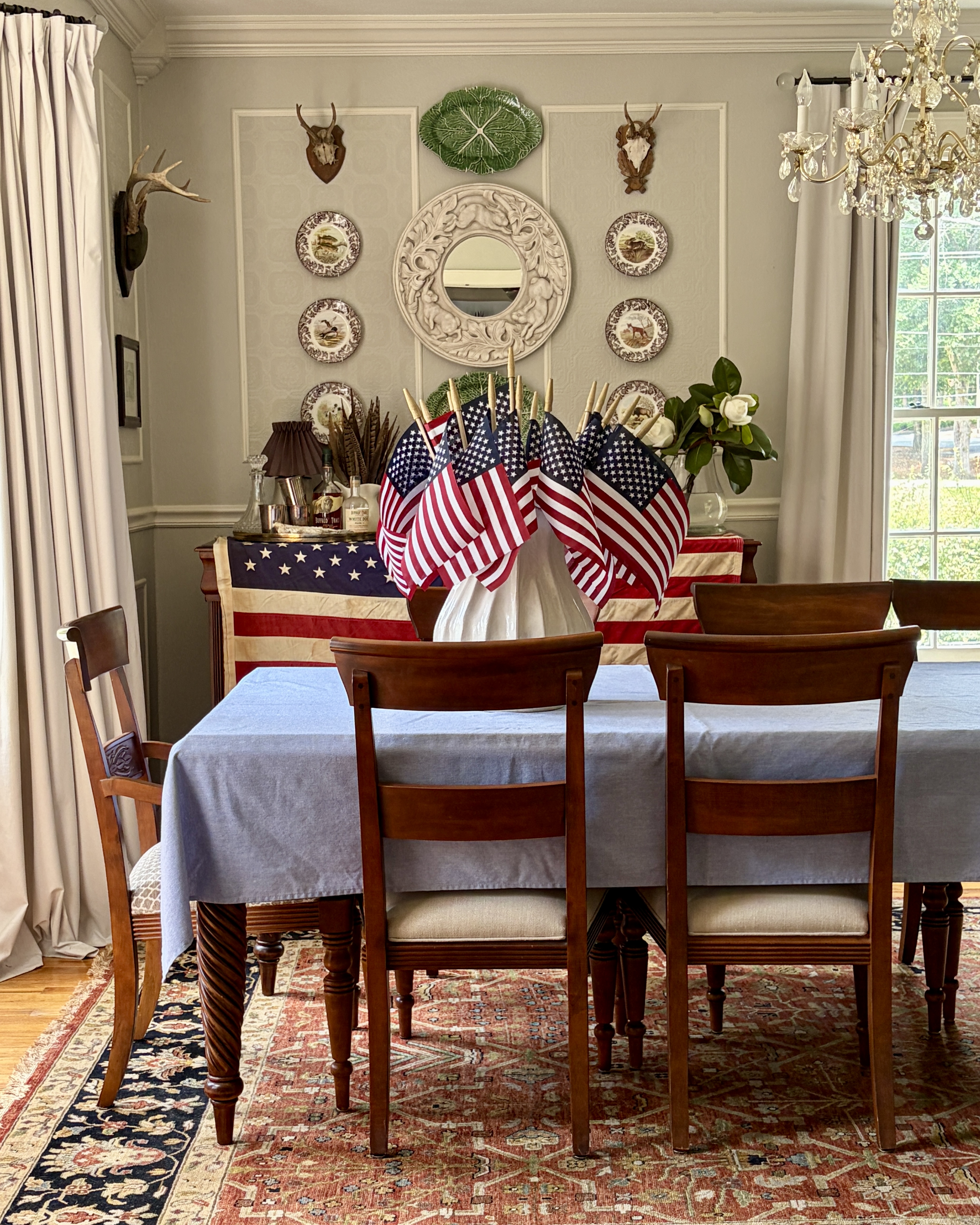
Southern dining room decorated in Americana style with traditional furnishings, layered textiles, vintage flags, and collected antiques
A Southern Americana interior combines traditional furnishings, collected objects, and seasonal patriotic accents without losing its timeless character.

Outside we have hung red, white, and blue buntings from the railings on the top floor. Flowerpots have been filled with red, white, and blue annual flowers.

The way we have decorated the outside of our house could have been from 1980 or 2026; it is timeless and restrained. Americana style has endured through the ages.

Why Americana Style Endures

As America prepares to mark 250 years, the enduring appeal of Americana style may lie in its ability to honor the past while continuing to adapt to the present.

Today, Americana style reflects the people living inside each home. Because America is a melting pot of people, Americana designs allow room for individuality and collections from personal life experiences.

Implementing this design style into a modern home is an act of layering unique perspectives and experiences in home décor, while combining it with a sense of place that echoes the culture and the landscape of the region.


Other Belle Antiquarian reader favorites:


This section contains affiliate links. I may earn a small commission at no additional cost to you.

To read more about Americana style, check out these recommended books: