
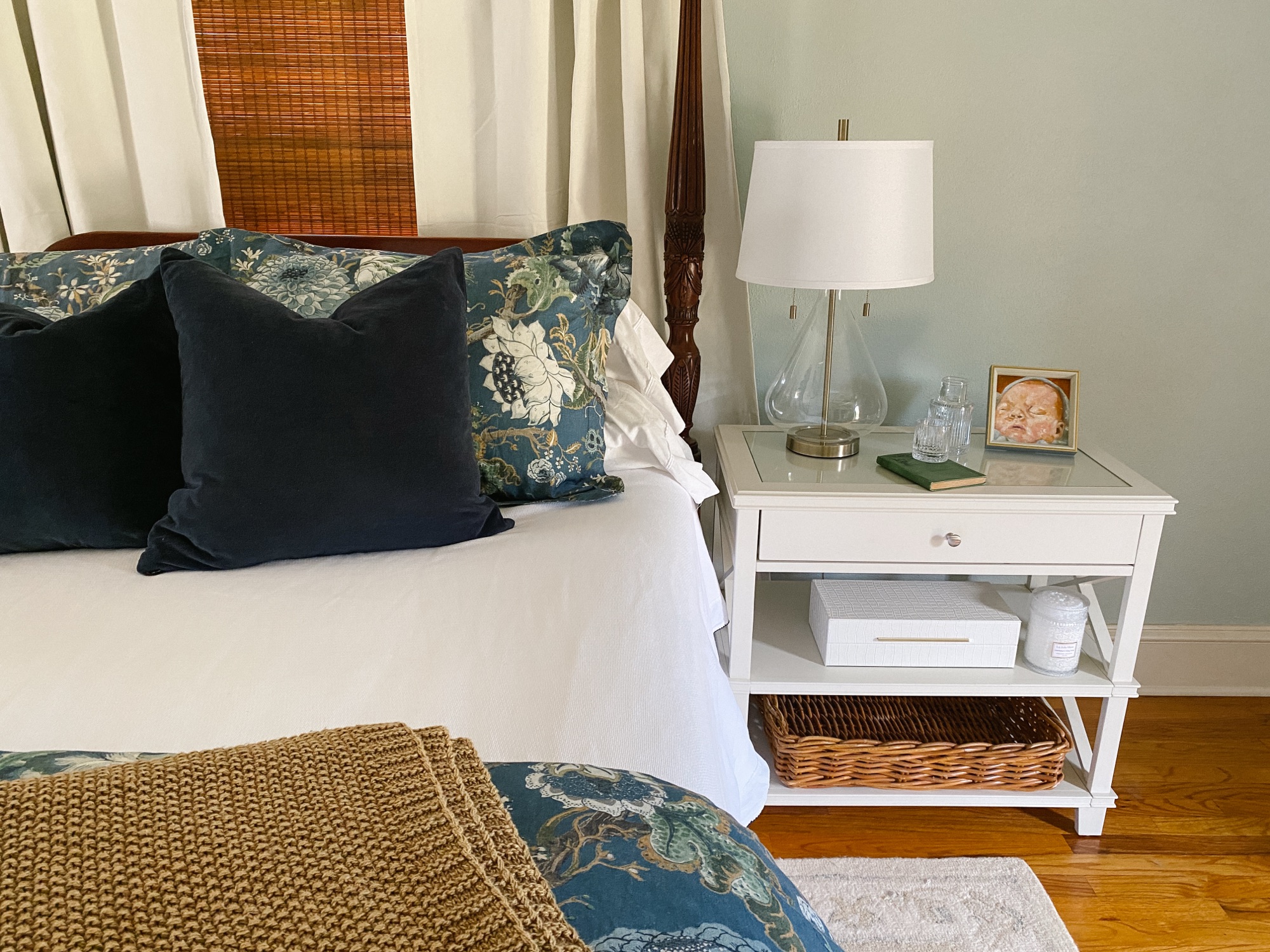
Feminine nightstand with lamp, carafe, small art, storage boxes, candle, and basket.

Home as a Haven: How to Create a Cozy Bedroom Retreat

Welcome back to the sixth installment of our weekly Friday series called Falling for Home: A Weekly Autumn Journal. Each week we explore ways to embrace the softness of the autumn season, create a welcoming environment to restore your spirit, and fall in love with our own homes again. If you’re just joining me here from Google, Pinterest, or Instagram, I invite you to read the other segments in this series, which can be found linked at the bottom of this article.

As the season progresses, we begin to lose daylight hours and the temperatures cool. The sun is setting earlier each day, and we begin to retreat indoors.

Today we’ll start a conversation on the importance of intentionally curating a personal haven in your home and creating a place to restore yourself… not just a place to crash at the end of the day to get some sleep.

The bedroom as a whole reflects the balance of function and comfort: closed storage to keep clutter tucked away, restful art, and layered bedding that invites you to linger.

Step One: Clear the Space for Peaceful Rest

Many of my readers are the family’s nurturers, often putting everyone else’s needs before their own. In the home, this translates into prioritizing the shared family spaces and even the children’s bedrooms. Our bedrooms become the catch all and dumping grounds for all the miscellaneous items that don’t have a designated spot. The clean laundry is often brought into our bedrooms until it can be folded and put away later.

Not only does this create physical clutter; it creates mental clutter and unrest in the very space that we retreat to get rest.

Create Processes

We need processes for dealing with items that make their way into our bedrooms. I like to use a method called “Touch it once.” For example, if I’m taking laundry out of the dryer, then dumping it on my bed, then moving it to a chair to fold it later, I’ve touched it 3 or 4 times before it gets put away. By folding each item as I take it out of the dryer, I will touch it only once before it gets put away. Doing it this way might not feel like it in the beginning, but it becomes a lot less work.

Look around your bedroom to assess miscellaneous piles of clutter. Those are the items that you’ll need to create a new process for. When we move piles of clutter from one spot to another to clean, we’re just moving the mess around and not actually taking care of the mess.

Essential Items

Next, I recommend that you only keep the essential items within sight. These would be things that support the rest, comfort, or function of your bedroom. For example, you’ll need a bedside table of some sort, a lamp within reach of your bed, and a hamper to hold your dirty laundry. Other examples are a throw blanket that gets used on chilly nights or a fan that cools you in warm weather. Essential items are ones that directly help you rest, prepare for the day, or feel comforted. If it distracts you, nags at you, or simply takes up space without providing function, it doesn’t belong in your bedroom.

Daily Items

In addition to essential items, we all have daily items, which I recommend organizing into closed storage containers. These items are practical, not decorative, and by placing them into closed storage containers we are able to keep surfaces peaceful without disrupting our routine. Examples of daily items would be chargers, medications, skincare, books, and pajamas. When each item has a designated space in a closed storage system, we easily prevent clutter from snowballing into piles. Items are still convenient and within reach; they’re just not visually tiresome or nagging.

Implementing these habits can take a little practice. However, you’ll find that if you consistently maintain these methods, it will be well worth the effort when you have a peaceful, relaxing space at the end of the day.

On his side of the bed: a leather catchall, favorite books, and a wood box for everyday necessities, proof that practicality can be handsome when it’s well-contained.

Step Two: Add Meaningful & Personal Touches

Your bedroom is probably a place that most guests won’t see. And if you’re a parent, it may be the one space in your home that’s truly yours. Your bedroom is an opportunity to create a room with décor that reflects your personality and sentimentality. By carefully selecting your furnishings and accessories, you can build an area for yourself that makes you feel at home.

Adding personal touches to your bedroom should be done with simplicity, restraint, and sentimentality. For example, a gallery wall of art or family photos creates too much stimulation and interest in a space that is intended for relaxation. Instead, try adding a small family photo in a frame on your nightstand or dresser.

You can easily personalize your bedroom by adding one small vase for flowers, a small antique dish as a catchall, or an heirloom quilt at the end of your bed. Instead of surrounding your room with your entire collections, pick one favorite that you can use in a functional way. By doing so, you’ll keep your space peaceful and uncluttered.

On her side: a small carafe for evening water, original art for a touch of beauty, and storage boxes to keep daily items close but unseen. Serenity comes from thoughtful restraint.

Step Three: Layer Comfort & Care

Repeating tones, from the bamboo shade to the throw blanket and picture frames, bring warmth and cohesion. A reminder that subtle echoes of color and texture create harmony in a room.

Gen Z is known for not using “the big light.” They’re referring to the overhead light, which we call “ambient lighting” in the interior design world. In an area like a bedroom, I tend to agree with them.

Strategically adding lamps to a bedroom for accent and task lighting creates a much more relaxing environment than using “the big light.” I recommend lamps for your nightstands that are easy to reach and turn on/off without getting out of bed. You should be able to easily fit your hand under the shade to operate the switch or use a lamp that has a switch on the cord. If you have a reading chair in your bedroom, a floor lamp can be a well-thought-out addition.

Another way to create a relaxing environment for yourself is to consider your comfort and senses. Stay away from scratchy or uncomfortable fabrics that will be next to your skin. Consider whether candles, fragrance plug-ins, and even laundry detergents are overpowering your senses. No smell is better than a strong smell.

Lastly, consider your needs while you are in your room. If you frequently find yourself getting up for water, a carafe of water and drinking glass will be helpful to you.

Soft lamplight turns the bedroom into a sanctuary at dusk, offering a place to exhale as the day comes to a close.

Step Four: Invest in Quality Where It Counts

If you follow me on Instagram, you know that I love a good bargain and buying things second-hand. However, there are some things in the bedroom that I won’t compromise on. A good rule of thumb is, the closer it is to your skin, the higher quality you need to invest in. A good example of this is choosing bargain window coverings, but higher quality bedding. You won’t be laying down at night on your curtains, but you will be on the sheets.

When purchasing bedding, I recommend looking at thread count and fabric materials. If there isn’t a thread count listed, it’s most likely very low. High thread count sheets will last decades, so while the upfront cost may be marginally more, they will last incredibly longer than cheaper options… saving you money in the long run.

It’s also important to consider fabric materials. Fabric materials with descriptions like “knit, jersey, cooling” are less breathable than materials with long-staple natural fibers like Egyptian cotton. They are inferior materials that usually weave some sort of synthetic material made of plastic into the fibers. Synthetic materials don’t last very long and will need to be replaced in a short amount of time.

Most of us are on a budget, and it’s simply not realistic to invest in the highest quality of furnishings and accessories all at once for our spaces. I encourage you to make a point of switching things over one at a time until you have created a well-curated space that you deserve. Swap furniture made of composite materials for solid wood pieces, synthetic bedding for high-quality bedding made from renewable materials, mass-produced art for original art that reflects your unique personality. In this way, we create a collected space that truly becomes a haven in our home.

Layering textures – the quilt, duvet, and throw – adds depth and comfort. Each piece contributes to the feeling of being enveloped in warmth.

Step Five: Introduce Seasonal Color & Mood

I would be remiss if I didn’t point out the impact that color has on your bedroom haven. The psychology of color tells us that our emotions are subconsciously affected by the colors in our spaces. Restaurant owners, marketing professionals, and health care facilities understand that color goes beyond preference.

When choosing wall color, linens, and accessories in a bedroom, it’s important to understand the effects of your choices. I recommend tones with less saturation if you are trying to create a palette to anchor your room’s mood. Too much visual interest will hinder relaxation in a bedroom.

Today I am recommending a set of three colors, which can also be seen on the image below. Pale Oak, Cloud White, and Hale Navy are choices that you can bring into your space in a variety of ways such as furniture, bedding, lampshades, throw blankets, and artwork. They also provide a relatively neutral backdrop for you to add your personal touches that were mentioned above. If you can’t repaint your bedroom at this time, these three colors also tend to work well with a myriad of other colors.


Throughout this article I have mentioned things that I find to be useful in a bedroom space. You will find examples of these items in this curated list, which can be found by clicking HERE or clicking on the image below. You’ll find many more choices in this list than the ones pictured.

Click to shop from a list of suggestions for each of these areas.

Explore More from Falling for Home: A Weekly Autumn Journal

This article is part of my series called Falling for Home: A Weekly Autumn Journal. Be sure to check out these reader favorites:

You can subscribe here to receive new articles, seasonal inspiration, and vintage-style favorites delivered right to your inbox.

How to Update a 1930s Bathroom Without Losing Its Charm

Updating a historic bathroom doesn’t have to mean losing its original charm. Our 1939 bathroom still features the vintage wall tile and fixtures that first caught my heart, but a few thoughtful additions gave the space new life. By keeping the original tile and layering in a teak table, relaxed roman shade, coordinating artwork, and a touch of live greenery, I created a bathroom that feels both timeless and livable. If you’ve ever wondered how to refresh a 1930s bathroom without replacing its historic character, you’ll love this approach. I’ve also included a Benjamin Moore color palette inspired by the original tile, perfect for anyone looking for bathroom design inspiration rooted in history.

Historic Bathroom at First Glance

The first time I saw the main bathroom in our 1939 Colonial Revival Home, I knew it wasn’t living up to its full potential. It’s a rather large bathroom for its era, full of the original soft peach tile on the walls and in the shower. The original bathtub is cast iron with a porcelain enamel finish. It’s very large compared to modern bathtubs. These were elements that I found to be valuable and desirable while looking for a historic home to purchase, and I wanted to honor them in my design.

The bathroom as it looked when toured prior to purchasing the house.

When we viewed our home prior to purchasing it, the large space under the window had a tiny vanity and some wall shelves. After purchasing it, I wanted to update it in a way that made it more functional, while keeping the vintage charm typical in a 1930s and 1940s home. Since nothing was broken, I was able to update without replacing anything major.

The walls in the whole bathroom have peach-colored tile. In this photo you can see a built-in storage cabinet that is set into the wall.

Refreshing a 1930s or 1940s Bathroom

As you might guess, the peach tile was the springboard for the whole design. This color might have been a reason other homeowners would have ripped it out. However, I knew that finding the right paint color to complement the peach would create a better feeling in the space. For the walls above the tile, I went with Benjamin Moore China White OC-141.

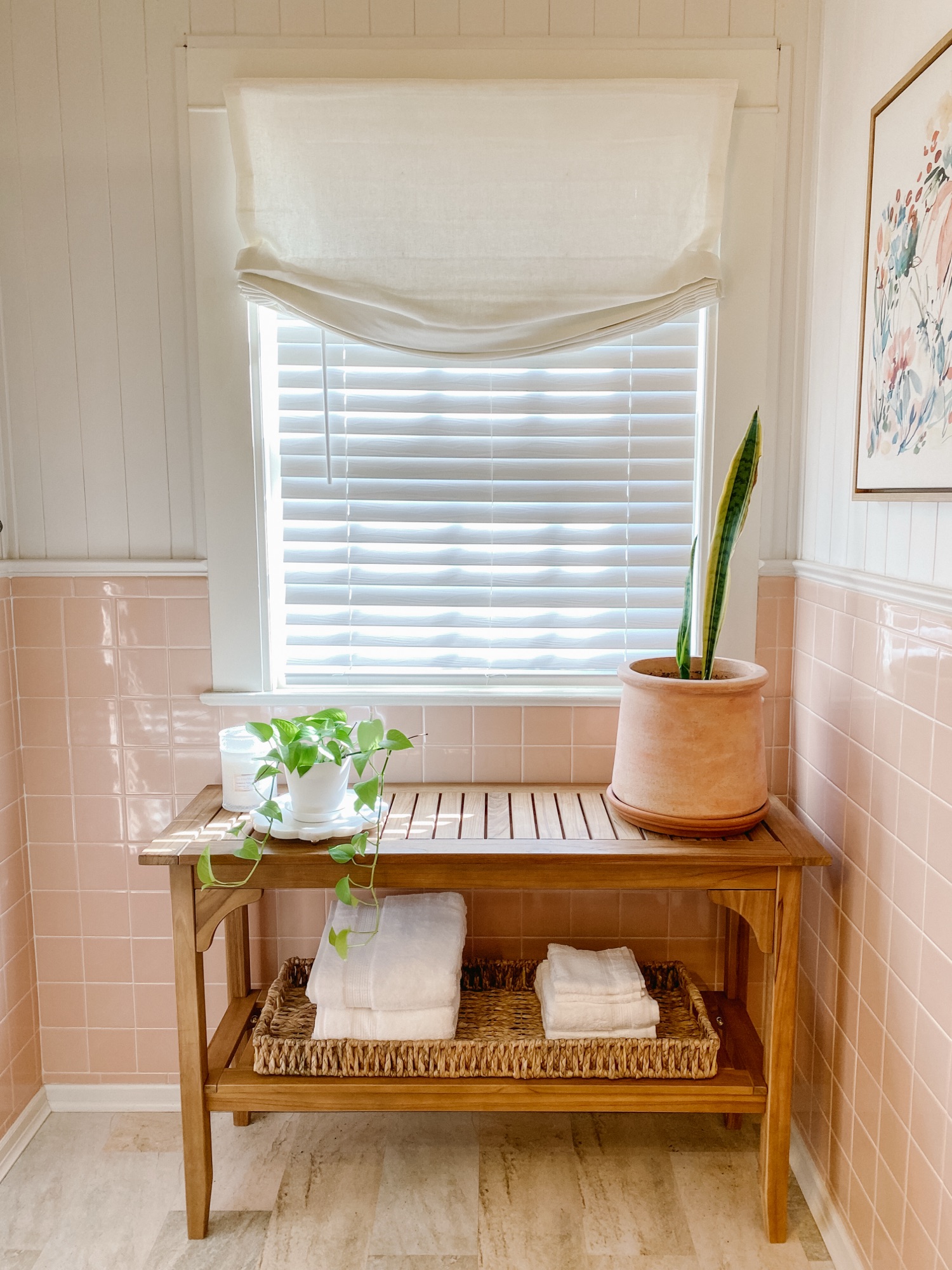
Again playing with peach tile, I leaned in a bit to the orange tones, and selected a teak table to place under the window. I also added a relaxed roman shade over the window blinds to soften the edges of the window. A lucky find, the seagrass basket was a clearance rack find, and it fits perfectly on the bottom shelf of the table.

Next, I added a few plants to the space. The live greenery adds a spa-like touch, and brings in green as an accent color. The last selection that I made for this design was the artwork. It’s the only artwork in our whole house that isn’t an original piece, but it brings together all of the colors in this bathroom perfectly.

Best Paint Colors for Bathrooms with Vintage Tile

The color palette for this bathroom is built around the original 1939 bathroom tile. For a similar color in wall paint, use Benjamin Moore Clementine Rose 1219. A complementary neutral trim color is Benjamin Moore China White OC-141. If you’re looking for an accent color that pairs well with the other two colors, try Benjamin Moore Paris Rain 1501.

Adding Modern Comfort to a Historic Bathroom

I hope this inspires you to rethink a total remodel. There are many ways to add modern comfort to a historic bathroom without gutting it. For us, the space functions well and the original tile and fixtures are in fantastic condition. (What you might not be able to tell is that the built-in cabinet is set deep into the wall, so we didn’t have a need to create additional bathroom storage.)

I know there’s a temptation from social media, TV, and Pinterest to “update” every space that isn’t decorated in a modern way. But the best way to truly honor a historic home is to allow it to be what it was built to be. Most historic homeowners will embrace the imperfections and charm of designs from by-gone eras.

The finished design. A 1930s vintage bathroom with modern comfort and classic accessories.

Shop This Look

If you see something you like in this design that you’d like to incorporate into your own space, you can find many of the items linked HERE for shopping.

Click to Shop

While You’re Here…

While you’re here, I hope you’ll take a few minutes to “look around” and read a few of our other articles. We’re currently in a series called Falling for Home: A Weekly Autumn Journal, which is all about falling in love with our own homes again as we meander through the autumn season together.

Let me know what you think of these bathroom colors in the comments below. Would you ever live with peach colored tile?

Transforming Our Breakfast Room: A Makeover Journey

Today I am sharing some before and after pictures of the breakfast room in our 1939 home. This is the casual dining space in our home that we use for our everyday meals, playing board games, and doing puzzles.

Our breakfast room is off of the kitchen, and has also has a door to the center hallway on the main floor. One of the things we love about living in a house that is not open concept, is that we can dedicate rooms to the functions we need and completely close the room by shutting the doors to it.

Before, the previous homeowners used this space as a family room.
After, we restored the space to its original purpose, a breakfast room.

The previous owners were using this room as a family room. They were using a sectional sofa that took up the entire room. The walls were painted a sherbet orange color with a lighter orange color on the ceiling. The only light in the room was a pendant fixture that was so dark we couldn’t tell if it was on unless we opened the yellow glass shade.

Before, a large sectional filled the entire room.
After, the space is restored to its original purpose, a breakfast room.

We transformed this space by painting the walls Benjamin Moore “Pale Oak” and the ceiling “White Dove.” Our general contractor gave us a handmade stained glass shade that his father had made. The shade is far from perfect and a little uneven on the edges, but we loved it for this space. I found a pendant online that could accommodate the shade.

The orange paint colors on the walls and ceiling were not appropriate for the room. The windows have south and west sun exposure, which means direct light comes into the room for most of the day. As a result everything in the room took on an orange glow. Combined with a light fixture that wasn’t functional, this was a space that no one in our family wanted to be in.

After I corrected the color on the walls and installed a functioning light fixture, the breakfast room was completely transformed. The total cost was around $250 for the paint and a pendant fixture. The breakfast room isn’t completely done. We’re on the hunt for a very specific table and chairs. I’m also deciding what to put on one of the walls. But I wanted to share how simply changing the paint and lighting can completely change a room.

I’d love to see how you transform your own spaces with paint. Be sure to tag me on Instagram or comment below to share your photos!

Transform Your Dining Room on a Budget

This article contains affiliate links and ads. You can find many of the pieces I feature by clicking on the links at the bottom of this article.

I’m happy to finally share the details on our dining room refresh. Months before our kitchen renovation began, we started on our dining room. This was a low cost project that we completed over a long weekend. With some paint, new draperies, an estate sale find, and collected antiques from the storage bins, I created a dining room that we look forward to hosting holiday dinners in.

The homeowner that did all of the major renovations on our home in the early 2000s painted it a sherbet green with a lighter shade of green on the ceiling. The seller we purchased it from didn’t make any changes to the dining room at all. Every room was kept exactly the way it was when they bought the house, right down to where the nails in the wall were. It was important to me to make this OUR home, and painting is an easy way to do that without changing the style and architecture of a historic home.

One of the changes we made with the biggest impact was to paint the ceiling. If you’re considering painting your ceilings a lighter shade of the wall colors, pause and think twice. Not necessarily because of resale value, but think of how you want people to feel while they’re in your home. If you’re wanting a dramatic effect and an artistic environment, then go for it! But if you want people to feel relaxed and settled, it’s not for you. It’s distracting and chaotic if it’s not done properly.

We painted our walls with Benjamin Moore “Revere Pewter,” and the ceiling is “White Dove.” The trim is Behr “China White.” The trim was already painted for us, and I like how it works with the Revere Pewter. China White reminds me of the color of antique ironstone dishes.

When we sold our last house three years ago, we sold most of our furniture, including the dining room table, chairs, and china cabinet. The rental house we were moving to didn’t have a dining room, and the dining set was looking a little dated, so we sold it on Facebook Marketplace. After we bought this house, I found an estate sale that was selling an Ethan Allen dining set for less than 1/10th of the retail cost. It’s currently on the Ethan Allen website, and the total cost for the table, 8 chairs, and buffet would’ve been over $11,000. We paid around $1,000. It’s worth it to check out estate sales!

I featured the drapery and hardware on an Instagram post several months ago. The drapery and hardware ended up being a source of frustration. The bay windows in our house do not match the measurements of modern bay windows. Modern bay windows have a larger center window with a smaller functional window on each side. Our original historic bay windows have a smaller center (functional) window, with a larger stationary window on each side. The drapery and hardware for our bay windows were custom made to fit them. And unfortunately, they were removed by the seller. I ended up finding hardware and drapery that I preferred, but it was time and money that we weren’t expecting to spend.

The other items in the room, like plates, pitchers, and artwork, are things that I’ve collected over the years. It was a little like Christmas opening all of my boxes that had been in storage for three years, and we’ve only had one broken crystal glass so far!

I’m lucky to have two pieces of artwork by my twin brother, Tyrus Lytton, displayed in our dining room. He painted a portrait of our daughter when she was two or three, and I found a frame online that complemented the antique mirror on the other side of the doorway. He also painted a small watercolor of our house. (Side note: my brother normally does large scale art installations all over the world. I’m very proud of him and thankful to have some of his artwork on a smaller scale.)

Below you can find a list of sources for the items that I used in our dining room. Some of the pieces are antiques, but I have linked similar ones that I found online. Click on the word to be taken to the source where you can find them.

P.S. There are also a few side-by-side- before and after photos below.

As you can see, a little paint and some new draperies can make a big impact. I’m curious if you’ve ever purchased a house and had items removed that were supposed to stay. Let me know in the comments if you’ve experienced that, too!

Until next time,

Abby

Welcome to Our New Home

original artwork by Tyrus Lytton

This year we moved to a new home in a small town about an hour away from where Ken and I were born and raised. While this may not seem like a big move, it’s quite an adjustment only having one grocery store to choose from. After three years of searching for the perfect historic home for us, we found one to settle in and make our own. A former homeowner completely updated the wiring, plumbing, and basement during an early 2000s remodel. (That was good news for us!) But, the most recent homeowner neglected to keep up with basic historic home maintenance, so we have a lot of things to do, like re-glazing all of the original (working) windows, refinishing the original iron railings (there are a lot of them), and taming the overgrown property full of invasive plants.

This is the original brick color. It has not been painted or lime washed.

In the coming months, I’ll be sharing how we are updating and caring for our almost 85 year old home. Since the major mechanical systems have been updated, many of the updates I’m making are considered cosmetic. I’ll be sharing the planning process and the exact materials I’ve used. The process I’m using and selections that I’m making are timeless, which means they will look wonderful in my home and yours, too.

This is the original brick color. It has not been painted or lime washed.

As you follow along, keep in mind that I am working to create a backdrop that can stay in place for decades to come long after I’m gone. Tile, flooring, and countertop selections are not exact copies of what a homeowner would use in a 1930s home, but they are reminiscent of colors and materials that could have been selected. My home is in a town that would have been very rural and agricultural, so “modern” art deco themes wouldn’t have been used. As I showcase rugs, furniture, and accessories, please remember that I am not aiming to create a museum-like atmosphere. While my style is certainly traditional, I am not actively seeking period pieces to fill my home.

Tomorrow I will be sharing our kitchen remodel, which includes countertops, backsplash, flooring, appliances, and adding an extra lower cabinet. In the meantime, I share quite a bit more on Instagram if you’d like to see more real-time progress. See you then!

Abby

The 50 Week China Cabinet Makeover

There really isn’t a solid reason why, but this china cabinet took me 50 weeks to finish. I wasn’t feeling a big creative push when I started working on it, and I think at the time we were transitioning out of an antique store we were in. I.e. I didn’t have a big need for additional inventory. Regardless of why, it actually took 50 weeks from start to finish.

Here it is “before”…

//assets.pinterest.com/js/pinit.js

As always, a little repair work was needed before painting.


//assets.pinterest.com/js/pinit.jsSo there are a few things that lead me to believe this is from the 1920s – 30s. I think it has some definite Art Deco elements like the original handles on the bottom, the feet, and the trim work. (And who said I don’t use my degree on a daily basis?! Those Furniture History classes come in handy more than I ever thought they would.)

So after 50 weeks, here is the after.

//assets.pinterest.com/js/pinit.js
Obviously there was a color change. I made my own “chalky” paint from scratch using Benjamin Moore’s Danville Tan. Painting was necessary mainly because of the repair work needed. I also changed the glass on the front. I created a “mercury glass” type of finish instead of clear glass. There are lots of methods for creating mercury glass if you search for it on Pinterest. It’s not my first time doing this technique, but a word to the wise: Just like a crackle finish will never turn out the same way twice, mercury glass will never turn out the same way twice. Let’s just say I thought long and hard, was definitely sure it was what I wanted to do, took some long, calming breaths, and said a prayer before I started it.

I’m happy the “mercury glass” turned out well!

It would have been fine without the mercury glass finish, but it didn’t seem quite complete to me without it.

The handles on the bottom are unique. I’m all about using the original hardware whenever possible.

Here’s the before and after…

//assets.pinterest.com/js/pinit.js

What a big difference! I know it’s hard to tell from the pictures how big this is. It’s only about 64″ tall, which is on the smaller side for a china cabinet. That’s typical for the time period it’s from though. I can totally see this being used as anything from bathroom storage to a bar or bookshelf.

//assets.pinterest.com/js/pinit.jsUntil next time…

Soft Aqua Dresser

Another new dresser! I don’t know why I’m so bad about showing these off to everyone once they’re finished. I’m really going to try to be better about that.

Here’s a small dresser that I picked up a while ago. As always, it needed some repair work. I don’t tend to paint quality wood furniture unless there’s something wrong with it. I do make exceptions for “ugly” furniture that needs a makeover though.

I usually try to paint furniture in neutral colors so that more people will be able to use them. But I have this one particular blue color that I love to use. It’s a custom color that I make. I make my own “chalky” paint. There are recipes galore on Pinterest.

I’ve had a hard time capturing the true color in photos. I like to describe it as the perfect, soft aqua/blue/teal color.

I’m happy that I was able to keep the original hardware. It still looks great, and it’s usually higher quality craftsmanship that what is currently available.

This is fairly small, just 35″ tall. Perfect for a guest bedroom or even bathroom storage.

I also just finished an Art Deco era china cabinet that I’ll post about soon. I seriously started working on it 50 weeks ago – almost a year! I’m glad it is done.

Dresser Makeover, Hardware Too!

Sometimes I forget exactly how many pieces of furniture have come and gone through our hands. It doesn’t seem like that many until I start scrolling through the files on our computer. It’s a lot, y’all. There’s a lot of learning and hands-on experience that have resulted from doing so many pieces, but from time to time I still come across problems that need to be solved.

Here’s a dresser that I just finished. Sorry, I don’t have a great before picture, but it’s the one on the right. It was blah, painted brown, and nothing to be desired. It’s wood, but the wood was painted over with a brown color. Not sure why.
I decided to go with gray and blue. I’m holding off on the “after” picture because I want to talk about my hardware problem first. I may have mentioned it before but ALWAYS, for the love of Pete, ALWAYS count the hardware before you buy it. Why? I promise you that you WILL spend more on new hardware than you did on the piece. And I also promise you that you won’t be able to find new hardware that matches up to old holes. Trust me.  So anyway, I counted the hardware, but failed to notice that some of it was damaged. Take a look:
Pretty brass hardware (y’all know it’s back, right?) with some faux tortoise cabochon type thingies. Except, some of the cabochons were broken and some were missing completely. First of all, let me be completely honest: The cabochons were ugly and plastic-y feeling. But I would have TOTALLY left them on there if they had all been intact. Not gonna lie – I would not have spent a dime to replace them. 
However, that wasn’t an option. I played around with several things, but I ended up coming up with this:
I married the old, original drawer pull with a new, pretty knob. And….I love it. But wait, there’s more. The next problem? Screws. Yep, turns out it was annoyingly difficult to find screws that worked. I got some blank stares at a local hardware store, and one morning I had two employees at Home Depot finally help me put together something that worked. I needed 8 screws exactly, but…
Instead I got 7 plus this screw ^ that someone didn’t turn into a screw. (Another trip back to Home Depot.)
Ok, finally. Here’s the after:

//assets.pinterest.com/js/pinit.js

//assets.pinterest.com/js/pinit.js

The hardware certainly wasn’t an issue I anticipated, but I think it completely transformed the piece. What do you think?

//assets.pinterest.com/js/pinit.js

Spring Entryway Decorations

The sunshine and warmer temps have definitely been inspiring. Our bright and happy Easter and Spring decorations have carried throughout the house. Here are a few pictures of the entryway.

Click any photo if you want to see it bigger!

//assets.pinterest.com/js/pinit.js

I don’t think I’ve shared a photo of this table yet. It was originally a dark cherry finish. The bottom has a glaze over powder blue and the top has been “crackled.” 

//assets.pinterest.com/js/pinit.js

This little lamb is so sweet, don’t you think? Plus, tulips in antique Ball jars is a no brainer. The chalkboard was picked up at Hobby Lobby and I used our barnwood vinegar stain from THIS POST to age the frame. Before, it was new and unstained. 

//assets.pinterest.com/js/pinit.js

This typewriter is a fave. I picked it up one year while on an adventure with my sister, Tara, at the Crabapple Antique Festival in Milton, Georgia. If you’re interested in finding other antique festivals in Georgia go HERE and HERE. (It’s an older post so the dates won’t be accurate, but you can put it in the Google-machine.) 

Barn Wood China Cabinet: Before & After

I like refinishing hutches. I have a whole folder on our hard drive dedicated to before and after pictures of hutches that we’ve done. They are straight forward, and they sell really well for us. (BONUS!)

So I don’t know why it is that we hate china cabinets. But both Ken and I do. Somehow those simple doors on the front that officially make it a “china cabinet” also turn it into a project from hell. I also have a folder dedicated to before & after pictures of china cabinets. I hope I don’t ever have to add another picture to it. I don’t want to say, “never” but, I never want to refinish another china cabinet again. Unless it’s free. And unless I’m doing it for myself.

Ugly, ugly!

Here’s the before of the latest china cabinet that we’ve redone. It was next to free because the glass shelves on the inside were gone. Buying it we knew we’d have to invest in the expense of replacing them, but we know a guy. 😉 Not really. We know Ace Hardware. They sell and cut glass.

Now, this is the point that I also have to point out the missing pane of glass on the right. I wish I could blame that on the kids. But that was an adult in the house. And not me.

The other pane came out and some chicken wire went in. Because chicken wire definitely goes with what we had planned for this.

Yesterday I posted about how we came upon the jackpot of barn wood. Check out that post (here). Before we even started on this china cabinet we knew that we wanted to add some of the barn wood to it and change the look completely. This is where I get on my soap box and proclaim, “Please do not throw out furniture. Find a way to reuse it. Invest in quality furniture to begin with and you will never need to replace it!”

Ahem, without further ado, the AFTER:

This took over a week to complete. Seriously, it did. With prepping, cutting wood, installing wood, drying wait time, painting, drying wait time, sanding, curing wait time, waxing, hardening wait time, installing chicken wire, and new glass shelves it was a FULL WORK WEEK. The wood is priceless. It cannot be replaced or replicated. This is a one of a kind, truly unique piece. And since I’m never making another one (never say never?), there is only one opportunity to get anything like it from us!

Now THAT’S a makeover! Completely different.

//assets.pinterest.com/js/pinit.jsHope you enjoy the before & after. If you’re local and you’re interested in purchasing this, please use the icons at the top to contact us. Facebook is the best way!

Update: This piece has sold and is no longer available,