
Vintage Book Shopping: Themes, Genres, and Gifts

This article contains commissionable links and ads.

The first antique I ever bought was a book. As a young teenager my family stopped into an old bookshop that used to be in historic Stone Mountain Village in Georgia. The shelves were absolutely crammed with books, and although I was an avid book lover from a very young age, I was a little overwhelmed with where to start browsing. I noticed there was a shelf marked “antique,” and for some reason, that’s where I started. I decided to look for the oldest book that I could afford. I walked out of the bookshop that day with my very first antique, a book called, “Reveries of a Bachelor.”

People often overlook buying vintage and antique books on their thrifting and antiquing adventures. Today I am sharing six things to consider when shopping for antique books: theme, genre, use, author, personalized gifts, and color/pattern.

Theme

Books can be a wonderful conversation starter, and grouped together they can become decorative accessories of interest. For example, one of our guest bedrooms has evolved into a red, white, and blue theme. On a nightstand in that room I stacked a group of books that evoke the feeling of “American government.” I currently have books in this stack with subjects like government, democracy, and America. If I want to grow this themed collection, while I am antiquing, I will look for both fiction and non-fiction books that fit with this theme. An example would be a book about American presidents, or maybe a murder mystery book with Washington, D.C. in the title.

Other themes that would be easy to search for are things like art, wild west (cowboys, western expansion), the region you live in (Southern U.S., the beach), cooking/food, gardening, or travel. Just remember not to limit yourself to either fiction or non-fiction; they can be mixed! (Check out these old gardening books HERE!)

Genre

I have wonderful memories of consuming books as a child. The characters from these books are often remembered fondly. I’ve put together a group of sentimental titles that would fit into a genre that an adolescent girl would enjoy. Books like The Secret Garden, Anne of Green Gables, and Pollyanna all make sense when grouped together in a display, because they’re all from the same genre. I’ve grouped my set on a shelf in our bedroom.

Other genres that would be fun to collect are early textbooks, British classics, poetry, music books, and hymnals. (Check out these antique poetry books HERE!)

Use

One of the best reasons to collect old books is because you’re actually going to use them. Years ago churches started throwing away all of the hymnals that used to be in stored the back of the pews. They moved to showing lyrics on screens instead of reading them from hymnals. However, many people prefer to use a hymnal to sing or play hymns on a piano. When I see a stack of old books for sale, I go through them to see if there are any old gardening books. I like to use them as references for plant problems or inspiration for things that I’d like to add to my garden.

Other books to look for if you want to actually use them are books on woodworking, cookbooks, or other types of how-to books. (Check out these old song hymnals HERE!)

Author

When people collect old books, they often choose them because of the author. One of the authors whose books I collect are those written by Edward Bulwer-Lytton. My family name is Lytton, and some relatives speculate that we are distantly related to the Lord Lytton. Another, more modern, author whose books I specifically search for is Martha Stewart. I find Martha Stewart’s books to be helpful resources for many topics that I’m interested in. Martha published her first book 43 years ago in 1982, so many of her books definitely fall into the vintage category.

Other authors that interest people are Hemingway, F. Scott Fitzgerald, Dickens, and Laura Ingalls Wilder, just to name a few. (Check out these vintage Martha Stewart books HERE!)

Personalized Gift

Another reason to consider buying vintage and antique books is for personalized gifts. Around the holidays I like to give a little something extra to people like our hair dressers and our dentist. If I was giving them a gift card or a tin of cookies, it would be fun to package their main gift with an antique dentistry book or a book on old hair styles. If you have someone in your life that is interested in wild life or travel, finding an antique book to give them on their topic of interest shows that you took a little extra effort in the thought that went into it. Be sure to look for these types of gifts all year long and set them aside for when you need them. (Check out these vintage hairstyles books HERE!)

Color and Pattern

Finally, another thing to consider when shopping for vintage and antique books is the cover. People have started using old books as decorative objects in their home. They can make an impact as decor when grouped by color. One side of my husband’s ancestry is largely found in Scotland. I have recently started collecting Scottish themed books for our bookshelf that have beautiful tartan patterned covers. These tartan decorated books are also beautiful in Christmas displays.

The next time you are thrifting and antiquing, don’t forget to look for books. Decide on a theme, a color, or even someone to buy a gift for. Recycling old objects in these ways puts them to use and keeps them out of a landfill. Happy Hunting! (Check out these vintage books with tartan covers HERE!)

Styled garland showing how to dry whole oranges and use them in natural Christmas decor.

How to Dry Whole Oranges for Christmas Decor

When I think of Christmas, I am reminded of fragrant oranges, spicy cloves, and warm cinnamon. For many years I have dried and preserved orange slices to use as Christmas decor. (See this article from 2020.) This year I decided that I would learn how to dry whole oranges, instead of just slices. Today I am sharing the simple steps to drying whole oranges.

The steps for drying whole oranges are very simple, but they are somewhat time-consuming. Today I am sharing the basic things you need to know about how to dry whole oranges. I chose to only dry half a bag of oranges. I wish I had done the entire bag! While it is a little lengthy to dry whole oranges, they turned out really well. I found other spots in the house that I would’ve placed more whole, dry oranges. Next year I’ll put the entire bag into the drying process.

Step One

Turn your oven on to the lowest temperature. My oven’s lowest temperature is 170*. My oven has convection bake and regular bake. I found that convection bake was more effective than the regular bake.

Step Two

Using a small paring knife, you will begin to cut into the orange rind from pole to pole. Don’t quite go all the way to the end/pole. Leave 1/4 of rind on each end of your cut. You’ll want to make sure your cut goes all the way into the pith/rind through to the orange flesh. However, once you start drying them, if you notice that you didn’t get all the way through to the orange flesh, you can take it back out of the oven and cut deeper before putting it back in.

You can see how I didn’t cut deep enough on this orange. You can cut deeper and put it back into the oven to finish drying.

Note: I experimented on one of my oranges to see if I could cut a design other than basic stripes. This doesn’t work as well. Using the method I described above, the oranges will develop gaps and vents, exposing the inner part of the fruit to be dried out. You can experiment as well, but in my experience, basic slits are best.

You can’t see them, but the slits into the orange are there.

Step Three

Once your oranges are cut, you need to decide how you want them to be placed into the oven. My oven is new, so I decided to line a cookie sheet with parchment paper and place them on top. Some people place them directly onto the racks. Other people place them onto metal cooling racks that have been put into a cookie sheet. A friend told me it would not affect drying time. You decide what’s best for you!

I used tongs to turn the oranges every couple of hours. If you notice a cut didn’t go all the way through, take it out to cut deeper before putting it back in again.

Step Four

Next you will leave the oranges in the oven to dry out until the rind is hardened and you believe that the fruit inside is dried out. I had been warned that this would take a long time, and it certainly did. On the first day, I dried them in the oven from 7 am to 7 pm. I didn’t want to leave the oven on overnight, so I took them out. The next day I dried them for another four hours. The third day, I dried them for the entire day again. All in all, I think this was about 24 hours of drying time. Which is why I wished I had dried the entire bag at once.

After Your Oranges are Dried

You can use your dried oranges in garlands, wreaths, or hanging on your Christmas tree. I have tucked dried oranges into my fireplace garland, along with pomegranates, feathers, holly berries, and pine cones. I added ribbon that resembled the colors of dried oranges and pomegranates.

When I dry orange slices, I will save them in an airtight bag to use for multiple years. Before I use dried slices again the next year, I inspect them to make sure there is no mold or anything undesirable on them. Since it is not possible to see inside and inspect whole oranges, I won’t be saving the dried whole oranges to use again next year.

Using natural elements in Christmas decor creates a rich and vibrant ambiance. Since a bag of oranges is relatively inexpensive, you really only need some time to create Christmas decor using whole dried oranges. Have you dried oranges before? Slices, or whole oranges? I’d love to hear your feedback in the comments below. Or, post a photo on Instagram and tag me so that I can see your dried oranges.

Merry Christmas!

Transform Your Dining Room on a Budget

This article contains affiliate links and ads. You can find many of the pieces I feature by clicking on the links at the bottom of this article.

I’m happy to finally share the details on our dining room refresh. Months before our kitchen renovation began, we started on our dining room. This was a low cost project that we completed over a long weekend. With some paint, new draperies, an estate sale find, and collected antiques from the storage bins, I created a dining room that we look forward to hosting holiday dinners in.

The homeowner that did all of the major renovations on our home in the early 2000s painted it a sherbet green with a lighter shade of green on the ceiling. The seller we purchased it from didn’t make any changes to the dining room at all. Every room was kept exactly the way it was when they bought the house, right down to where the nails in the wall were. It was important to me to make this OUR home, and painting is an easy way to do that without changing the style and architecture of a historic home.

One of the changes we made with the biggest impact was to paint the ceiling. If you’re considering painting your ceilings a lighter shade of the wall colors, pause and think twice. Not necessarily because of resale value, but think of how you want people to feel while they’re in your home. If you’re wanting a dramatic effect and an artistic environment, then go for it! But if you want people to feel relaxed and settled, it’s not for you. It’s distracting and chaotic if it’s not done properly.

We painted our walls with Benjamin Moore “Revere Pewter,” and the ceiling is “White Dove.” The trim is Behr “China White.” The trim was already painted for us, and I like how it works with the Revere Pewter. China White reminds me of the color of antique ironstone dishes.

When we sold our last house three years ago, we sold most of our furniture, including the dining room table, chairs, and china cabinet. The rental house we were moving to didn’t have a dining room, and the dining set was looking a little dated, so we sold it on Facebook Marketplace. After we bought this house, I found an estate sale that was selling an Ethan Allen dining set for less than 1/10th of the retail cost. It’s currently on the Ethan Allen website, and the total cost for the table, 8 chairs, and buffet would’ve been over $11,000. We paid around $1,000. It’s worth it to check out estate sales!

I featured the drapery and hardware on an Instagram post several months ago. The drapery and hardware ended up being a source of frustration. The bay windows in our house do not match the measurements of modern bay windows. Modern bay windows have a larger center window with a smaller functional window on each side. Our original historic bay windows have a smaller center (functional) window, with a larger stationary window on each side. The drapery and hardware for our bay windows were custom made to fit them. And unfortunately, they were removed by the seller. I ended up finding hardware and drapery that I preferred, but it was time and money that we weren’t expecting to spend.

The other items in the room, like plates, pitchers, and artwork, are things that I’ve collected over the years. It was a little like Christmas opening all of my boxes that had been in storage for three years, and we’ve only had one broken crystal glass so far!

I’m lucky to have two pieces of artwork by my twin brother, Tyrus Lytton, displayed in our dining room. He painted a portrait of our daughter when she was two or three, and I found a frame online that complemented the antique mirror on the other side of the doorway. He also painted a small watercolor of our house. (Side note: my brother normally does large scale art installations all over the world. I’m very proud of him and thankful to have some of his artwork on a smaller scale.)

Below you can find a list of sources for the items that I used in our dining room. Some of the pieces are antiques, but I have linked similar ones that I found online. Click on the word to be taken to the source where you can find them.

P.S. There are also a few side-by-side- before and after photos below.

As you can see, a little paint and some new draperies can make a big impact. I’m curious if you’ve ever purchased a house and had items removed that were supposed to stay. Let me know in the comments if you’ve experienced that, too!

Until next time,

Abby

How To Arrange a Grocery Store Bouquet of Flowers

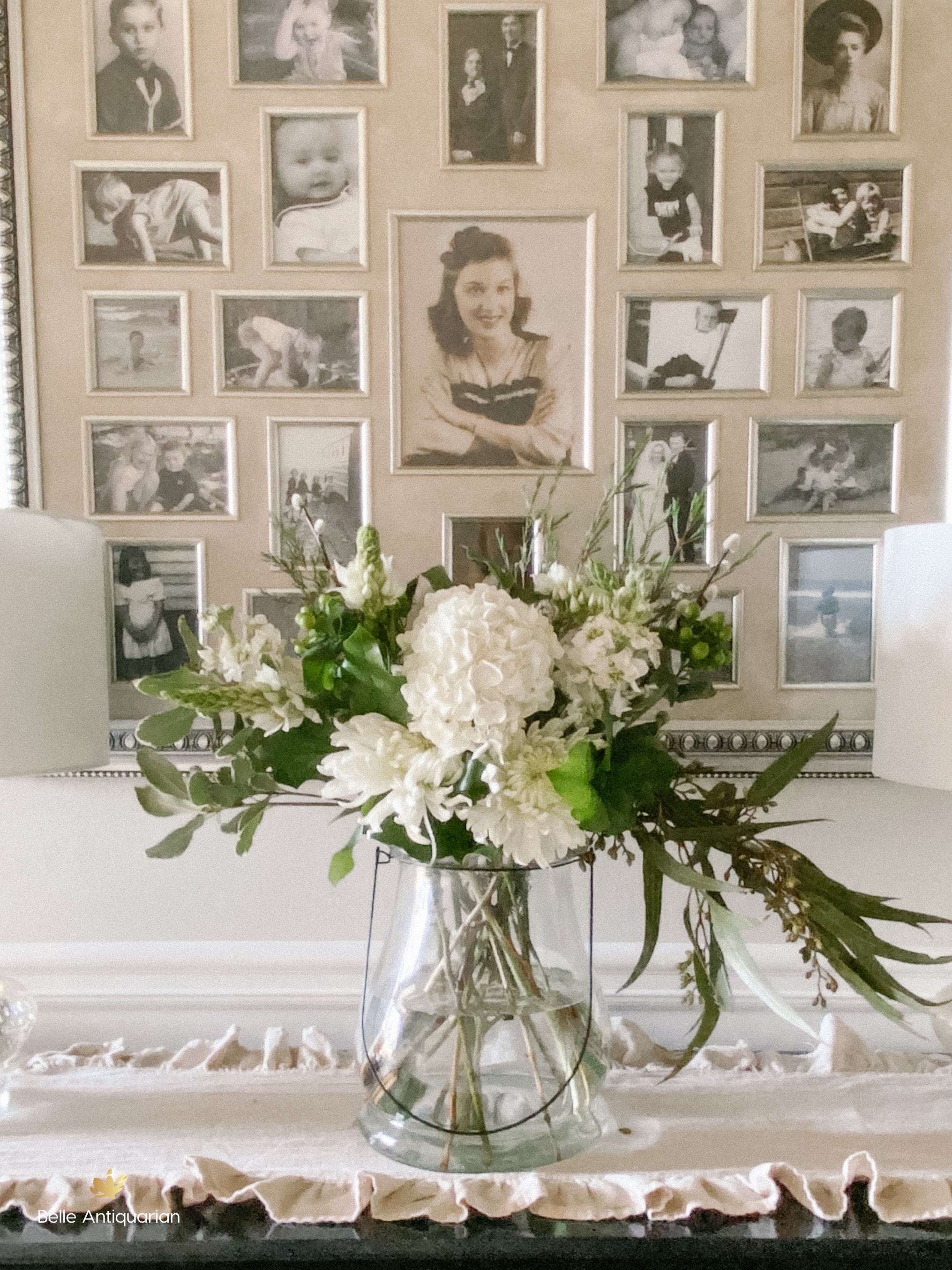
Well, I’ve been saying for a while now over on my Instagram that I would give some pointers on arranging flowers. The problem is that every time I start to do so, it turns out to be way too long for Instagram stories or Reels. One day I’ll get around to make an IGTV or YouTube video. For today I thought I would give some basic tips for arranging a grocery store bouquet of flowers, which can sometimes be the most frustrating to arrange.

Tip #1 Cutting

You never want to unwrap your grocery store bouquet of flowers and just plop them into a vase of water. Not only do each and every one of the stems need a fresh snip so that they can drink water, the flowers aren’t meant to all be the same height. You will want to cut some shorter or taller so that your arrangement has shape and all of the flowers can be seen.

Tip #2 Focal Point

Speaking of cutting flowers, you will want to decide which flower or flowers you want to be the focal point. That flower will need to be one of 3 places: bottom and center, middle and center, or top and center. Unwrap your grocery store bouquet and separate out what you have. Usually grocery store bouquets will give you only one of a special flower, and that flower is meant to be the focal point. In my picture and video you can see that the white hydrangea is the focal point. That was the only flower in the bouquet that there was only one of.

Tip #3 The right size vase

If you find that your grocery store bouquet looks very sparse in your vase, try finding a smaller container to use as a vase. Teapots, vintage drinking glasses, and even small pitchers make great alternative vases. If your arrangement is too big for your vase, try turning it into several smaller arrangements. Another option is to use multiple bouquets to fill up a vase.

Tip #4 Keeping them alive and fresh

Usually bouquets come with a little packet of flower food to add to the water in the vase. I usually only use half of the packet and save the other half in a baggie. After a couple of days, change out the water in the vase and use the other half of the flower food packet. My number one tip for keeping your flowers fresh is to make sure there is nothing but stems below the water line – no leaves, no flowers, no greenery of any kind. This will keep your flowers fresh longer!

Here’s a quick time-lapse video of me arranging this grocery store bouquet!