
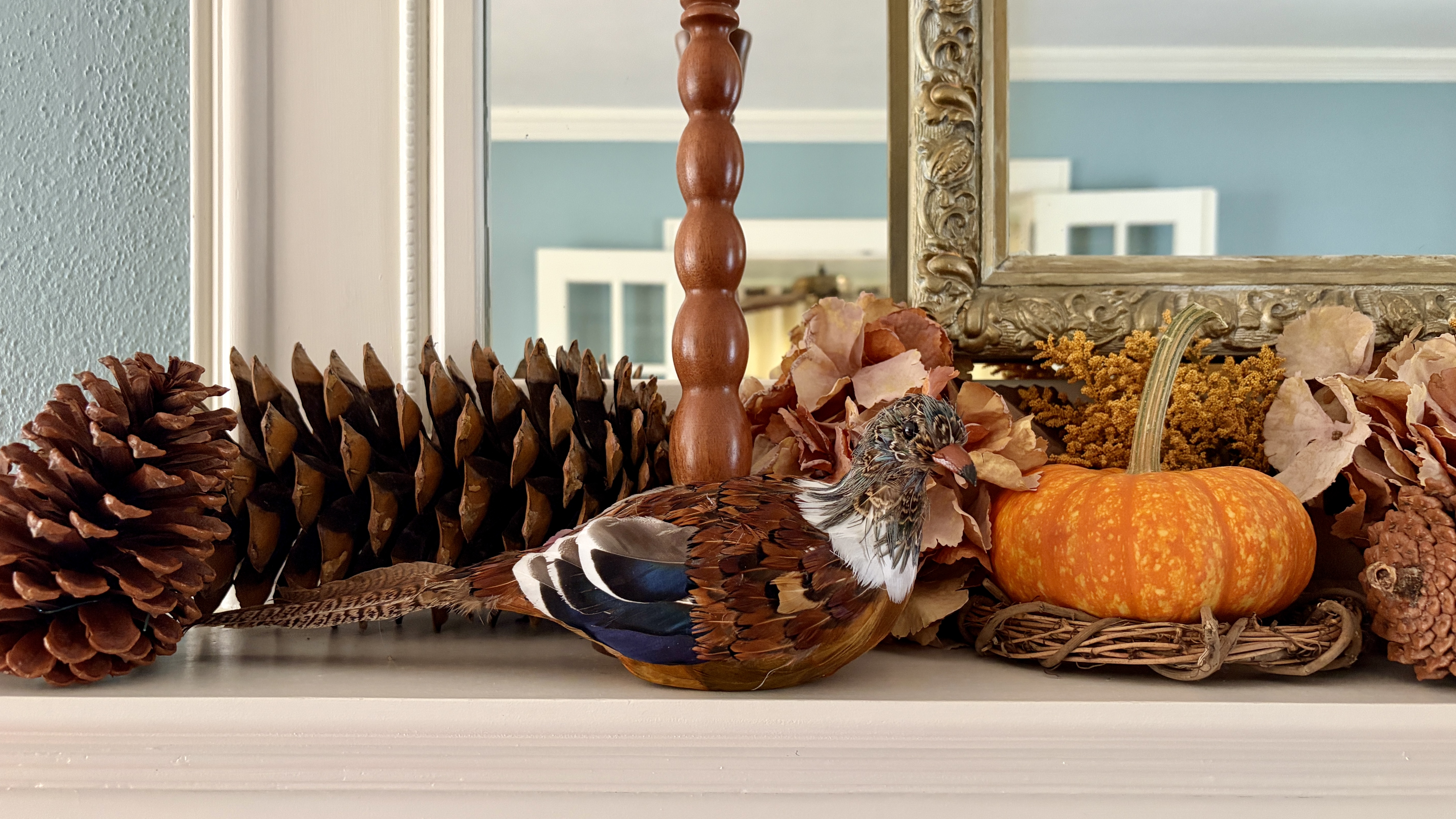
Fall decorating on a mantel with a pheasant figurine, pumpkin on a grapevine wreath, large pinecones, wooden candlesticks, and a gilt mirror.

A Collected Approach to Fall Decorating

As I arrange the pumpkins on the stairs outside of our front door, I wonder if it’s possible for them to bake as they sit outside. The calendar may say that fall has officially arrived, but the weather here in the Deep South is late to the party.

I can feel beads of sweat gathering on my forehead as I place each pumpkin exactly where I want it on the stairs. It’s a meager attempt to make it look like fall, even though it doesn’t feel like it yet.

Over the years I have accepted that Fall in the South doesn’t look like it does in movies like Good Will Hunting and Practical Magic. Fall reveals itself a little slower and more subtly down here.

Summer tries to linger a little longer in the South. So, I stopped dragging dozens of fall décor bins up from the basement, and I adopted a collected approach to fall decorating. A collected approach to fall decorating is a more natural way of letting a Southern home move seamlessly into the season.

Abby Smolarsky arranging orange, cream, and blue-green pumpkins on the steps outside her black front door.

This post contains affiliate links. If you make a purchase through one of these links, I may earn a commission at no additional cost to you. As an Amazon Associate I earn from qualifying purchases.

Letting Your Home Move into Fall

Fall in my home often feels like a time of transition. Summer has kept me busy with gardening and traveling, and our holiday calendar for the next few months is already filling up.

Despite the warm weather, I am ready to nestle down in my home for the season. I’ll do some fall decorating, but a complete room overhaul is unnecessary when careful thought is put into seasonal additions.

For my husband and me, our home is our retreat where we can withdraw from the hectic world after a long day. We like our things, collected and curated, and we prefer not to put them all away to make room for décor that is only brought out for a few weeks.

During the fall, I’ll leave most of our furniture and collections out where they’re normally styled. With a few thoughtful additions, our everyday things transform into part of the seasonal décor.

Traditional dining room with wood furniture, collected wall plates, a floral tablecloth, and a pumpkin centerpiece surrounded by dried hydrangeas.

Making Fall Decorating Feel at Home

As a lover of all things old and worn, I naturally gravitate towards a muted color spectrum. The traditional colors of Halloween would be garishly out of place in our home. In spaces filled with worn rugs, old books, and patinated copper, bright orange and black would feel out of character.

In our collected home, fall colors are successfully incorporated with existing décor when they reflect what is happening outside in nature. Instead of bright orange tones, I lean into softer terracotta colors that can be seen in dried grasses and leaves. Rather than using black, I prefer to use rich browns often associated with autumn sticks and pinecones. Each collected home is different, and the seasonal colors you choose should complement your existing décor.

Handmade clay jack-o’-lanterns on silverplate trays beside a blue-and-white ginger jar with rust velvet ribbon, a brass lamp, and autumn flowers.

With a collected approach to fall decorating in mind, I decorated a drop-leaf table that sits in the bay window of our living room. I left our oversized blue and white ginger jar and a thrifted lamp in their normal places, and I added a few touches to make this space feel like fall.

Two handmade terracotta pumpkins crafted by a local artisan are placed onto silver trays we’ve collected over the years. The pumpkins are rustic and even show marks from the potter’s hands where they formed the stems. When placed onto silver trays, the pumpkins are transformed into pieces of art that belong beside our other antique furnishings.

Behind the pumpkins, a piece of burnt orange velvet ribbon makes the ginger jar feel like it’s included in the season. This color was thoughtfully selected to bridge the color of the terracotta pumpkins with the existing pieces on the table.

Rather than using an “instead of” style of decorating for fall, I aim to use my favorite and familiar things in new ways.

Using Familiar Things in New Ways

When I shop for seasonal décor, I find myself evaluating each piece for the different ways it can be used throughout the year. I’m not attempting to participate in minimalism or deprive myself of decorating in a decadent way. Rather, it brings interest and joy into my life when I think of creative ways that pieces can be repurposed.

Pheasant feathers arranged in a silverplate sugar bowl beside a turtle shell, stacked vintage books, a small radio, and a framed photograph.

As collectors, we have things in our home that can be used in ways we never thought of. A shawl can be turned into a table scarf, or perhaps a collection of frames can be filled with family photos from a pumpkin patch.

This year I purchased small grapevine wreaths that can be used in spring to symbolize a bird’s nest, and in the fall, they became pedestals for tiny pumpkins to rest upon.

Limelight hydrangeas that filled our backyard with a bright, refreshing ambiance over the summer are now dried and used in vases and wreaths in our fall dining room.  A creamer and sugar set found at a local estate sale became vessels for pheasant feathers, which are then tucked into small vignettes.

In a collected home, items can be brought together and reimagined in new ways each season. As our spaces evolve and change over time, the way we integrate these pieces into our seasonal décor is constantly changing.

Framed photograph of a child at a pumpkin patch beside dried hydrangeas in a brown glass vessel tied with blue velvet ribbon.

Finding Your Own Collected Approach

This year when you decorate for fall, consider using pieces you already have in your home and adopting a collected approach for styling your seasonal décor alongside them.

By restyling what you already have, repurposing new decor in creative ways, and making selections that complement your existing decor, your collected home will be beautifully decorated for the fall season.


Looking for fall decor seen in our home or pieces that can be seamlessly added to your collected fall decor? Find these and more in my Amazon storefront.

Small pumpkin resting on a grapevine wreath beside a pheasant figurine, large pinecones, dried flowers, and wooden candlesticks on a mantel.
Elegant banner image reading “How to Create a Thanksgiving Floral Arrangement,” featuring orange pumpkins and green botanical accents on a soft cream background.

How to Create a Thanksgiving Floral Arrangement

As an empty nester, I cherish the moments when my family gathers for the holidays. I love decorating our home in meaningful ways, and today I’m sharing how I create a Thanksgiving floral arrangement to make the table feel special.

Over the years we normally had Thanksgiving at home, just the four of us. My husband worked nights and weekends in law enforcement, and he usually only had a few hours on Thanksgiving to sit down with us for a meal.

We didn’t always have fancy heirloom plates or crystal wine glasses. For many years, the most treasured Thanksgiving decorations on the table were placemats that the kids made and brought home from school. During the early years, Thanksgiving simply meant the parade on TV, the smell of onions and celery softening in butter, and the sound of kids playing a board game together while they waited to eat.

Now that they’re older, I’ve started creating a special Thanksgiving floral arrangement to decorate our table. Last year, I shared an arrangement filled with warm fall tones and garden greenery. This season, I’m changing things up a bit and walking you through each step so you can create one, too.

Flowers have a way of making the table feel special, whether it’s set for two or twelve. When my kids come home for Thanksgiving, they share in the excitement of the season. Not only do they enjoy eating the familiar Thanksgiving food that they love, but they can also tell that I’ve gone out of my way to make the table special, just for them.

If you’d like to share some flowers on your table this Thanksgiving, here are the steps you’ll want to take.

This article contains affiliate links. As an Amazon and LTK affiliate, I may earn a small commission from qualifying purchases at no extra cost to you. All opinions are my own.

Step One: Choose Your Vessel

The first thing I like to do when I’m creating a Thanksgiving floral arrangement is to think about what kind of vase or vessel I’ll be using. If the floral arrangement is going to be in the center of the table while we’re eating our Thanksgiving meal, then I’ll select a container that creates a profile that is low enough to be able to see each other’s faces while talking. On the other hand, if the flowers are going to be on a sideboard or entryway, then I might pick something taller to create more of a vertical look.

In my case, I’m creating a floral arrangement for the center of the Thanksgiving table, so I’m going to select something that looks nice in proportion with the length of the table, but it won’t inhibit the conversations.

Another thing to consider when choosing the vessel for your Thanksgiving floral arrangement is whether it suits the occasion. There are many ways to use ordinary objects and turn them into something beautiful to hold your flowers. Things like ironstone tureens, transferware bowls, or vintage silver pieces can be just the right thing to set a festive tone for a table setting with Southern and heirloom aesthetics. Don’t be afraid to repurpose containers in creative ways; they often make the most charming vases.

Vintage silver bowl used as a vessel for a Thanksgiving floral arrangement, sitting on a marble countertop in soft autumn light.
A vintage silver bowl makes a beautiful vessel for a Thanksgiving floral arrangement.

Vessels to consider: Low compotes, ironstone tureens, transferware bowls, vintage silver pieces, or even dough bowls lined with floral foam

Step Two: Build the Foundation

After you have selected your container, the next step is to build the foundation for your floral arrangement. I want to make sure my flowers stay in the positions I’ve arranged them in. In order for them to do this, I’ll use something inside the vessel to secure them. There are a few options to secure your flowers, and the most common are floral foam, chicken wire, or a flower frog. Some people even make a grid over the container by using clear tape. By using one of these methods, the Thanksgiving floral arrangement will be given structure and stability. This is especially important if the flowers are on a table that’s in a busy area or has a lot of movement around it.

Green floral foam soaking in a clear plastic container of water, preparing the base for a Thanksgiving floral arrangement.
Soak floral foam before arranging to help flowers stay fresh longer.

Before I start adding my greenery and flowers, I also want to think about water. You can make your floral arrangements a few days before your Thanksgiving meal, but you’ll want to make sure to take some steps to keep it looking fresh. Some flowers will prefer the water to be very clean. In that case, you’ll need to gently drain and refill the water every other day. If the water looks cloudy, it’s best to drain and refill it.

Other arrangements will have flowers that are “heavy drinkers.” You can simply use a watering can with a narrow spout like the one I use to refill the water in the container as needed. Be sure to check on the water often to prevent the flowers from dying before Thanksgiving Day.

Here are a few of my favorite things to use when I’m arranging flowers. I’m including everything from my favorite containers to my favorite floral snips. Click the image to shop these exact items in my LTK.

Graphic showing Belle Antiquarian’s favorite floral arranging tools and supplies, including vessels, floral snips, wire frogs, and floral foam, styled on a neutral gingham background.
My go-to floral arranging tools and supplies for creating timeless, garden-inspired arrangements.

Three: Select Seasonal Greenery

A lot of people ask me how to get their flowers to look like the ones created by a florist. One of the secrets to a beautiful Thanksgiving floral arrangement is the greenery. After we select our vessel and consider the foundation, the next step is to start adding greenery. For a truly Southern table, greenery often does the heavy lifting.

In the South we’re lucky to have a lot of greenery in our yards that is suitable for flower arrangements. Magnolia and camellia stems are beautiful and easy to find. I’ve also used boxwood and cedar cuttings in my arrangements. If you’re lucky enough to have autumn ferns in your yard, they make a wonderful addition to Thanksgiving floral arrangements.

When you’re thinking about which greenery to use, don’t be afraid to use more than one kind. Some greenery has matte leaves, and others are glossy. Some have big, wide leaves, and others have feathery tips. Layering more than one kind of greenery can create visual interest.

Your greenery sets the shape and volume of your floral arrangement. It’s the quiet structure beneath every bloom. Once we start adding them, your flowers will generally follow the shape that you created with the greenery.

Camellia branches arranged in a silver bowl with floral foam, forming the greenery base for a Thanksgiving floral arrangement.
Camellia branches form the base of this Thanksgiving arrangement. Their glossy leaves add structure and shine.

Lastly, consider the scale of your greenery in proportion to the scale of the vessel you’re using. If you’re using a small vase, large greenery, like Magnolia, will take up more visual space. You may not want as much Magnolia in that case. In a very large container, tiny leaves may get lost in the floral arrangement, so you may need more of them.

When I cut greenery in my yard, I use floral shears, snips, and a gathering basket to gather what I need before bringing it indoors.

Consider: Shape, color, texture, and size of leaves

Step Four: Add Blooms and Accent Elements

It’s finally time to talk about the stars of the show: the flowers themselves. (Are you surprised that there was so much to consider before even adding the flowers?)

Bundles of fall flowers in shades of rust, amber, and cream resting in a kitchen sink before arranging.
Fresh flowers in warm autumn tones, ready to be arranged for Thanksgiving.

If you’ve been following me on Instagram for a while, you know that my favorite place to buy flowers is Trader Joe’s. Trader Joe’s is very accommodating to me when I come in to buy a lot of flowers for floral arrangements. They know that flowers are a big part of entertaining guests, and they expect their floral section to be busy at this time of year. They’ll even send you home with a bucket of water if you’re buying multiple bundles.

Woman arranging fall flowers in a silver vessel near a kitchen window, creating a Thanksgiving floral arrangement.
Arranging flowers at home is one of my favorite holiday traditions.

Ideally, when I go into Trader Joe’s to look for flowers for a Thanksgiving floral arrangement, I like to look for flowers that come in fall colors and will also last a long time. Flowers like this will be Chrysanthemums, roses, marigolds, sedum, and eucalyptus. I’ll look for colors like russet, amber, burnt orange, cream, and blush. I generally stay away from bright whites and bold reds for my Thanksgiving floral arrangements.

Pro Tip: A Florist’s Formula for Balance
When arranging flowers, think in categories:
air (delicate stems that add lightness), filler (connective greens), disks (rounded blooms), spikes (height and rhythm), and focals (your statement flowers).
This simple formula helps every arrangement feel natural and balanced.

Illustrated chart showing five elements of a floral arrangement: Air Stems, Filler, Disks, Spikes, and Focals, on a gingham background with botanical sketches.
The five key elements of a balanced floral arrangement — Air Stems, Filler, Disks, Spikes, and Focals.

Step Five: Arrange for Entertaining

Now that you’ve created your Thanksgiving floral arrangement, there are a few things to keep in mind before you serve the turkey. If you made your floral arrangement ahead of time (and I hope you did), it’s best to keep it away from heat sources. The flowers will stay fresher if they aren’t in a hot kitchen or close to a HVAC vent.

We talked above about keeping the floral arrangement lower on the table so that conversations aren’t inhibited. But sometimes the arrangements turn out bigger than we expected. (This happens to me a lot, actually!) In that case, be sure to move your flowers off to another spot when it’s time to eat. The most important thing is to entertain your guests gracefully, not make your flowers the star of the show. After all, a welcoming table is more about warmth than perfection.

Finally, take some direction from the colors and textures in your flowers when deciding on the table décor. Colors in your napkins and tablecloth should complement or repeat the colors that you selected for flowers. Your Thanksgiving floral arrangement is just part of the table setting that you create for your guests, and it should blend seamlessly with the rest of the design.

Step Six: Finishing Touches

Once your flowers are in place, it’s time for a few finishing touches. Don’t be afraid to get creative and add unique touches to your floral arrangement. There’s artistic expression in how we position each stem, in the quiet rhythm of arranging. Even if we are all given the same exact flowers and tools to use, our arrangements will turn out looking quite different from each other.

Finished Thanksgiving floral arrangement in vintage silver bowl on dining table with vintage brown transferware plates.
The finished Thanksgiving arrangement, filled with autumn blooms and Southern charm.

One way to add your own touch is to think outside the box for items that aren’t commonly used when arranging flowers. I’ve wired some dried Magnolia seed pods to long bamboo skewers and added them into my arrangement as unique accents. Brown velvet ribbon or pheasant feathers would be wonderful additions to a Thanksgiving floral arrangement as well.

Close-up of a Thanksgiving floral arrangement featuring a wired magnolia seed pod, orange alstroemeria, and autumn chrysanthemums.
A dried magnolia seed pod, wired to a bamboo skewer, adds natural texture and Southern charm to the arrangement.

Tip: When the meal is over and your guests have gone, be sure to move your flowers to a spot where you’ll see them. Flowers bring joy and life to our rooms, and you can get the most out of them when you see them.

In Closing

This Thanksgiving, remember that who is gathered around the table is more important than what is on it. Flowers are a wonderful way to celebrate the season, but our friends and family will really remember the ways we embrace them this season through small, meaningful gestures.

Soft petals, inherited bowls, and laughter around the table make a house feel like a home. More importantly, loved ones who gather to share a meal make any place feel like home when they’re together. Be sure to let them know you’re thankful for them.


Explore More from This Series

Each article in this series celebrates the beauty of Southern living through the seasons. You can find the full collection on the homepage under Home for the Holidays: A Southern Season of Charm.