The Collected Kitchen

Welcome

Ask anyone to share memories of their life with you, and they’re bound to share one or two that involve time spent in a kitchen. The scent of celery and onions softening in butter. The bowl that was used for everything from mixing a brownie batter to holding popcorn on movie night. Perhaps they’ll remember music playing on the radio as the dishes were washed. When we gather as a family or with friends, we always find ourselves in the kitchen, the hub of the home. It’s the place where stories are swapped, hands are busy, and hearts come home.

Welcome back to the next installment of Falling for Home: A Weekly Autumn Journal. We’ve reached the midpoint of the series, as we’re journeying our way through topics that are dedicated to timeless seasonal living, traditional Southern décor, and creating a home you love year-round. If you’re just joining me, or you found your way here from Google, Pinterest, or Instagram, you can find links to the other articles in the series at the bottom of this article.

What Is a Collected Kitchen?

A collected kitchen is one that is curated by a combination of preference, utility, and time. You could go online to Amazon, eBay, or Etsy to order a complete set of items to mimic the look. But a truly collected kitchen evolves from time spent discovering what works for you. A collected kitchen is created by picking up items here and there to create a space of function and beauty that is uniquely designed for you.

The true beauty of a collected kitchen is that it’s not staged. The crock on the counter is there because it’s used every time the stove is turned on. The plate hung on the wall holds a memory of weekend antiquing adventures or the grandma who passed it on.

A collected kitchen isn’t sterile or empty. Chances are, you won’t see it on your Pinterest page. The counters will likely have things on them. Because we are using what we find to be the most functional and beautiful, everything isn’t going to match. If you’re looking for a “model home aesthetic,” you won’t find it in a truly collected kitchen. It’s a kitchen that feels like the warm heart of a home, one that’s inviting, personal, and well-loved.

Cream on Cream: A Canvas for the Seasons

We recently restored our 1939 kitchen. During that time, we added some custom cabinetry, installed new countertops and backsplash, and updated the flooring. The one thing that stayed in the kitchen and became a springboard for my whole design was some existing cream-colored cabinetry. As I was designing the space, I really evaluated how I wanted to feel and how it would reflect my personal style.

Truth be told, the kitchen is sometimes an overwhelming and overstimulating space for me. While my family loves my cooking, and I’m often told that I am good at it, it can be stressful for me. I needed my kitchen to be a calm space. I intentionally stayed away from bold colors and stark contrasts between materials. Using various shades of cream, along with natural wood tones in accessories, I created a space that allows me to cook in peace.

Another reason that I chose a monochromatic cream color palette was that it created a canvas for seasonal flexibility. I can mix in and swap out seasonal décor easily because I have a neutral backdrop. In fall, copper pieces warm the kitchen with a soft glow. During the winter holidays I can easily add some evergreen without clashing with anything. In spring, it’s easy to mix in pastel colors because they blend beautifully with the cream canvas that I created.

Objects That Work—and Tell a Story In My Collected Kitchen

Over the years I have found ironstone pitchers in various shapes and sizes. Some of them are the color of parchment paper with brown crazing that has deepened over time. Others, while over 50 years old, look almost new. I group them together to fill display spaces in our cabinetry, but I often get them down to use for floral arrangements or orange juice on a Sunday morning. As a group, in various shades of white and cream, they become functional art.

Through our glass cabinet doors, you can see stacks of milk glass mixing bowls and antique Ball jars. These don’t sit in storage behind glass as museum pieces that are too precious to use. Any time I’m baking, I’ll use either my vintage milk glass mixing bowls or my favorite yellow-ware bowls. The milk glass bowls are extremely thick and were made for durability that is non-existent today. I’ve actually dropped one on the kitchen floor, and it didn’t break!

An old plate rack that I picked up for $10 holds plates and platters that we use for meals. On top of the refrigerator, I keep an extra large wicker basket, which holds seasonal linens and works to fill a void between the top of the refrigerator and our tall ceilings. These natural elements add texture, warmth, and patina to create an authentically lived-in space.

The Working Kitchen Philosophy

We’ve all been in kitchens that are stark white with not a single thing on the counters. Or maybe you’ve seen a kitchen with open shelves that are full of framed photos and knick-knacks, but not a single cooking utensil. I can only wonder how much memory-making is being done in these kitchens. Are little hands making messes with flour while “helping” with the cookie dough? Are teenagers gathering to try their hand at cooking late at night?

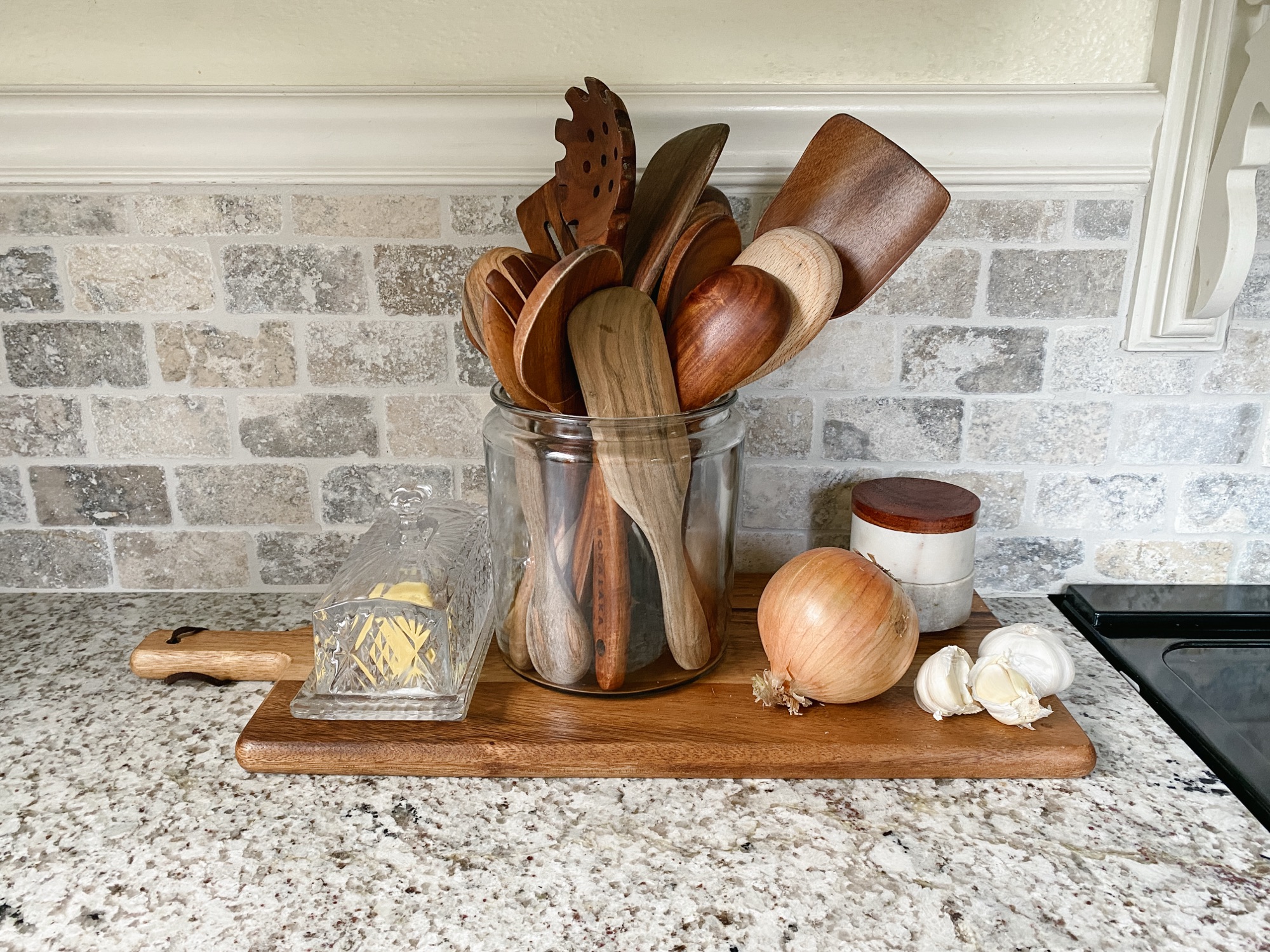
When I look at the crock of wooden utensils next to my stove, I can tell which ones are the most used. My favorite spatula is worn smooth and the wood has lightened from years of washing it. It represents hundreds of meals cooked for family and friends – random Mondays and special Thanksgivings, nights after winning the game and mornings after being up with a sick baby.

A working kitchen is going to show signs of use, and I’m wondering when that began to be a source of shame. Why are we worried about being judged for using the most functional room in our homes?

Items I use daily for cooking are kept right next to the stove.

Paint Palette: The Warmth of Neutral Ground

Throughout the Falling for Home series, I have been sharing paint palettes that reflect the theme of each article. The Collected Kitchen inspired me to share a palette with two warm neutral tones for the wall and trim colors, as well as an accent tone that is reminiscent of patinated copper or vintage pantry paint. This gentle palette lets your meaningful pieces take the spotlight.

Shop the Look

I’m often asked about the vintage and antique pieces in my home. They have truly been collected over the years. You don’t need a full antique collection to create charm, just a few timeless touches that work for your space. If you’re interested in starting your own collection, I’ve compiled a curated list of timeless kitchen essentials, similar to the ones I own. You can click HERE to explore this list on LTK, or you can click the collage below to shop this style.

An Invitation to Embrace Imperfection

It’s easy to feel like our kitchens aren’t good enough to invite others into them. Maybe you’re just starting out, or perhaps you’re worried about being judged about functional “clutter” in your kitchen. Have you hidden away Grandma’s bowl for safekeeping, or are you afraid you’ll scratch your biscuit tin? Maybe you’ve seen the perfect English kitchen on Instagram or the curated collage on Pinterest, and you don’t feel like yours measures up. Whether you have laminate countertops or soapstone (I wish!), your kitchen can be filled with functional and beautiful vintage and antique pieces that are meant to be used and enjoyed daily.

I want to remind you that your kitchen is more than how it’s decorated. It is the most used room in your home, and it holds memories and meaning. Your family and friends aren’t there to judge you by the plates your meals were served on. They’re going to remember the flavors they experienced, the conversations they had, and the memories they made. Don’t wait to start making those memories until you feel like your home is show-worthy. Send the invitation. Cook for your family.

Explore More from Falling for Home: A Weekly Autumn Journal

This article is part of my series called Falling for Home: A Weekly Autumn Journal. Be sure to check out these reader favorites:

You can subscribe here to receive new articles, seasonal inspiration, and vintage-style favorites delivered right to your inbox.

How to Update a 1930s Bathroom Without Losing Its Charm

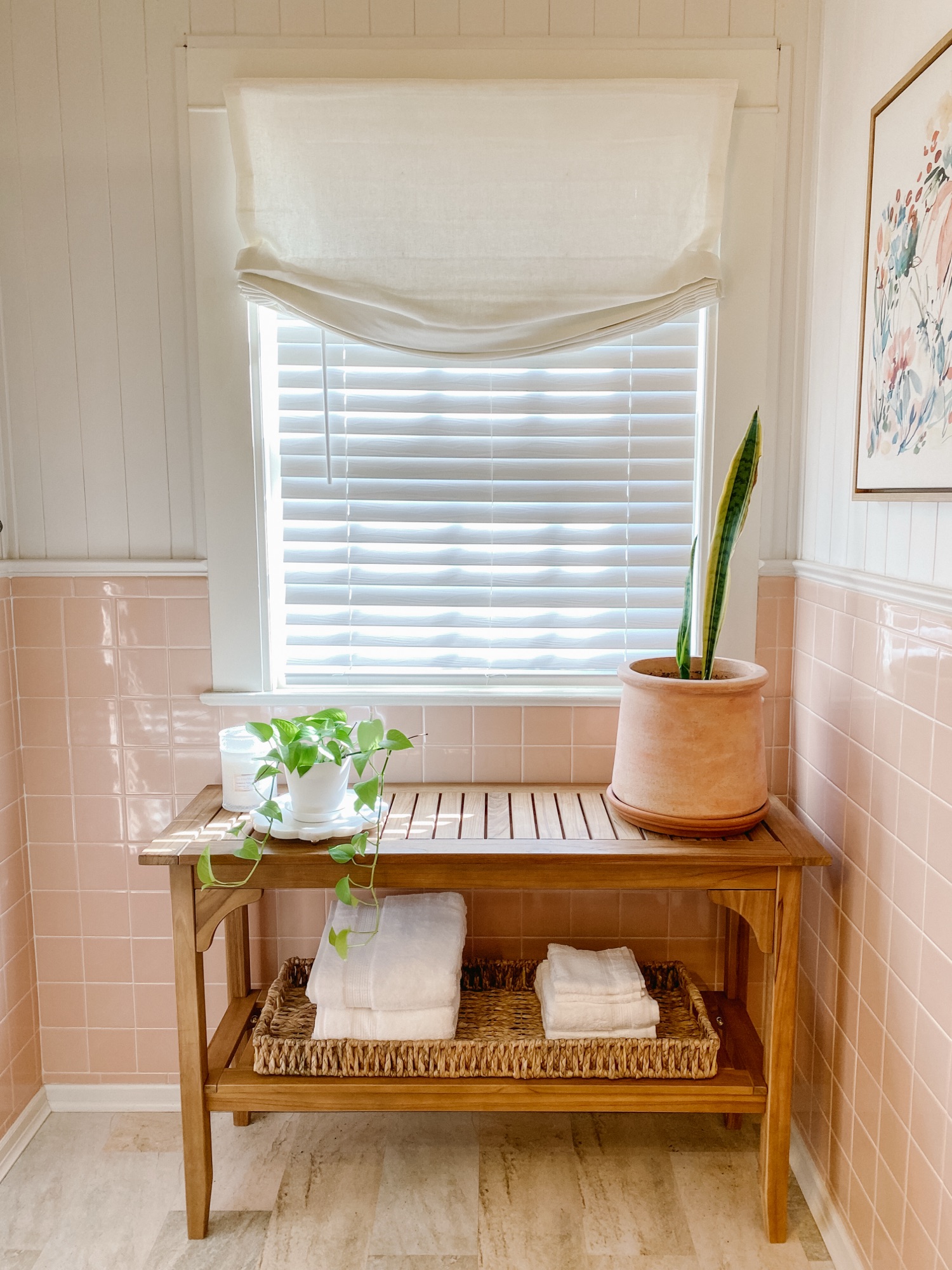
Updating a historic bathroom doesn’t have to mean losing its original charm. Our 1939 bathroom still features the vintage wall tile and fixtures that first caught my heart, but a few thoughtful additions gave the space new life. By keeping the original tile and layering in a teak table, relaxed roman shade, coordinating artwork, and a touch of live greenery, I created a bathroom that feels both timeless and livable. If you’ve ever wondered how to refresh a 1930s bathroom without replacing its historic character, you’ll love this approach. I’ve also included a Benjamin Moore color palette inspired by the original tile, perfect for anyone looking for bathroom design inspiration rooted in history.
Historic Bathroom at First Glance

The first time I saw the main bathroom in our 1939 Colonial Revival Home, I knew it wasn’t living up to its full potential. It’s a rather large bathroom for its era, full of the original soft peach tile on the walls and in the shower. The original bathtub is cast iron with a porcelain enamel finish. It’s very large compared to modern bathtubs. These were elements that I found to be valuable and desirable while looking for a historic home to purchase, and I wanted to honor them in my design.

The bathroom as it looked when toured prior to purchasing the house.

When we viewed our home prior to purchasing it, the large space under the window had a tiny vanity and some wall shelves. After purchasing it, I wanted to update it in a way that made it more functional, while keeping the vintage charm typical in a 1930s and 1940s home. Since nothing was broken, I was able to update without replacing anything major.

The walls in the whole bathroom have peach-colored tile. In this photo you can see a built-in storage cabinet that is set into the wall.

Refreshing a 1930s or 1940s Bathroom

As you might guess, the peach tile was the springboard for the whole design. This color might have been a reason other homeowners would have ripped it out. However, I knew that finding the right paint color to complement the peach would create a better feeling in the space. For the walls above the tile, I went with Benjamin Moore China White OC-141.

Again playing with peach tile, I leaned in a bit to the orange tones, and selected a teak table to place under the window. I also added a relaxed roman shade over the window blinds to soften the edges of the window. A lucky find, the seagrass basket was a clearance rack find, and it fits perfectly on the bottom shelf of the table.

Next, I added a few plants to the space. The live greenery adds a spa-like touch, and brings in green as an accent color. The last selection that I made for this design was the artwork. It’s the only artwork in our whole house that isn’t an original piece, but it brings together all of the colors in this bathroom perfectly.

Best Paint Colors for Bathrooms with Vintage Tile

The color palette for this bathroom is built around the original 1939 bathroom tile. For a similar color in wall paint, use Benjamin Moore Clementine Rose 1219. A complementary neutral trim color is Benjamin Moore China White OC-141. If you’re looking for an accent color that pairs well with the other two colors, try Benjamin Moore Paris Rain 1501.

Adding Modern Comfort to a Historic Bathroom

I hope this inspires you to rethink a total remodel. There are many ways to add modern comfort to a historic bathroom without gutting it. For us, the space functions well and the original tile and fixtures are in fantastic condition. (What you might not be able to tell is that the built-in cabinet is set deep into the wall, so we didn’t have a need to create additional bathroom storage.)

I know there’s a temptation from social media, TV, and Pinterest to “update” every space that isn’t decorated in a modern way. But the best way to truly honor a historic home is to allow it to be what it was built to be. Most historic homeowners will embrace the imperfections and charm of designs from by-gone eras.

The finished design. A 1930s vintage bathroom with modern comfort and classic accessories.

Shop This Look

If you see something you like in this design that you’d like to incorporate into your own space, you can find many of the items linked HERE for shopping.

Click to Shop

While You’re Here…

While you’re here, I hope you’ll take a few minutes to “look around” and read a few of our other articles. We’re currently in a series called Falling for Home: A Weekly Autumn Journal, which is all about falling in love with our own homes again as we meander through the autumn season together.

Let me know what you think of these bathroom colors in the comments below. Would you ever live with peach colored tile?

Vintage Book Shopping: Themes, Genres, and Gifts

This article contains commissionable links and ads.

The first antique I ever bought was a book. As a young teenager my family stopped into an old bookshop that used to be in historic Stone Mountain Village in Georgia. The shelves were absolutely crammed with books, and although I was an avid book lover from a very young age, I was a little overwhelmed with where to start browsing. I noticed there was a shelf marked “antique,” and for some reason, that’s where I started. I decided to look for the oldest book that I could afford. I walked out of the bookshop that day with my very first antique, a book called, “Reveries of a Bachelor.”

People often overlook buying vintage and antique books on their thrifting and antiquing adventures. Today I am sharing six things to consider when shopping for antique books: theme, genre, use, author, personalized gifts, and color/pattern.

Theme

Books can be a wonderful conversation starter, and grouped together they can become decorative accessories of interest. For example, one of our guest bedrooms has evolved into a red, white, and blue theme. On a nightstand in that room I stacked a group of books that evoke the feeling of “American government.” I currently have books in this stack with subjects like government, democracy, and America. If I want to grow this themed collection, while I am antiquing, I will look for both fiction and non-fiction books that fit with this theme. An example would be a book about American presidents, or maybe a murder mystery book with Washington, D.C. in the title.

Other themes that would be easy to search for are things like art, wild west (cowboys, western expansion), the region you live in (Southern U.S., the beach), cooking/food, gardening, or travel. Just remember not to limit yourself to either fiction or non-fiction; they can be mixed! (Check out these old gardening books HERE!)

Genre

I have wonderful memories of consuming books as a child. The characters from these books are often remembered fondly. I’ve put together a group of sentimental titles that would fit into a genre that an adolescent girl would enjoy. Books like The Secret Garden, Anne of Green Gables, and Pollyanna all make sense when grouped together in a display, because they’re all from the same genre. I’ve grouped my set on a shelf in our bedroom.

Other genres that would be fun to collect are early textbooks, British classics, poetry, music books, and hymnals. (Check out these antique poetry books HERE!)

Use

One of the best reasons to collect old books is because you’re actually going to use them. Years ago churches started throwing away all of the hymnals that used to be in stored the back of the pews. They moved to showing lyrics on screens instead of reading them from hymnals. However, many people prefer to use a hymnal to sing or play hymns on a piano. When I see a stack of old books for sale, I go through them to see if there are any old gardening books. I like to use them as references for plant problems or inspiration for things that I’d like to add to my garden.

Other books to look for if you want to actually use them are books on woodworking, cookbooks, or other types of how-to books. (Check out these old song hymnals HERE!)

Author

When people collect old books, they often choose them because of the author. One of the authors whose books I collect are those written by Edward Bulwer-Lytton. My family name is Lytton, and some relatives speculate that we are distantly related to the Lord Lytton. Another, more modern, author whose books I specifically search for is Martha Stewart. I find Martha Stewart’s books to be helpful resources for many topics that I’m interested in. Martha published her first book 43 years ago in 1982, so many of her books definitely fall into the vintage category.

Other authors that interest people are Hemingway, F. Scott Fitzgerald, Dickens, and Laura Ingalls Wilder, just to name a few. (Check out these vintage Martha Stewart books HERE!)

Personalized Gift

Another reason to consider buying vintage and antique books is for personalized gifts. Around the holidays I like to give a little something extra to people like our hair dressers and our dentist. If I was giving them a gift card or a tin of cookies, it would be fun to package their main gift with an antique dentistry book or a book on old hair styles. If you have someone in your life that is interested in wild life or travel, finding an antique book to give them on their topic of interest shows that you took a little extra effort in the thought that went into it. Be sure to look for these types of gifts all year long and set them aside for when you need them. (Check out these vintage hairstyles books HERE!)

Color and Pattern

Finally, another thing to consider when shopping for vintage and antique books is the cover. People have started using old books as decorative objects in their home. They can make an impact as decor when grouped by color. One side of my husband’s ancestry is largely found in Scotland. I have recently started collecting Scottish themed books for our bookshelf that have beautiful tartan patterned covers. These tartan decorated books are also beautiful in Christmas displays.

The next time you are thrifting and antiquing, don’t forget to look for books. Decide on a theme, a color, or even someone to buy a gift for. Recycling old objects in these ways puts them to use and keeps them out of a landfill. Happy Hunting! (Check out these vintage books with tartan covers HERE!)

Creating a Cozy Holiday Experience for Guests

It’s less than twenty days until Christmas, and touches of holiday spirit can be felt in nearly every room in our home. One of the things we love most about the holidays is welcoming our friends, family, and neighbors into our home to celebrate the season with us. It’s important to us that our guests experience the contagious holiday excitement, while also feeling at ease. We truly want them to make themselves at home when they come through the door.

I recently had the opportunity to talk with Kierra Todd with Redfin.com. Kierra asked me how we ensure a comfortable experience for our guests during the holidays. One way I do this is by mixing natural elements with conversation pieces. Today I am sharing our dining room decorated for a Christmas gathering. The vintage and antique Christmas decor we’ve collected over the years has started many conversations while gathered around the table with guests. And by collecting and foraging from our yard for decor, we ground the space and bring commonality.

Interior designer Abby Smolarsky at Belle Antiquarian, highlighted, “By mixing natural elements and conversation pieces, guests will feel the excitement of the season. In the dining room, guests will see magnolia and holly from our yard, as well as a tree sparkling with collected antique ornaments. It’s the perfect mixture for putting people at ease.”

Redfin.com

In the South we are blessed to have quite a few plants to forage at Christmastime. Our property boasts several magnolia species, abundant holly trees, and evergreen. I gather clippings and wire them together to adorn tables, buffets, and fireplace mantels throughout the house. Tucked here and there you will see some of my favorite pheasant feathers. My wonderful neighbor, Claire, gave me a bag of long-leaf pine cones that she had collected, which were the perfect finishing touch. Each region will have vegetation that can be brought inside for decor. If you don’t have anything in your yard, try asking a friend or neighbor if you can come clip a few things to add to your decor. Be sure to bring a basket, sharp clippers, and gloves to protect your hands from pointy leaves like holly.

Vintage and antique Christmas decor are among my favorite things to look for while treasure hunting. Throughout my years of selling antiques, I have collected some unusual and special ornaments. It’s fun to gaze and watch them sparkle on our dining room tree while gathered for a special meal. Part of the reason these ornaments are so special is because they were collected slowly over time and in various places. They each hold a story or memory, and they have kept the conversation flowing at the Christmas table on more than one occasion. It’s okay to start small with one or two baubles and add to them as the years go by. They’ll become part of your story as well.

The dining room feels festive, but also approachable. It’s doable. Anyone can gather foliage from their yard and bring it inside. Everyone can pick up a vintage ornament here and there. It’s how we share our space with the people we care about, sharing a little bit of our lives with theirs.

I’m honored to be featured on Redfin for this special holiday article. You can find the whole article and many more tips HERE.

No matter if you live in an apartment in Miami, FL, a rental home in Tuscaloosa, AL, or a
house in Bakersfield, CA
, this guide will walk you through essential steps to declutter and clean your home, add festive touches, prepare for guests, and set the stage for holiday entertainment, ensuring your home is ready to impress and delight all season long.
Prepare Your Home for the Holidays: 7 Tips for a Festive Season | Redfin

Transform Your Dining Room on a Budget

This article contains affiliate links and ads. You can find many of the pieces I feature by clicking on the links at the bottom of this article.

I’m happy to finally share the details on our dining room refresh. Months before our kitchen renovation began, we started on our dining room. This was a low cost project that we completed over a long weekend. With some paint, new draperies, an estate sale find, and collected antiques from the storage bins, I created a dining room that we look forward to hosting holiday dinners in.

The homeowner that did all of the major renovations on our home in the early 2000s painted it a sherbet green with a lighter shade of green on the ceiling. The seller we purchased it from didn’t make any changes to the dining room at all. Every room was kept exactly the way it was when they bought the house, right down to where the nails in the wall were. It was important to me to make this OUR home, and painting is an easy way to do that without changing the style and architecture of a historic home.

One of the changes we made with the biggest impact was to paint the ceiling. If you’re considering painting your ceilings a lighter shade of the wall colors, pause and think twice. Not necessarily because of resale value, but think of how you want people to feel while they’re in your home. If you’re wanting a dramatic effect and an artistic environment, then go for it! But if you want people to feel relaxed and settled, it’s not for you. It’s distracting and chaotic if it’s not done properly.

We painted our walls with Benjamin Moore “Revere Pewter,” and the ceiling is “White Dove.” The trim is Behr “China White.” The trim was already painted for us, and I like how it works with the Revere Pewter. China White reminds me of the color of antique ironstone dishes.

When we sold our last house three years ago, we sold most of our furniture, including the dining room table, chairs, and china cabinet. The rental house we were moving to didn’t have a dining room, and the dining set was looking a little dated, so we sold it on Facebook Marketplace. After we bought this house, I found an estate sale that was selling an Ethan Allen dining set for less than 1/10th of the retail cost. It’s currently on the Ethan Allen website, and the total cost for the table, 8 chairs, and buffet would’ve been over $11,000. We paid around $1,000. It’s worth it to check out estate sales!

I featured the drapery and hardware on an Instagram post several months ago. The drapery and hardware ended up being a source of frustration. The bay windows in our house do not match the measurements of modern bay windows. Modern bay windows have a larger center window with a smaller functional window on each side. Our original historic bay windows have a smaller center (functional) window, with a larger stationary window on each side. The drapery and hardware for our bay windows were custom made to fit them. And unfortunately, they were removed by the seller. I ended up finding hardware and drapery that I preferred, but it was time and money that we weren’t expecting to spend.

The other items in the room, like plates, pitchers, and artwork, are things that I’ve collected over the years. It was a little like Christmas opening all of my boxes that had been in storage for three years, and we’ve only had one broken crystal glass so far!

I’m lucky to have two pieces of artwork by my twin brother, Tyrus Lytton, displayed in our dining room. He painted a portrait of our daughter when she was two or three, and I found a frame online that complemented the antique mirror on the other side of the doorway. He also painted a small watercolor of our house. (Side note: my brother normally does large scale art installations all over the world. I’m very proud of him and thankful to have some of his artwork on a smaller scale.)

Below you can find a list of sources for the items that I used in our dining room. Some of the pieces are antiques, but I have linked similar ones that I found online. Click on the word to be taken to the source where you can find them.

P.S. There are also a few side-by-side- before and after photos below.

As you can see, a little paint and some new draperies can make a big impact. I’m curious if you’ve ever purchased a house and had items removed that were supposed to stay. Let me know in the comments if you’ve experienced that, too!

Until next time,

Abby

Hot Beverage Station/Coffee Bar

This post includes affiliate links and ads. You can find all of the exact pieces that I feature by clicking the links.

One of the reasons I wanted a really neutral kitchen color scheme is because I absolutely adore color. That sounds contradictory, but by having a neutral background I can decorate with all of my lively, colorful accessories and change them out seasonally. In today’s article I am featuring my new hot beverage station/coffee bar, which I have accessorized with colorful antique plates and a red antique rug.

One side of our kitchen had a blank space that I needed to make functional. We considered adding a base cabinet there during our renovation, but there were a few issues. There are a door, window, and HVAC vent all along that wall. I knew I would find the perfect piece to use as a coffee bar and hot beverage station. And I did!

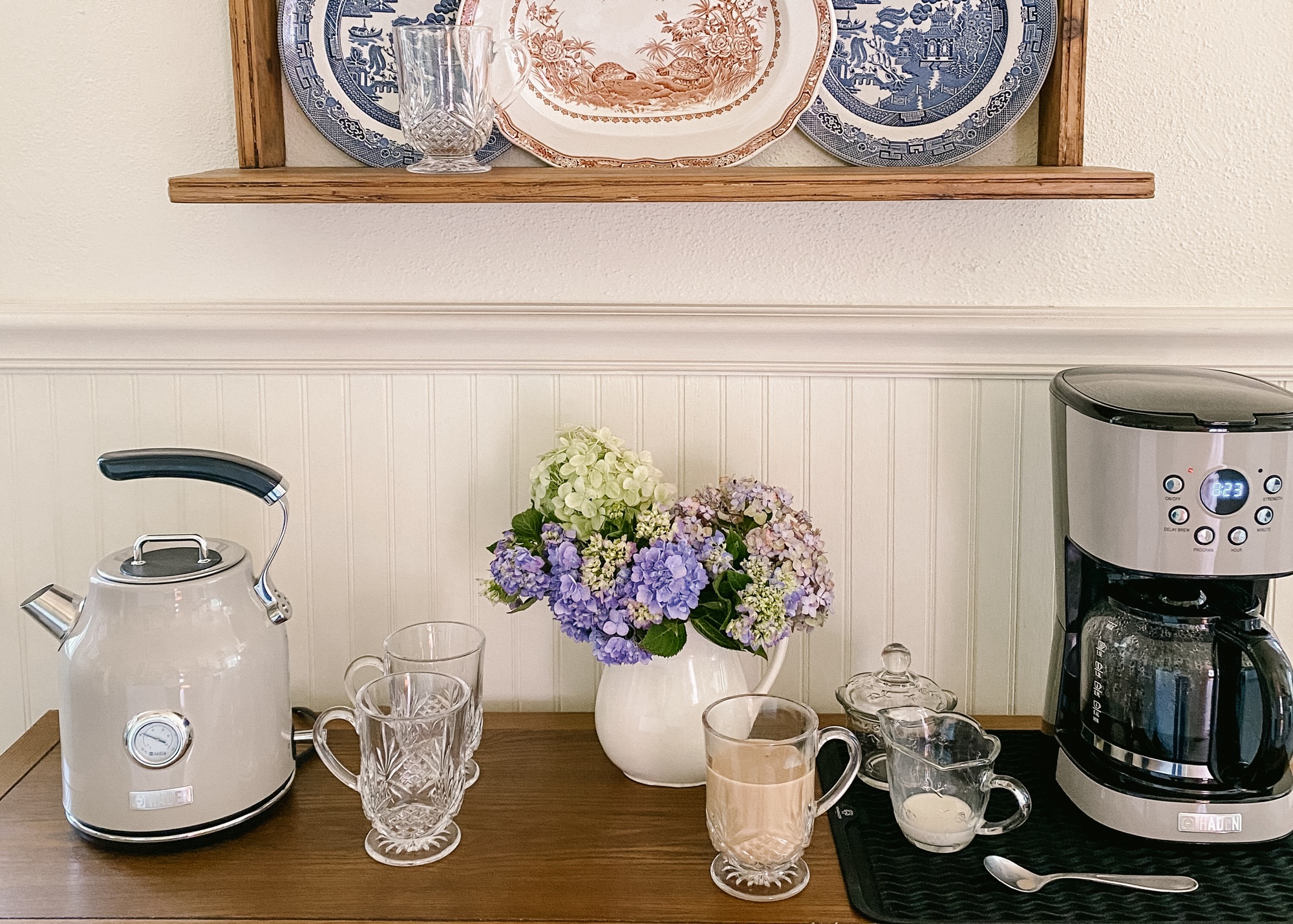
THIS gorgeous oak sideboard allows the HVAC vent to flow, while also giving me “counter” space to use for my *stunning* electric tea kettle and coffee maker. Ken and I were a little unsure about ordering a piece of furniture online. The reviews were really good, but we live in the country, and we weren’t sure about it making it here in one piece. Still, it arrived quickly and packaged extremely well to protect all of the wood. The legs did need to be attached, but we did that together in about ten minutes. The shelf underneath provides extra storage that would be good for cookbooks or a basket like this one. The plate rate that I’m using above the sideboard is an antique piece that I found, but I found a couple of other options HERE and HERE.

Not only do I have more counter space to use as a coffee bar, but the 4 drawers and 2 doors are very deep. I have room to store my tea bag organizers, coffee grounds, filters, and mugs and glasses. I’m protecting the sideboard surface under the coffee maker with a silicone mat. This keeps me from worrying about spills on the beautiful wood.

The only one who loves my red antique rug more than me is Annie. I found a really similar rug that I know you’ll love, too.

Want to find almost everything that I’ve pictured and featured? You can do so in 3 different ways: click the links above in the article, click HERE for my LTK shop, or click HERE for my Lowe’s Storefront.

Welcome to Our New Home

original artwork by Tyrus Lytton

This year we moved to a new home in a small town about an hour away from where Ken and I were born and raised. While this may not seem like a big move, it’s quite an adjustment only having one grocery store to choose from. After three years of searching for the perfect historic home for us, we found one to settle in and make our own. A former homeowner completely updated the wiring, plumbing, and basement during an early 2000s remodel. (That was good news for us!) But, the most recent homeowner neglected to keep up with basic historic home maintenance, so we have a lot of things to do, like re-glazing all of the original (working) windows, refinishing the original iron railings (there are a lot of them), and taming the overgrown property full of invasive plants.

This is the original brick color. It has not been painted or lime washed.

In the coming months, I’ll be sharing how we are updating and caring for our almost 85 year old home. Since the major mechanical systems have been updated, many of the updates I’m making are considered cosmetic. I’ll be sharing the planning process and the exact materials I’ve used. The process I’m using and selections that I’m making are timeless, which means they will look wonderful in my home and yours, too.

This is the original brick color. It has not been painted or lime washed.

As you follow along, keep in mind that I am working to create a backdrop that can stay in place for decades to come long after I’m gone. Tile, flooring, and countertop selections are not exact copies of what a homeowner would use in a 1930s home, but they are reminiscent of colors and materials that could have been selected. My home is in a town that would have been very rural and agricultural, so “modern” art deco themes wouldn’t have been used. As I showcase rugs, furniture, and accessories, please remember that I am not aiming to create a museum-like atmosphere. While my style is certainly traditional, I am not actively seeking period pieces to fill my home.

Tomorrow I will be sharing our kitchen remodel, which includes countertops, backsplash, flooring, appliances, and adding an extra lower cabinet. In the meantime, I share quite a bit more on Instagram if you’d like to see more real-time progress. See you then!

Abby

1920 Lane cedar chest tall footed

Antique Lane Cedar Chest

Hi, there!

Last weekend we went antiquing in Braselton, Georgia. We’re familiar with the antique shops of Braselton, because it’s where I actually had my first antique booth in 2012. After stopping in Countryside Antiques, we drove next door to A Flea Antique. While we were there we picked up a Lane cedar chest.

1920 Lane cedar chest tall footed

I had been looking at a cedar chest in a different antique store a couple of months ago, but it wasn’t a Lane chest. I like the style of this chest, which I have learned is called a Tall Hasp with Feet, or THF. To give you an idea of the size, it measures 27″ high by 46″ wide by 19.25″ deep.

After bringing our new Lane chest home, I did some research. I learned that MOST Lane chests can be dated by the serial number on the bottom of the chest or under the lid. The serial number, read backwards, gives the production date. However, my chest only has a style number, not a serial number. I found out that some of the earlier chests did not have a serial number listed. Lane stopped their production of cedar chests in 2014, but I did contact the company to request some information.

1920 Lane cedar chest tall footed

As part of my interior design degree, I have taken several Furniture History courses. Combined with my time selling antiques, I believe this chest to be from the 1928-1940 time range. This is mainly due to the style of the feet, the bullseye rosettes used, and the floral design motif on the front.

Other than being in desperate need of some wood conditioner and wax, the chest is in great condition! The only thing I am unsure of, and asked Lane Furniture Company about, is whether the green lid is how it was originally decorated. It hasn’t been colored in recent history, but at some point it may have been refinished that way. I’m really not sure.

Here’s a look before moisturizing and waxing:

1920 Lane cedar chest tall footed

Here’s a 15 second video showing how I gave it some TLC…

After here’s an “after”…

1920 Lane cedar chest tall footed

If you’re interested in following along with more of my antiquing adventures, be sure to follow along on Instagram. Here’s a little snippet of what you’ll find us doing!

I’m not a Lane cedar chest expert, and the information that comes up on a Google search hasn’t had all of the answers that I’m looking for. If you have any information about this chest, please either send me an email or leave a comment below. I would greatly appreciate any details about this piece.

Silver Bowls and Ironstone inspiration

A few months ago I saw a picture on Instagram that inspired me to collect some silver bowls to display with my ironstone pitchers. At the time that I saw the inspiration picture I only had one silver bowl (and actually it was a trophy bowl – pictured below). I also only had 2 ironstone pitchers. But this picture embodied what I want my style to be – timeless, classic, and somewhat neutral.

My ironstone pitcher collection.

Since the time that I saw that picture, I have been able to add 2 more ironstone pitchers to my collection. (They are a little harder and a little more expensive to find.) And I have added 6 more silver bowls. I plan on combining these in my dining room hutch as soon as Valentine’s Day is over.

This is the first silver bowl (a trophy) that I purchased.

Unfortunately I cannot find my original inspiration picture on Instagram. I thought I had it bookmarked/saved, and I do not. So below I am showing two pictures that I found on Pinterest. (Did you know that you can save pictures on Instagram to look at later? Just click the bookmark flag underneath the picture! You can find all of your saved pictures by going to your profile page and clicking on “saved”.)

This inspiration photo that I found on Pinterest is from Sweet Pea Home.

This inspiration picture is from For the Love of a House:

This week I found the smallest silver bowl yet. Isn’t it a cutie? All of the bowls I’ve found at thrift stores and one at an antique store. The ones I’ve thrifted I have paid between 75 cents and $6. I paid $18 for the one from the antique store.

On another topic – which way do you prefer to display your silver pieces in? Polished or unpolished? I actually plan to display mine unpolished.

What do you think of ironstone and silver displayed together? I’d love to see your pictures! Tag me on Instagram! I also have more inspiration pictures on my Pinterest board called “Display” if you care to see more!

My first, and the rest is history…

I was inspired by an Instagram post to share about the first antique I ever bought, and how I got into interested antiques.

The first antique I ever bought was a book. The title of the book was The Reveries of a Bachelor. I had never read it, and I never did read it. I did not know at the time that it was one of Emily Dickinson’s favorite books. I was a teenager, and I was browsing in an antiquarian bookstore. I wanted to buy the oldest book I could find. When I realized that I could not afford the oldest book I could find, I settled for a book published in the 1850s that was only 99 cents. The book was meaningful to me because I felt the value in its age, not because I knew anything about the books itself. I had it for about 20 years, and unfortunately it met its end with some puppy teeth.

Growing up I also heard stories of an aunt and uncle who sold antiques and frequented auctions. I romanticized the world of antiques. I wanted to do those things, too. I wanted to buy from Sotheby’s. (One day?!)

How did I get from buying an old book to selling antiques? In college my favorite classes were my furniture history classes. I loved how an age of a piece could be identified by the shape of its legs or the pattern in the veneer. I still have my furniture history textbooks to use as references. During one of my internships a designer I was working under asked what my dream job was. I told her it was to own an antique store. She seemed surprised, but I do think a degree in interior design is certainly helpful for that line of work.

Funny enough, I cannot tell you what the second antique I ever bought was. I have tried to remember, and I just can’t. I have continued to love to buy antique books. Today my favorites are old versions of the classics I’ve read. I also love to buy books written by Lord Lytton, who shares my maiden name. I’ve said it before, buying an antique is usually a sentimental thing, and so I’m truly curious. What was the first antique you ever bought?